


When buyers compare sublimation aluminum sheets, thickness is often one of the first specifications they ask about. The difference between 0.45 mm, 0.65 mm and 1.0 mm is not mainly about which one prints “better.” It is about how the finished blank should feel, how much rigidity it needs, how it will be mounted or handled, and what size and shape the final product will have.
Worthwill commonly supplies sublimation aluminum in 0.25 mm, 0.35 mm, 0.45 mm, 0.65 mm, 1.0 mm and 1.15 mm thicknesses. Among these options, 0.45 mm, 0.65 mm and 1.0 mm are frequently considered for photo panels, signs, awards, wall décor and other custom printing blanks. For the full current range of finishes, sizes and supply forms, see the Aluminum Sublimation Sheet & Blanks product page. This guide compares the three thicknesses and explains how to choose them according to the finished product rather than thickness alone.
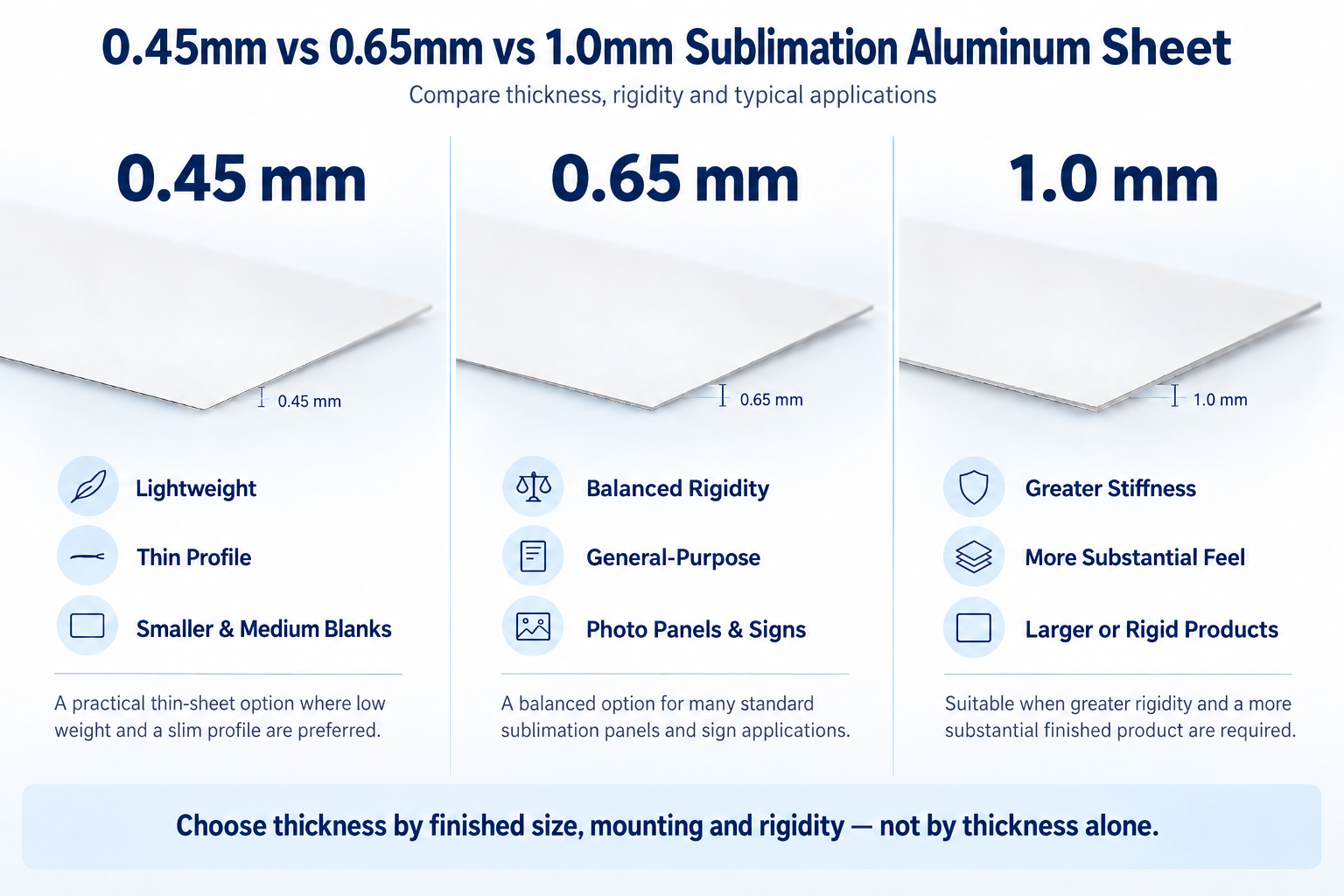
The three thicknesses can all be used for sublimation aluminum products when the coating, blank design and printing process are suitable. The practical difference is mainly the balance between lightweight handling and finished-product stiffness.
| Thickness | General Character | Common Starting Point | Buyer Consideration |
|---|---|---|---|
| 0.45 mm | Lightweight and thin | Smaller and medium-sized blanks where easy handling and a slim profile are important | Consider support, mounting and packing if the finished piece has a larger unsupported area |
| 0.65 mm | More rigid than 0.45 mm while still relatively light | Photo panels, signs and general-purpose sublimation blanks | A useful middle option when more stiffness is wanted without moving to a thicker panel |
| 1.0 mm | Greater stiffness and a more substantial metal feel | Larger pieces or finished products that need more rigidity | Check whether the added thickness suits the mounting method, edge treatment, press setup and packing |
These are selection starting points, not fixed size rules. A small blank does not automatically require 0.45 mm, and a large blank does not automatically require 1.0 mm. The complete finished-product specification should decide the thickness.
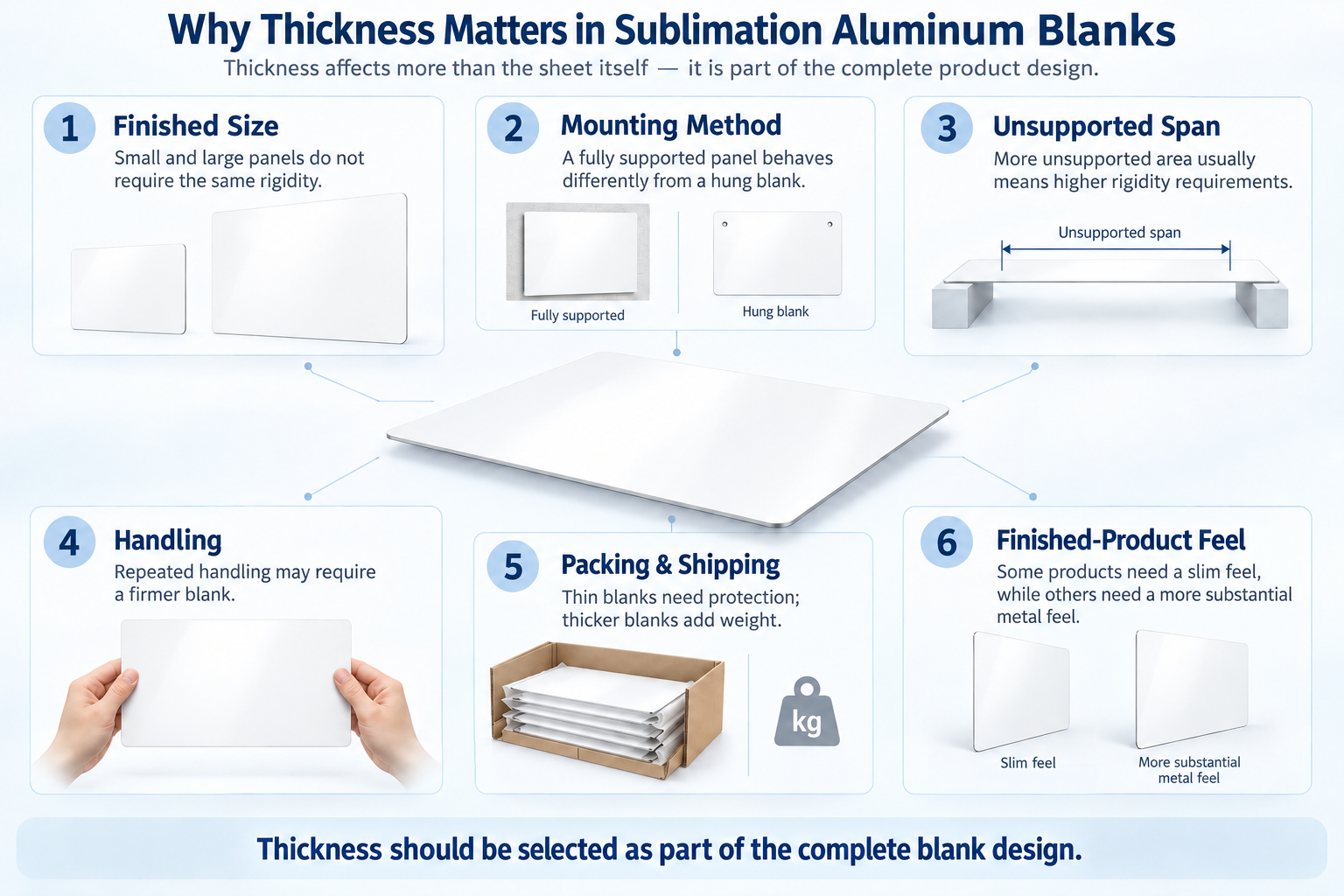
Thickness changes the mechanical feel of the aluminum blank before and after printing. As thickness increases, the panel generally becomes more resistant to casual flexing and feels more substantial in the hand. At the same time, the piece becomes heavier and may require different cutting, edge-processing, mounting and packing considerations.
Finished dimensions: A compact blank and a large wall panel do not have the same stiffness requirement.
Mounting method: A fully supported panel behaves differently from a piece mounted only at several points or hung from holes.
Unsupported span: Larger unsupported areas generally make rigidity more important.
Edge and corner processing: Rounded corners, holes, slots and custom outlines can affect how the finished blank is handled.
Shipping and packing: Thin blanks may need suitable separation and support, while thicker blanks add more weight to the shipment.
Finished-product feel: Some products are designed to feel light and slim, while others benefit from a more substantial metal presentation.
For this reason, thickness should be treated as part of the complete blank design rather than an isolated purchasing number.
A 0.45 mm sublimation aluminum sheet is a lightweight option frequently selected for smaller and medium-sized blanks where a thin profile and easy handling are important. It can work well for many personalized printing products that do not require a heavy or especially rigid metal feel.
Typical projects may include smaller photo panels, decorative blanks, awards, signs, nameplates and promotional pieces, depending on the finished dimensions and support method. Because 0.45 mm material is relatively thin, buyers should pay attention to the unsupported area of the finished part and how the pieces will be packed, stored and mounted.
A lightweight finished blank.
A slim metal profile.
Convenient handling for smaller or medium formats.
A design that has suitable support or does not require high panel stiffness.
Do not select 0.45 mm only because it is thinner. If the blank is large, has a long unsupported span, or must feel especially rigid after installation, compare it with 0.65 mm or 1.0 mm before placing a bulk order.
A 0.65 mm sublimation aluminum sheet provides additional rigidity compared with 0.45 mm and is suitable for many photo panels, signs and general-purpose sublimation blanks. For buyers who want a balance between manageable weight and a firmer finished feel, 0.65 mm is often a practical specification to evaluate.
This thickness can be considered for medium-format wall décor, photo panels, signs, awards and other blanks where the finished piece should feel more stable than a thinner sheet but does not necessarily need the stiffness of 1.0 mm material.
More rigidity than a 0.45 mm blank.
A general-purpose thickness for photo panels or signs.
A balance between handling, weight and finished-product stiffness.
A middle option for buyers comparing several blank sizes within one product program.
For repeat orders, keep the thickness together with the exact finished size, surface finish, shape and mounting details in the purchasing specification. This prevents a nominally similar blank from being treated as interchangeable when the finished requirement is different.
A 1.0 mm sublimation aluminum sheet offers greater stiffness and may be preferred for larger pieces or products that require a more substantial metal feel. The additional thickness can be useful when the finished panel needs to resist casual flexing better than thinner options or when the buyer wants a heavier presentation.
Typical applications can include larger photo panels, display pieces, signs, plaques and premium-feel printed products, subject to the actual size, mounting method and blank design. The benefit of greater stiffness should still be weighed against added material weight, packing requirements and the buyer’s downstream fabrication and heat-press setup.
Greater finished-panel stiffness.
A more substantial metal feel.
Larger blanks or pieces with more unsupported area.
Applications where the finished product should feel less flexible during handling or display.
A thicker sheet is not automatically the best option for every product. If the finished piece is small, fully supported or intentionally lightweight, 1.0 mm may provide more thickness than the design actually needs.
The following comparison summarizes the practical differences buyers should review before confirming a specification.
| Selection Factor | 0.45 mm | 0.65 mm | 1.0 mm |
|---|---|---|---|
| Relative feel | Thin and lightweight | Moderate rigidity | More substantial and stiff |
| Typical starting point | Smaller and medium blanks | General-purpose panels and signs | Larger or more rigid finished pieces |
| Handling | Easy to handle; support may matter more on larger pieces | Balanced handling and stiffness | Heavier and firmer |
| Unsupported area | Review carefully as size increases | Suitable for many medium applications | Often considered when greater stiffness is needed |
| Mounting | Works well where the design provides suitable support | Flexible choice for many mounting approaches | Useful where a firmer panel is preferred |
| Packing | Protect from bending, rubbing and surface damage | Protect printable faces and edges | Allow for greater piece and shipment weight |
| Printing | Requires testing with the actual coating and press system | Requires testing with the actual coating and press system | Requires testing with the actual coating and press system |
Thickness should not be used as a shortcut for judging print quality. The visible printing result depends on the complete sublimation system, including the printable coating, sublimation ink, transfer paper, heat press, temperature uniformity, pressing time and pressure.
Thickness and blank dimensions can influence heat transfer and handling during pressing, so a setting that works for one product should not automatically be copied to another thickness or size. Worthwill’s current printing reference treats press values as starting points only and recommends a sample press before bulk production.
For the full printing procedure, preparation steps and starting heat-press references, see How to Print on Aluminum Sheets: Step-by-Step Sublimation Guide.
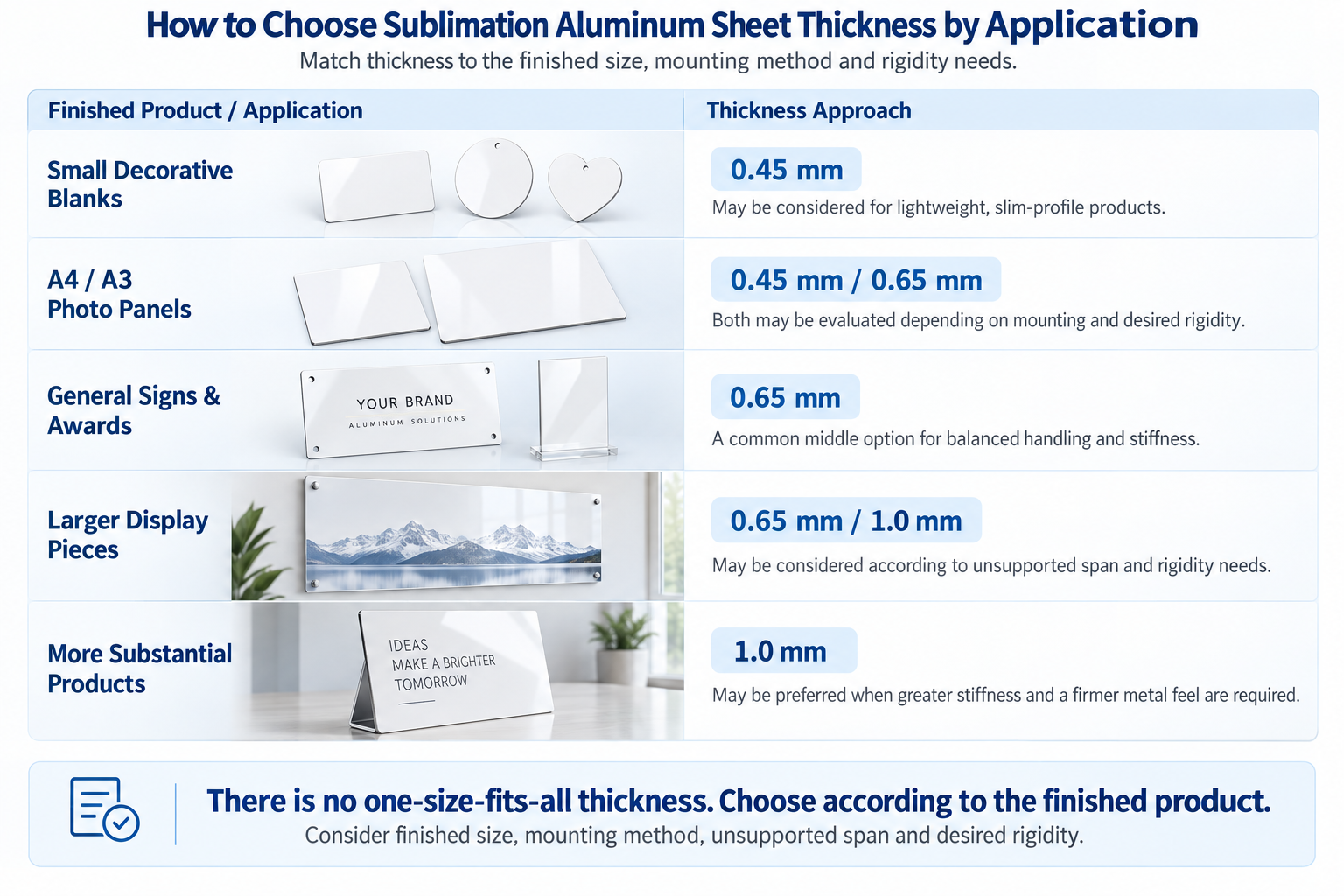
The best starting point is the finished product, not the thickness list. First define the dimensions, shape, mounting method and required feel, and then compare the available thicknesses against those conditions.
| Finished Product | Thickness Approach |
|---|---|
| Small decorative blanks, nameplates and compact personalized products | 0.45 mm may be considered when a lightweight, thin profile is preferred; confirm support and handling requirements |
| A4, A3 and other photo panels | 0.45 mm or 0.65 mm may both be evaluated depending on mounting, rigidity and the desired finished feel |
| General signs, awards and wall décor | 0.65 mm is a common middle option; compare 0.45 mm or 1.0 mm when the product should be lighter or stiffer |
| Larger photo panels and display pieces | 0.65 mm or 1.0 mm may be evaluated according to unsupported span, mounting and required rigidity |
| Products designed to feel especially substantial | 1.0 mm may be preferred when greater stiffness and metal feel are part of the product requirement |
These examples are not universal size-to-thickness rules. A4, A3, round, rounded-corner and pre-drilled blanks can be produced in different specifications. For a broader discussion of finished dimensions and geometry, see Sublimation Aluminum Blanks Sizes & Shapes Guide: A4, A3, Round, Rounded Corner & With Holes.
Two blanks with the same outside dimensions can need different thicknesses because their installation and handling conditions are different. A panel fixed against a rigid backing has more support than a similar panel suspended from holes. A rounded-corner photo blank may be handled differently from a long rectangular sign, and a piece packed individually may experience different shipping loads from loose stacked blanks.
How will the blank be mounted: fully supported, framed, taped, fixed through holes or hung?
How much of the panel will remain unsupported after installation?
Will the product be handled repeatedly by the end user or mainly remain on display?
Does the design include holes, slots, narrow sections, custom corners or other fabricated features?
How should the product feel in the hand: light and slim, balanced, or more substantial?
How will finished blanks be separated, packed and protected during transport?
Answering these questions usually gives a more reliable thickness decision than choosing from dimensions alone.
Thickness is only one part of a sublimation aluminum order. Worthwill supplies high glossy white, matte white, pearl, brushed, satin, titanium and mirror finishes, and the material can be supplied as full sheets, cut-to-size panels or finished blanks.
A buyer ordering 0.65 mm material should still specify the finished dimensions, printable surface, shape, corner treatment, holes, protective film and packing. For brushed or other directional surfaces, grain direction should also be confirmed before cutting so blanks within the same project remain consistent.
A clear RFQ makes it easier to confirm whether 0.45 mm, 0.65 mm or 1.0 mm fits the actual product. Instead of sending only “I need 0.65 mm sublimation aluminum,” include the full finished-part requirement.
Product condition: full sheet, cut-to-size panel or finished blank.
Thickness: 0.45 mm, 0.65 mm, 1.0 mm or another required option.
Finished size: length × width, diameter or drawing dimensions.
Surface finish and printable face.
Shape, corner radius and edge requirements.
Hole diameter, quantity and exact position where required.
Mounting method or final application when it affects rigidity selection.
Quantity for each size, finish and part number.
Protective-film requirement.
Packing and labeling requirements.
For a more complete purchasing checklist, see Aluminum Sublimation Blanks Buying Guide: RFQ Checklist for Bulk Orders.
Not automatically. A 1.0 mm sheet provides greater stiffness and a more substantial feel, while 0.65 mm offers a balance of rigidity and manageable weight for many general-purpose panels and signs. The better specification depends on the finished size, mounting, unsupported span, handling and required product feel.
No. 0.45 mm is a commonly supplied sublimation aluminum thickness and is frequently selected for smaller and medium-sized blanks where a lightweight profile is useful. The question is whether it provides enough finished-product rigidity for the specific dimensions and mounting method.
Both can be evaluated. A4 and A3 describe the finished dimensions, but they do not determine one mandatory thickness. Consider the mounting method, desired rigidity, packing, handling and finished-product feel before confirming the specification.
It can. Heat-transfer settings vary with the coating, thickness, blank dimensions, ink, transfer paper and heat press. Do not assume that one temperature, time and pressure combination will work for every thickness. Complete a sample press and record the approved settings for repeat production.
Yes. Worthwill’s current sublimation aluminum range commonly includes 0.25 mm, 0.35 mm, 0.45 mm, 0.65 mm, 1.0 mm and 1.15 mm. Other requirements can be discussed according to the application and order specification.
For most buyers, the useful question is not “Which thickness is best?” but “Which thickness gives this finished blank the required rigidity, handling and presentation?” A 0.45 mm sheet is a lightweight option for many smaller and medium blanks, 0.65 mm provides additional rigidity for general-purpose photo panels and signs, and 1.0 mm offers greater stiffness for larger or more substantial products.
Before ordering, confirm the thickness together with the finished dimensions, mounting method, unsupported span, surface finish, shape, holes, protective film and packing. Review Worthwill’s Aluminum Sublimation Sheet & Blanks product page for current supply forms, finishes and customization options, then send the complete blank specification or drawing for quotation.