


Choosing a sublimation aluminum sheet is not only a question of thickness and size. The surface finish also changes how the unprinted blank looks and how the finished image is visually perceived. A bright photographic panel, a text-heavy sign and a decorative metallic nameplate may all use sublimation aluminum, but they do not necessarily need the same finish.
Worthwill supplies aluminum sublimation sheets and blanks in high glossy white, matte white, pearl, brushed, satin, titanium and mirror finishes. Among these options, high glossy white, matte white and brushed metallic surfaces represent three distinctly different visual directions. The right choice depends on the artwork, viewing environment, finished product and the appearance the buyer wants to achieve.
This guide compares high glossy, matte and brushed sublimation aluminum and explains what buyers should confirm before placing a bulk order.
There is no single finish that is best for every sublimation project. High glossy white is commonly selected when a bright white base, stronger reflected shine and a photographic appearance are wanted. Matte white reduces glare and is often practical for signs, text-heavy graphics and displays. Brushed finishes add a directional metallic grain that remains visually noticeable around or through printed areas.
| Finish | Visual Character | Common Starting Point | Buyer Should Confirm |
|---|---|---|---|
| High Glossy White | Bright white base with a reflective glossy surface and strong visual contrast | Photo panels, artwork, personalized prints and awards | Viewing light, reflections and the desired photographic appearance |
| Matte White | White printable surface with reduced glare | Signs, text-heavy graphics, display panels and decorative products | Whether the design should look softer and less reflective |
| Brushed Gold / Silver / Copper | Directional metallic grain remains visible as part of the finished appearance | Nameplates, decorative signs, artwork and premium blanks | Grain direction, metallic color and a printed approval sample |
Finish selection should be based on the finished design rather than price or finish name alone.
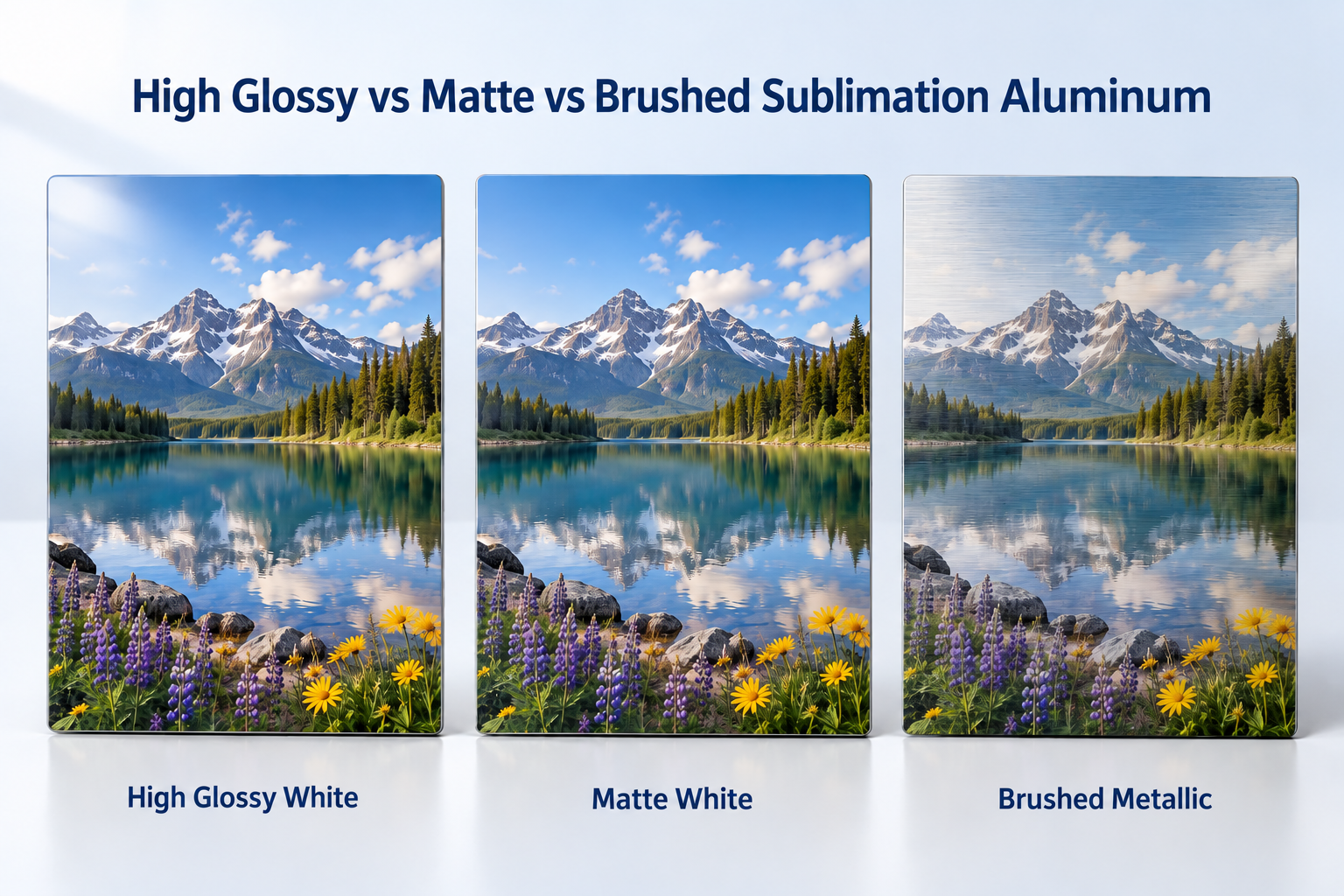
All three options belong to the same general family of coated aluminum materials developed for dye sublimation printing, but the visible surface underneath and around the artwork is different.
The main differences buyers notice include:
Surface reflectivity and glare.
Whether the background appears white or metallic.
Whether a directional grain is visible.
How strongly ambient light changes the appearance of the finished image.
How the finish works with photographs, text, logos and decorative graphics.
Whether surface orientation needs to be controlled during cutting and fabrication.
These differences affect appearance rather than creating a simple hierarchy of print quality. A glossy finish is not automatically a better printing material than a matte or brushed finish. Printing performance still depends on the printable coating, sublimation ink, transfer paper, heat press, temperature uniformity, pressing time and pressure.
High glossy white sublimation aluminum has a bright white printable base with a reflective glossy appearance. It is commonly selected when the finished product needs strong visual contrast and a bright photographic presentation.
For photo panels, personalized artwork and image-focused products, the white background provides a neutral-looking base for the printed design while the glossy surface gives the finished piece a more reflective appearance.
High glossy white is commonly considered for:
Metal photo panels.
Wall art and personalized prints.
Awards and commemorative products.
Bright graphic displays.
Image-focused decorative products.
The reflective surface should still be evaluated in the actual viewing environment. Strong overhead lighting, windows or direct light sources can produce visible reflections, so a highly glossy finish is not automatically the right choice for every display location.
For appearance-critical projects, buyers should approve a printed sample using the intended artwork rather than judging the material only from an unprinted sheet.
Matte white sublimation aluminum keeps a white printable surface but reduces the reflective appearance associated with a high glossy finish.
This makes matte material useful when glare control and easy viewing are important, especially for designs containing text, information, logos or graphics that may be viewed under bright indoor lighting.
Matte white is commonly considered for:
Information and advertising signs.
Text-heavy graphics.
Display panels.
Decorative products.
Photo or artwork applications where a less reflective appearance is preferred.
Matte does not mean that photographs cannot be printed on the material. It simply produces a different visual presentation from high glossy white. The better option depends on the artwork and the way the finished panel will be viewed.
A buyer comparing glossy and matte white should therefore print the same test image on both finishes when appearance is especially important. Comparing identical artwork under the intended lighting is more useful than selecting the finish from a catalog name alone.
Brushed sublimation aluminum creates a very different effect from white glossy or white matte surfaces. Worthwill currently offers brushed gold, brushed silver and brushed copper options for sublimation applications.
The defining feature is the directional metallic grain. That grain remains visually noticeable around or through printed areas, allowing the metal texture to become part of the finished design instead of disappearing behind a plain white background.
Brushed sublimation aluminum is commonly considered for:
Nameplates and identification pieces.
Decorative signs.
Artwork with an intentional metallic effect.
Awards and display products.
Premium or specialty sublimation blanks.
Because the surface itself has a visible metallic character, the same artwork may be perceived differently on brushed silver, brushed gold, brushed copper and white sublimation surfaces. Buyers should not assume that artwork prepared for high glossy white will create the same visual effect on a brushed metallic finish.
A printed approval sample is especially useful when the metallic background is an important part of the design.
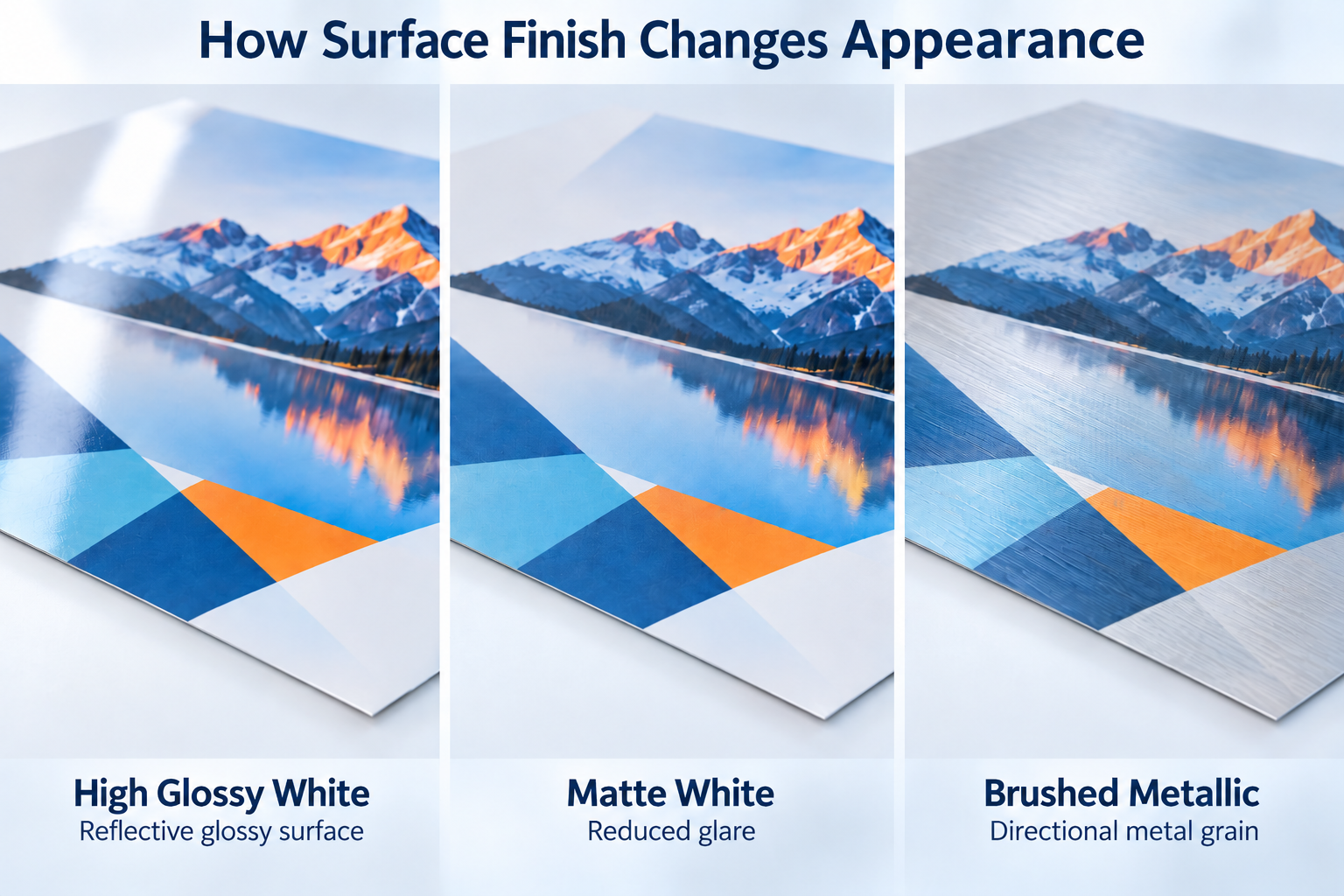
The following comparison summarizes the main practical differences.
| Selection Factor | High Glossy White | Matte White | Brushed Gold / Silver / Copper |
|---|---|---|---|
| Base appearance | Bright white | White | Metallic |
| Surface reflection | More reflective | Reduced glare | Metallic reflection varies with grain direction and lighting |
| Directional grain | No brushed grain requirement | No brushed grain requirement | Yes |
| Typical visual style | Bright, clean and photographic | Softer and less reflective | Decorative, metallic and textured |
| Common applications | Photo panels, artwork, personalized prints, awards | Signs, text-heavy graphics, displays, decorative panels | Nameplates, decorative signs, artwork, premium blanks |
| Cutting orientation | Normally not grain-dependent | Normally not grain-dependent | Grain direction should be controlled |
| Sample approval | Recommended for appearance-critical orders | Recommended for appearance-critical orders | Especially important when metallic appearance is part of the design |
This table should be treated as a selection guide rather than a fixed rule. The final choice still depends on the specific artwork, application and buyer-approved sample.
Surface finish should not be treated as the only factor that determines heat-press settings.
Printing performance depends on the complete system, including the printable coating, aluminum thickness and dimensions, sublimation ink, transfer paper, heat press, temperature uniformity, pressing time and pressure. A setting that works well for one blank should not automatically be copied to a different finish, thickness or size.
Before bulk printing:
Identify the printable face.
Remove any protective film from the surface being printed.
Keep the blank and transfer paper clean.
Complete a sample press.
Record the approved temperature, time, pressure, finish, thickness, ink and paper combination for repeat production.
For the full printing procedure and starting heat-press references, see Worthwill’s How to Print on Aluminum Sheets guide.
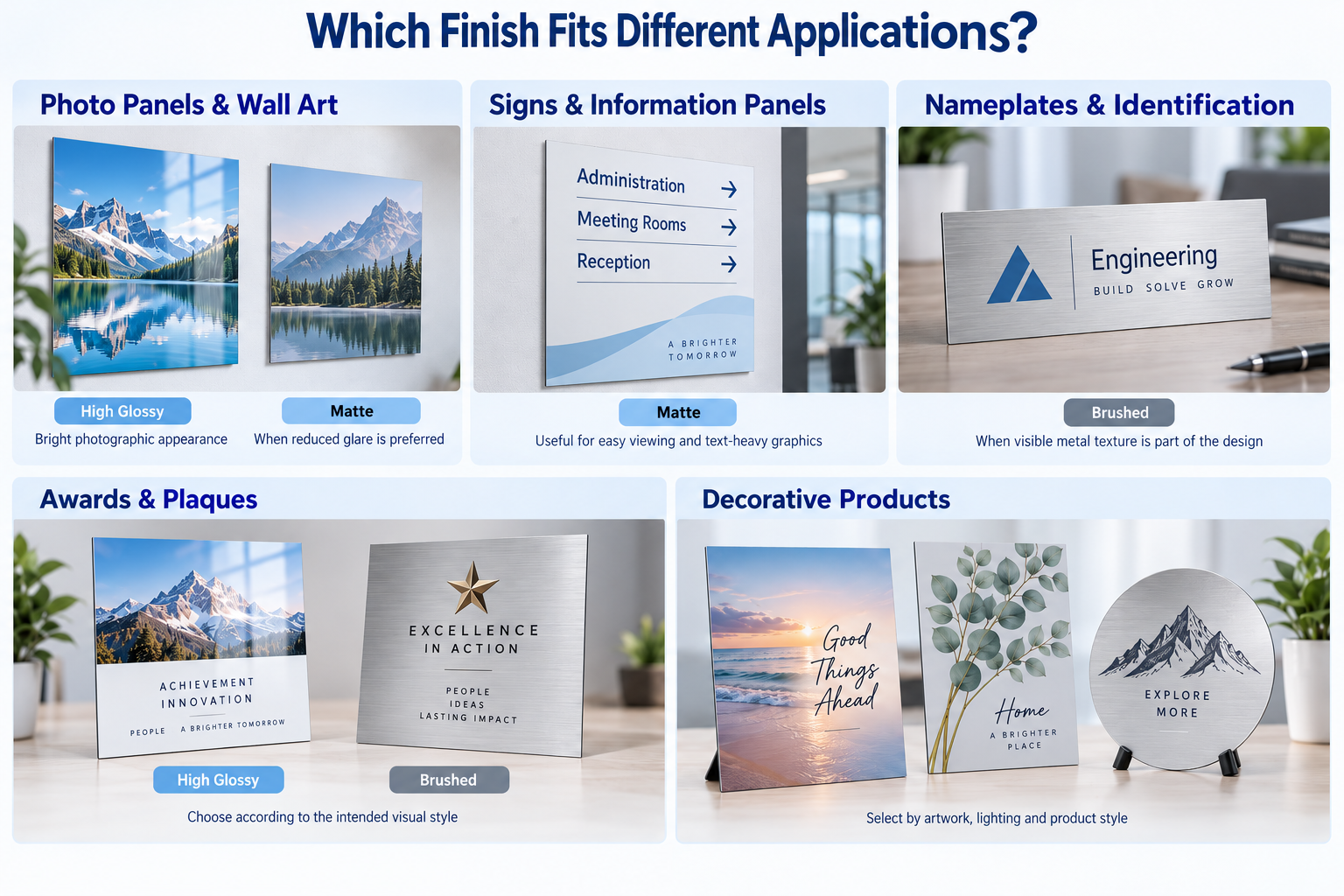
The finished product is usually the best starting point for finish selection.
| Application | Finish Approach |
|---|---|
| Photo Panels and Wall Art | High glossy white when a bright photographic appearance is preferred; matte white where reduced glare is more important; brushed when the artwork intentionally uses a metallic visual effect |
| Signs and Information Panels | Matte white is often useful for easy viewing and text-heavy graphics; high glossy can be selected for brighter graphic presentation |
| Nameplates and Identification Pieces | Brushed metallic finishes are commonly considered when visible metal texture is part of the design; white finishes remain options where a clean white background is preferred |
| Awards and Plaques | High glossy, matte or brushed can all be used depending on whether the desired appearance is photographic, understated or metallic |
| Decorative and Personalized Products | Select according to artwork, lighting, product style and the intended background appearance |
| OEM Printing Programs | Define the finish together with thickness, dimensions, shape, grain direction where applicable, protective film and approved sample |
The finish should therefore follow the design requirement rather than being selected independently from the finished product.
Surface finish and aluminum thickness solve different specification questions.
Finish mainly affects the visual appearance of the blank and printed product. Thickness affects factors such as rigidity, handling, unsupported span, mounting and the overall feel of the finished piece.
Worthwill commonly supplies sublimation aluminum in 0.25 mm, 0.35 mm, 0.45 mm, 0.65 mm, 1.0 mm and 1.15 mm thicknesses. A buyer might choose high glossy, matte or brushed material in a thickness appropriate to the particular product specification, subject to production confirmation.
For a detailed comparison of commonly considered options, see 0.45mm vs 0.65mm vs 1.0mm Sublimation Aluminum Sheet: Which Thickness Should You Choose?
Finished size and shape should also be specified separately. A4, A3, round, rounded-corner and pre-drilled blanks can require different fabrication details even when the same finish is used. See the Sublimation Aluminum Blanks Sizes & Shapes Guide for more information.
Brushed surfaces are directional. If several blanks are cut with different grain orientations, pieces from the same project may appear inconsistent even when the material and printed artwork are otherwise the same.
For repeat orders using brushed sublimation aluminum:
Define the required grain direction before cutting.
Show the orientation on the drawing when the blank has a clear top and bottom.
Keep grain orientation consistent within the same finished product or production batch.
Confirm whether the printed artwork must align with the brushing direction.
Retain an approved sample when visual consistency is important.
For rectangular or custom-shaped blanks, grain direction should be treated as part of the finished specification rather than an informal production preference.
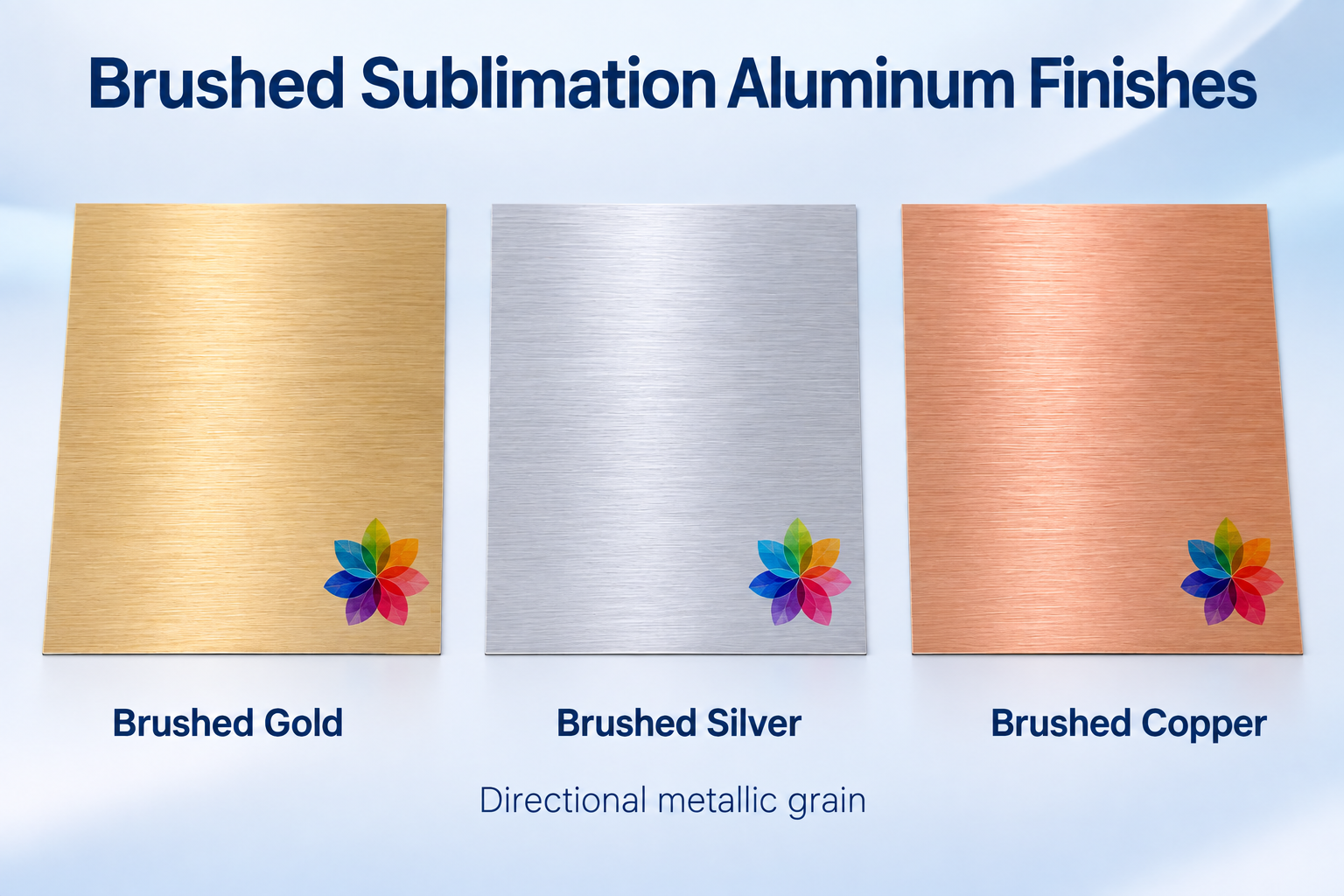
Terms such as glossy, matte, brushed gold or brushed silver are useful descriptions, but they are not complete appearance specifications by themselves.
Color and finish names do not guarantee that materials from different suppliers or coating batches will create exactly the same visual result. Lighting, coating appearance, metallic tone and the printing system can all influence how the finished product is perceived.
For appearance-critical or repeat OEM orders, Worthwill recommends approving both an unprinted surface sample and a printed test sample before mass production.
The printed sample is particularly important because it shows the actual interaction between the artwork, coating, metallic or white background, ink, paper and heat-press process.
Instead of requesting only “glossy sublimation aluminum” or “brushed metal blanks,” describe the complete finished requirement.
A clear RFQ should include:
Product condition: full sheet, cut-to-size panel or finished blank.
Required thickness.
Finished size or drawing dimensions.
Surface finish: high glossy white, matte white, brushed gold, brushed silver, brushed copper or another available option.
Required grain direction for brushed finishes.
Shape, corner radius and hole details where required.
Protective-film requirement.
Quantity for each size and finish.
Packing and labeling requirements.
Final application.
Whether an unprinted and printed approval sample is required.
For more detailed purchasing requirements, see the Aluminum Sublimation Blanks Buying Guide: RFQ Checklist for Bulk Orders.
Not automatically. High glossy white provides a brighter and more reflective photographic appearance, while matte white reduces glare. The better finish depends on the artwork, viewing environment and desired finished appearance.
High glossy white is commonly selected for photographic work because the bright white base and glossy appearance provide strong visual contrast. Matte and brushed finishes can also be used when a less reflective or more metallic effect is required.
Yes. Matte white is still a sublimation-printable surface. It simply produces a less reflective appearance than high glossy white. The final result should be confirmed with the intended artwork and printing system.
Brushed sublimation aluminum has a visible directional metallic grain. Worthwill supplies brushed gold, silver and copper options. The grain can remain noticeable around or through printed areas, so both the metallic color and grain direction become part of the finished design.
Yes. Grain direction should be confirmed before cutting so blanks in the same project maintain a consistent orientation. When orientation matters to the artwork or installation, show it on the drawing or approved sample.
No. Finish and thickness are separate specification decisions. Thickness should be selected according to finished dimensions, rigidity, mounting, unsupported span, edge processing, packing and required product feel.
High glossy, matte and brushed sublimation aluminum do not represent a simple good-better-best ranking. They create different visual results.
High glossy white is a strong starting point for bright photographic panels and image-focused products. Matte white is useful when reduced glare and comfortable viewing are priorities. Brushed gold, silver and copper are better suited to designs that intentionally incorporate visible metallic texture and directional grain.
Before placing a bulk order, confirm the finish together with thickness, finished size, shape, grain direction where applicable, protective film, packing and sample requirements. Review Worthwill’s Aluminum Sublimation Sheet & Blanks product page for the current range of finishes, thicknesses, sizes and customization options, and use an approved printed sample when appearance is critical.