Related Products



Position: Home > Products > Specialty Aluminum Products
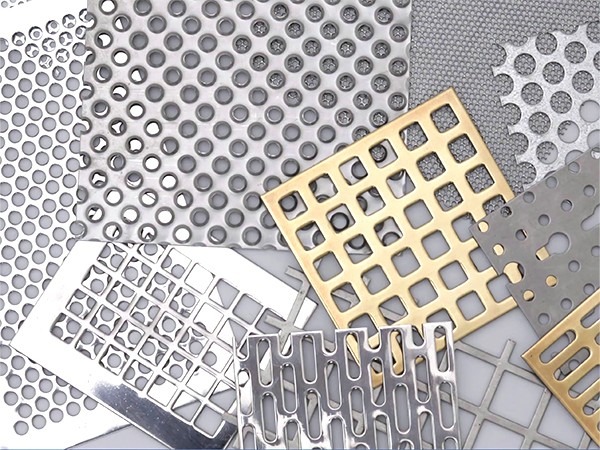
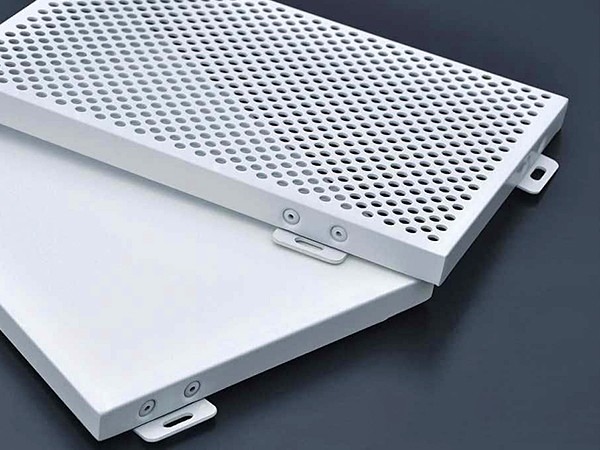
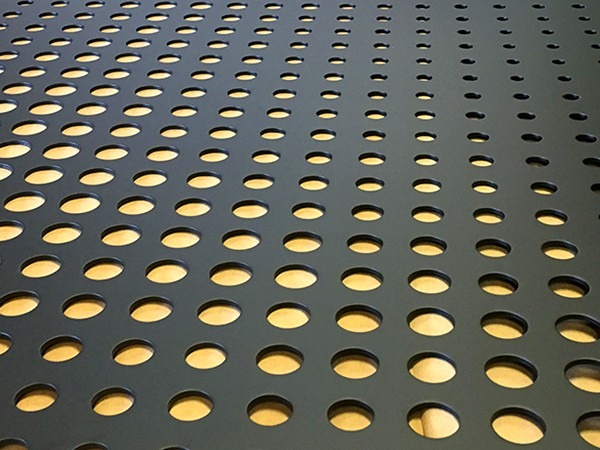
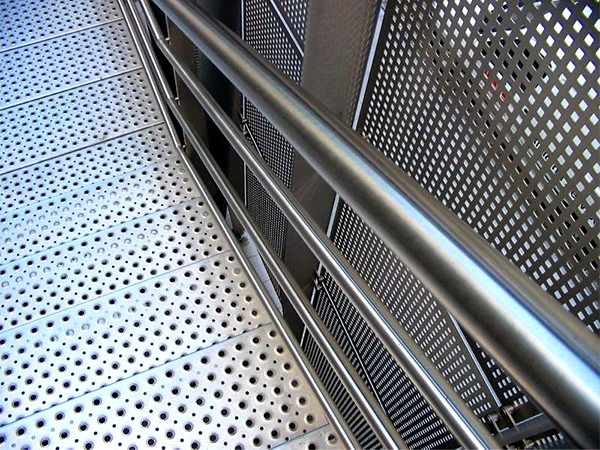
Worthwill supplies perforated aluminum sheet, plate and fabricated panel for architectural, decorative and industrial applications. The aluminum substrate is punched, CNC processed or laser cut into controlled hole patterns to provide the required combination of airflow, light transmission, screening, appearance and weight reduction.
Common alloy options include 1060, 1100, 3003, 5005, 5052 and 6061. Typical order thicknesses range from 0.5 to 6.0 mm, with common sheet sizes including 1000 × 2000 mm, 1220 × 2440 mm (4 × 8 ft), 1250 × 2500 mm and 1500 × 3000 mm. Final dimensions depend on alloy, thickness, hole pattern, fabrication and project requirements.
Round holes are the most widely specified pattern, while square, slotted, oblong, oval, hexagonal and decorative perforations can also be produced. Hole diameter, pitch, arrangement and open area can be customized according to drawings or application requirements. Mill finish, anodized, powder-coated, PVDF-coated and other agreed surface finishes are available.
For quotation, send us the required alloy and temper, thickness, sheet or finished-panel dimensions, hole shape, hole size, pitch or open-area requirement, surface finish, quantity and end application. For architectural panels, drawings showing panel dimensions, edge details, fixing points and perforation layout are recommended.
Perforated aluminum is produced by creating a controlled pattern of openings in aluminum sheet or plate. Instead of treating perforation as a single specification, buyers should define the aluminum alloy, temper, material thickness, hole shape, hole size, pitch, arrangement, open area, finished dimensions and surface treatment together.
Worthwill supplies flat perforated aluminum sheet and plate as well as fabricated perforated panels for architectural and industrial projects. Product specifications can be adjusted for ventilation screens, ceilings, facade screens, sunshades, equipment guards, partitions, acoustic systems, decorative panels and general sheet-metal fabrication.
| Item | Available Specification |
|---|---|
| Product Forms | Perforated aluminum sheet, plate, flat panel and fabricated architectural panel |
| Common Alloys | 1060, 1100, 3003, 5005, 5052, 6061; other grades subject to confirmation |
| Common Tempers | O, H14, H24, H32, T6 and other alloy-appropriate tempers |
| Typical Thickness | 0.5–6.0 mm; other thicknesses subject to processing and project confirmation |
| Common Sheet Sizes | 1000 × 2000 mm, 1220 × 2440 mm (4 × 8 ft), 1250 × 2500 mm, 1500 × 3000 mm; custom cut sizes |
| Hole Shapes | Round, square, slotted, oblong, oval, hexagonal, decorative and custom patterns |
| Round Hole Diameter | Commonly 2–10 mm; approximately 0.5–50 mm can be reviewed according to material thickness and process |
| Hole Arrangement | 60° staggered, straight, diagonal or drawing-specific arrangement |
| Pitch / Centers | Customized according to hole size, required open area and panel design |
| Open Area | Common project range approximately 10–60%; calculated from hole size and arrangement |
| Surface Finish | Mill finish, anodized, powder coated, PVDF coated and other agreed finishes |
| Processing | Perforating, CNC punching, laser cutting, cut-to-size, bending and selected panel fabrication |
| Applications | Facades, ceilings, sunscreens, ventilation, screens, equipment guards, partitions, acoustic systems and decoration |
These values describe common perforated aluminum specifications rather than a fixed production range for every order. Very small holes, large openings, thick plate, high open-area designs or complex fabricated panels should be reviewed against the material thickness, alloy, panel dimensions and processing method before production.
Perforated aluminum is aluminum sheet or plate with repeated or custom-designed openings produced by punching, CNC processing, laser cutting or another suitable fabrication method. Unlike expanded metal, which is slit and stretched into a mesh structure, perforated aluminum retains a continuous sheet around controlled openings.
The perforation pattern can be designed for functional purposes such as airflow, ventilation, screening and weight reduction, or for architectural purposes such as facade decoration, privacy screening and light-and-shadow effects.
A complete perforated aluminum specification should therefore identify more than the hole diameter alone. Hole size, center-to-center pitch, arrangement, edge margins and open area all influence the appearance, remaining metal area and fabrication behavior of the finished sheet or panel.
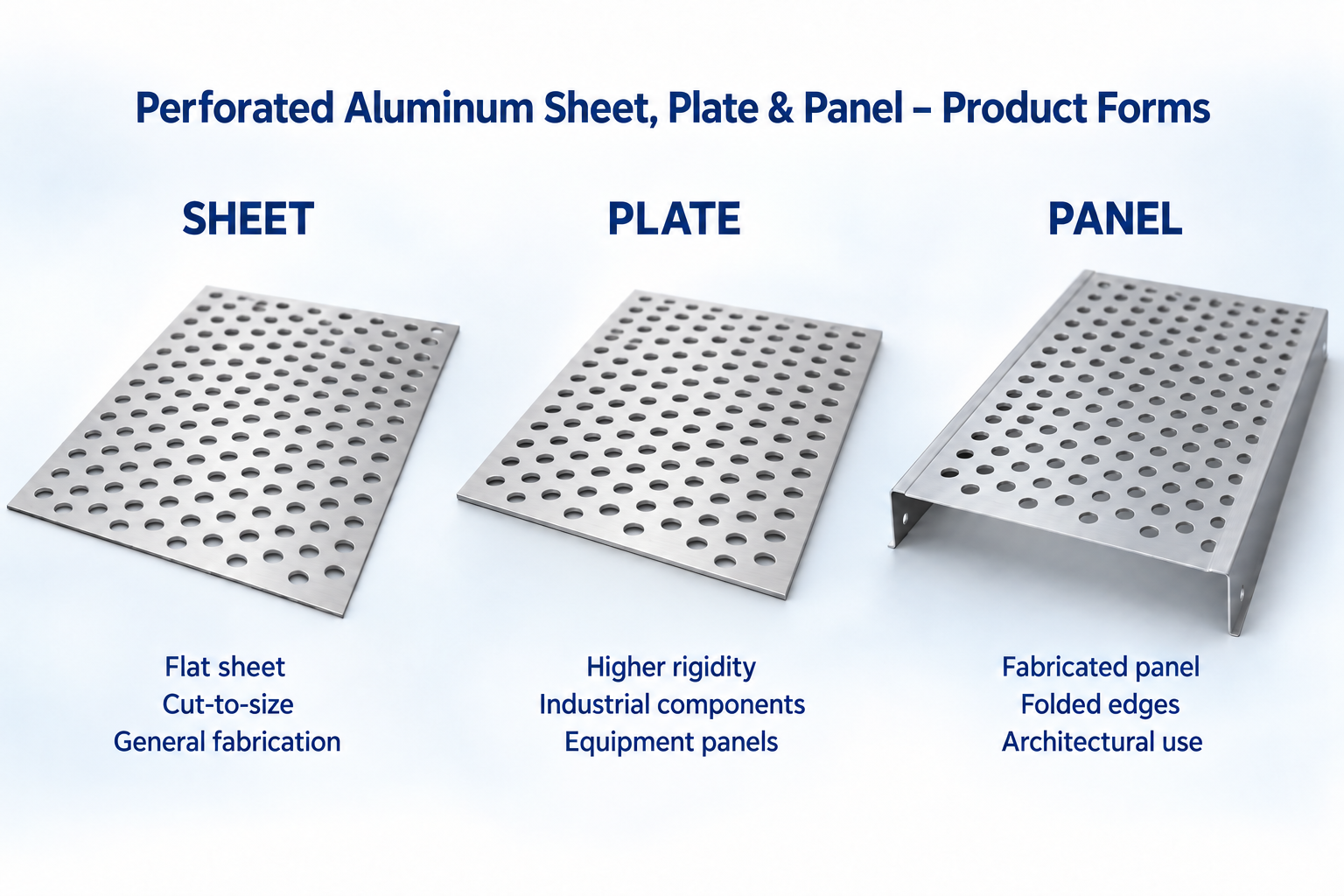
Perforated aluminum sheet is the most common supply form for ventilation components, decorative screens, ceilings, partitions, machine guards and general fabrication. Standard-format sheets can be supplied for subsequent cutting, bending or assembly by the customer.
1220 × 2440 mm, commonly described as a 4 × 8 ft perforated aluminum sheet, is an important commercial format. Other standard and custom dimensions can be reviewed according to the selected thickness, alloy and perforation pattern.
The term perforated aluminum plate is generally used when a thicker or more rigid aluminum substrate is required. It is suitable for equipment screens, protective panels, architectural components and fabricated parts where greater panel stiffness is needed.
Thicker plate requires additional review because achievable hole size, pitch and perforation method are related to material thickness. The final specification should therefore be confirmed from the drawing rather than assuming that every thin-sheet pattern can be transferred directly to thicker plate.
Perforated aluminum panels are commonly used for architectural facades, ceilings, sunscreens, equipment screening, balcony screens and interior feature walls. Panels may be supplied flat or fabricated with folded edges, fixing details and other project-specific features.
For complete exterior facade components, perforation should be coordinated with panel size, alloy, thickness, folded edges, reinforcement, support spacing and fixing design. Buyers can also review our Aluminum Facade Cladding Panel for fabricated architectural cladding options.
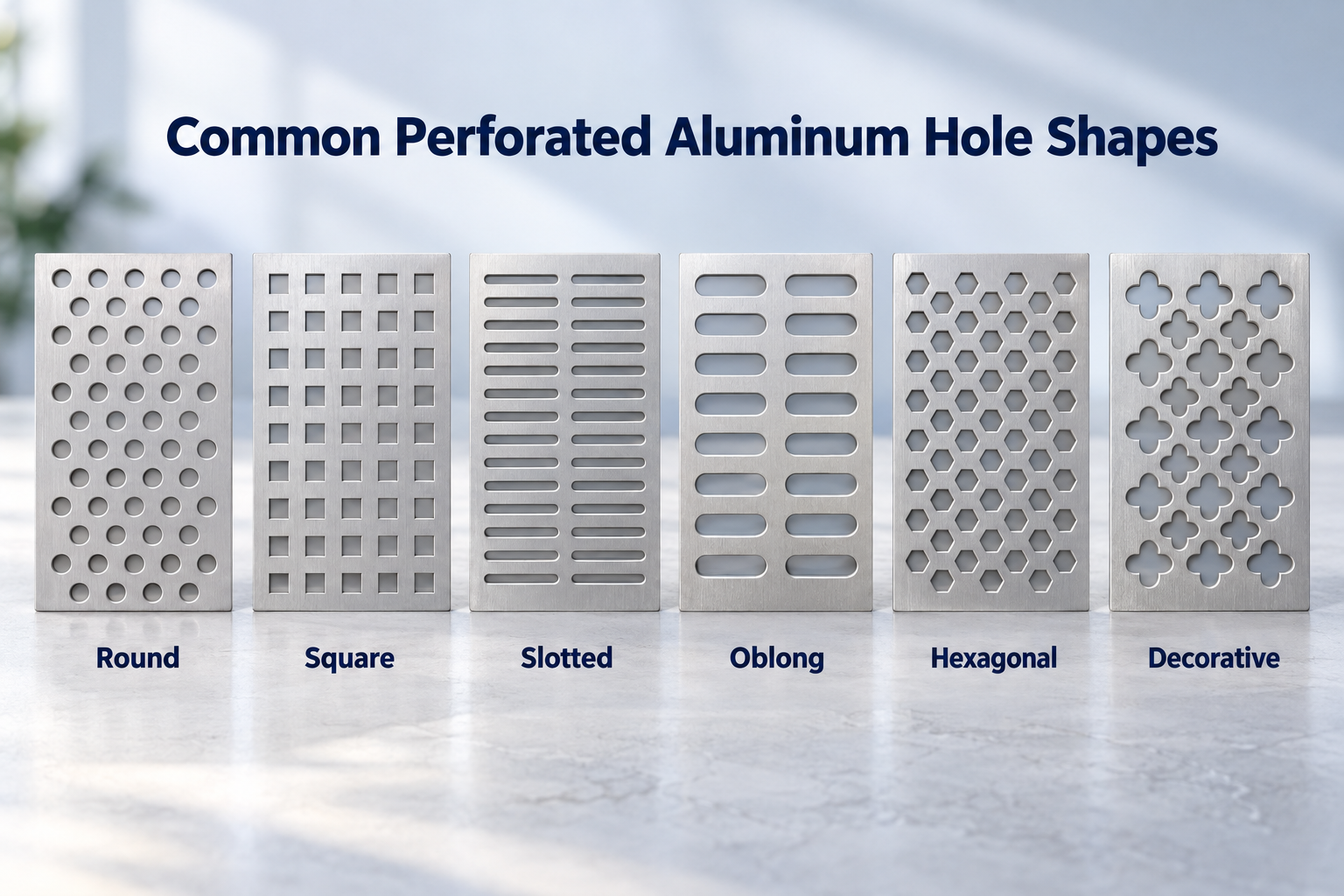
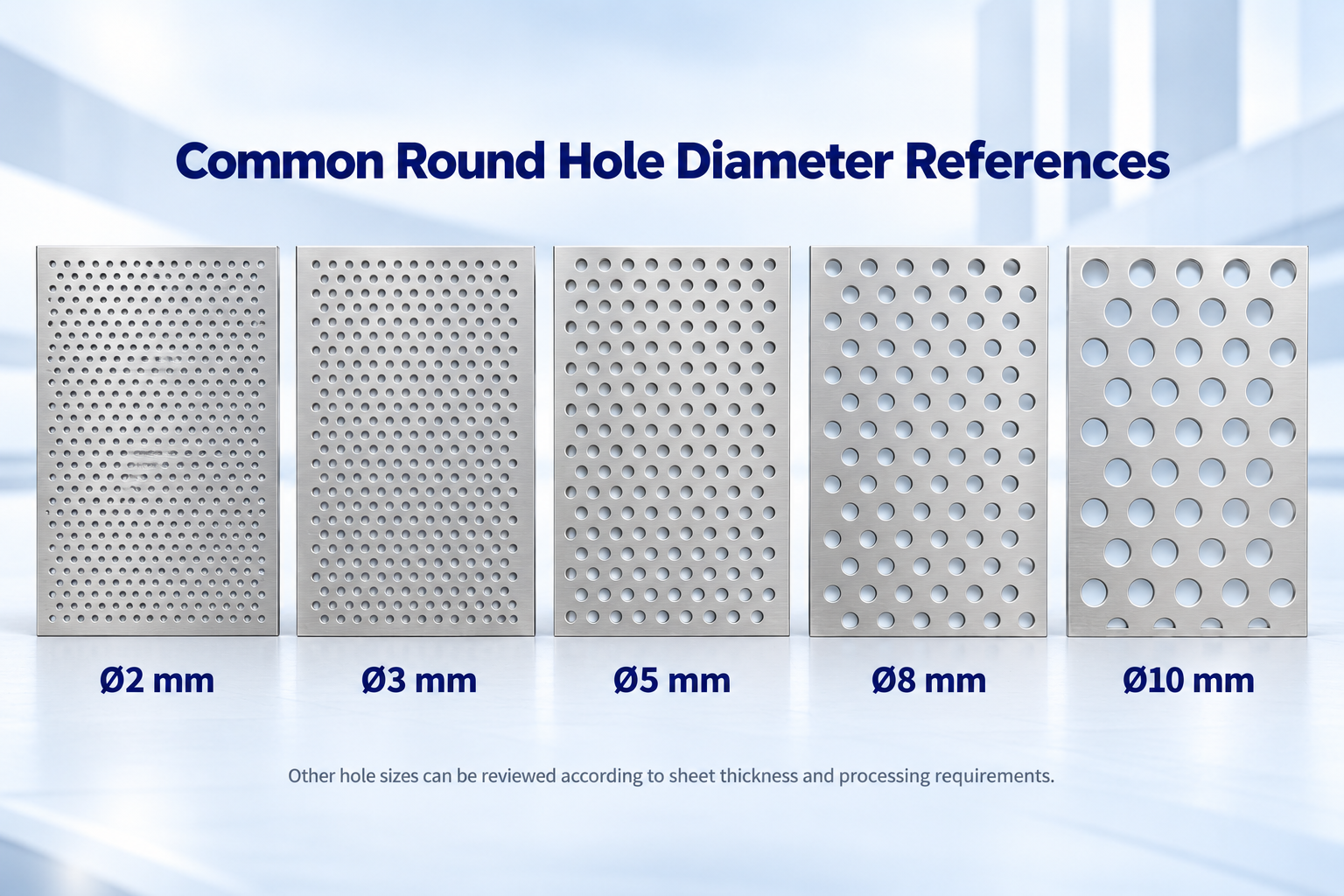
Round holes are the most commonly specified perforation because they are suitable for a broad range of architectural and industrial applications. Common round-hole diameters include 2, 3, 4, 5, 6, 8 and 10 mm.
Smaller or larger holes can be reviewed according to material thickness and processing method. For general quotation purposes, approximately 0.5–50 mm can be treated as a customizable reference range rather than a guaranteed range for every alloy and thickness.
Round holes are frequently arranged on 60° staggered centers because this creates an efficient and visually uniform perforation pattern. Straight-row arrangements are also available when the design requires aligned horizontal and vertical rows.
Square holes create a more geometric appearance and are used for decorative screens, ventilation panels, machine guards and architectural applications. Hole dimensions, pitch and corner condition should be specified on the drawing.
Slotted or oblong holes provide elongated openings and can be used where the required airflow, drainage, screening or visual direction differs from a conventional round-hole pattern.
The slot width, slot length, orientation and center spacing should all be specified. “Slotted hole” alone is not enough information for accurate production or quotation.
Hexagonal, oval and custom decorative patterns can be produced for projects where appearance is an important design requirement. Architectural patterns can also use changing hole sizes or spacing to create gradient or graphic effects.
Complex patterns should be supplied as a drawing or digital design file whenever possible so that perforation layout, margins and finished-panel dimensions can be reviewed before production.
Hole pitch means the center-to-center distance between adjacent perforations. Two sheets with the same hole diameter can have very different open areas if their pitch or arrangement is different.
A higher open area normally allows more airflow, light transmission and visibility through the panel, while leaving less solid aluminum between the openings. A lower open area provides more remaining metal area and a visually denser surface.
For this reason, buyers should specify either the required hole size and pitch or the target open area. For architectural projects, perforation appearance should also be reviewed together with viewing distance, panel dimensions, edge margins and structural requirements.
1060 and 1100 are commercially pure aluminum grades with good formability and corrosion resistance. They can be considered for decorative panels, ventilation components, signs and general fabricated parts where easy forming is more important than high mechanical strength.
For more substrate information, see our 1060 Aluminum Sheet & Coil.
3003 provides a practical balance of formability, moderate strength and corrosion resistance. It is widely considered for architectural screens, ceilings, wall panels, ventilation components and general perforated sheet fabrication.
See our 3003 Alloy Aluminum page for substrate information.
5005 is commonly selected for architectural and decorative aluminum products, particularly when a controlled decorative surface or anodized appearance is required. Final alloy and finish should be confirmed together when appearance consistency is important.
5052 provides higher strength than common 1xxx and 3003 grades together with useful corrosion resistance and fabrication performance. It can be considered for equipment guards, transportation parts, industrial enclosures and more demanding fabricated panels.
See our 5052 Alloy Aluminum page for more information.
6061 is a heat-treatable alloy used where higher strength or structural rigidity is required. Perforation and forming requirements should be reviewed carefully together with temper, particularly for thicker plate or subsequently bent components.
See our 6061 Alloy Aluminum page.
The alloy should be selected according to strength, formability, corrosion exposure, surface-finish requirement, perforation method and final fabrication rather than assuming that one aluminum grade is suitable for every perforated product.
Mill-finish perforated aluminum retains the natural rolled aluminum surface and is suitable for many industrial components or for customers who plan further fabrication or finishing.
Anodized perforated aluminum provides a controlled metallic surface for architectural, decorative, signage and equipment applications. The alloy, anodizing specification and required appearance should be confirmed together. See our Anodized Aluminum Sheet & Coil.
Powder-coated perforated aluminum provides a broad range of colors, gloss levels and textures and is widely used for decorative screens, ceilings and architectural panels. For more information, see our Powder Coated Aluminum Sheet/Coil.
PVDF-coated perforated panels can be considered for demanding exterior architectural applications where the project requires suitable weathering and color-retention performance. Coating specification, pretreatment, color, gloss and service environment should be confirmed before production. See our PVDF Coated Aluminum Coil & Sheet.
For visible architectural panels, perforation, bending, welding and surface finishing should be coordinated in the manufacturing sequence so that the finished edges, corners and visible faces meet the approved project requirement.
The correct specification depends on the function of the finished component. A decorative facade panel may prioritize visual pattern, panel flatness and surface finish, while a ventilation panel may prioritize airflow and open area.
Material thickness and hole size must also be considered together. Very small openings in relatively thick material may require a different process from conventional punching, while very large openings can reduce the amount of metal remaining between holes.
Panel dimensions, edge margins and post-perforation fabrication also matter. If the sheet will later be bent, folded or welded, the perforation pattern should leave appropriate solid areas around bend lines, edges and fixing positions.
For exterior architectural work, the perforated aluminum face panel is only one part of the complete system. Structural support, fixings, coating selection, drainage, fire requirements and local project standards should be reviewed by the responsible project parties.
For a faster and more accurate quotation, provide the following information:
If the perforation pattern has already been engineered, sending the current drawing is preferable to describing the pattern only by text.
Round holes are the most widely used general-purpose pattern. They are suitable for architectural screens, ventilation, ceilings, guards and industrial fabrication. Square, slotted, hexagonal and decorative patterns are selected when the project requires a different appearance or function.
Round holes around 2–10 mm are common for many general applications. Smaller and larger holes can be produced depending on aluminum thickness, alloy, perforation method and panel design. Approximately 0.5–50 mm can be treated as a reference custom range, but the exact capability should be confirmed against the required material and drawing.
1220 × 2440 mm, approximately 4 × 8 ft, is a common commercial sheet format. 1000 × 2000 mm, 1250 × 2500 mm, 1500 × 3000 mm and custom cut sizes can also be reviewed according to thickness and perforation pattern.
Open area is the percentage of the sheet surface occupied by perforations. It is determined by hole size, pitch and hole arrangement. Open area influences airflow, light transmission, visibility, appearance and the amount of solid aluminum remaining in the panel.
Yes. Depending on alloy, application and project specification, perforated aluminum can be supplied with mill finish, anodized, powder-coated, PVDF-coated or other agreed finishes. For fabricated architectural panels, the perforation and fabrication sequence should be coordinated with the final surface treatment.
| Item | Available Specification |
| Product Name | Perforated Aluminum Sheet, Plate & Panel |
| Alternative Names | Aluminum Perforated Sheet, Perforated Aluminium Sheet, Perforated Aluminum Plate, Perforated Aluminum Panel, Perforated Metal Aluminum Sheet |
| Product Forms | Flat sheet, plate, flat panel and fabricated architectural panel |
| Common Alloys | 1060, 1100, 3003, 5005, 5052, 6061; other grades subject to final confirmation |
| Common Tempers | O, H14, H24, H32, T6 and other alloy-appropriate tempers |
| Typical Thickness | 0.5–6.0 mm; other thicknesses subject to processing and project confirmation |
| Common Sheet Sizes | 1000 × 2000 mm, 1220 × 2440 mm (4 × 8 ft), 1250 × 2500 mm, 1500 × 3000 mm; custom cut sizes |
| Hole Shapes | Round, square, slotted, oblong, oval, hexagonal, decorative and custom patterns |
| Round Hole Diameter | Commonly 2–10 mm; approximately 0.5–50 mm can be reviewed according to material thickness and processing method |
| Hole Arrangement | 60° staggered, straight, diagonal or drawing-specific arrangement |
| Pitch / Hole Centers | Customized according to hole size, required open area and panel design |
| Open Area | Common project range approximately 10–60%; calculated according to hole size, pitch and arrangement |
| Edge / Margin | Full perforation, standard solid margins or drawing-specific non-perforated zones |
| Surface Finish | Mill finish, anodized, powder coated, PVDF coated and other agreed surface finishes |
| Processing | Perforating, CNC punching, laser cutting, cut-to-size, bending and selected panel fabrication |
| Applications | Facades, ceilings, sunscreens, ventilation screens, equipment guards, partitions, acoustic systems and decorative fabrication |
| Drawing Requirement | Recommended for custom hole patterns, complex margins and fabricated architectural panels |
| Inspection | Material dimensions, hole size, hole pitch, pattern arrangement, panel dimensions, surface appearance and other agreed inspection items |
| Packing | Export packing with suitable surface protection, edge protection and pallet or wooden-case support according to product dimensions and finish |
All specifications are subject to final technical confirmation. Production capability may vary with alloy, temper, material thickness, hole size, pitch, open area, panel dimensions, surface finish, fabrication method and order quantity.
Send us your product, alloy, size, quantity and application requirements for a detailed quotation.