


3003 and 3105 are two 3xxx-series aluminum alloys commonly considered for painted gutter coil and roll-formed rainwater systems. Both offer useful formability and corrosion resistance, and both can be used for seamless gutter production when the alloy, temper, thickness, coating and coil dimensions are matched to the forming process.
Worthwill supplies aluminum gutter coil in 3003 and 3105 alloys. The current confirmed gutter-coil range is 0.70–1.00 mm thickness, 610–990 mm parent-coil width, 150 / 300 / 505 mm coil ID, PE / HDP / PVDF coating, RAL and custom color matching, with custom slitting available according to gutter-machine requirements.
The important point is that 3105 is not automatically the “better” alloy simply because its alloy number is higher. For seamless gutters, the better choice is the alloy that gives the required forming behavior, strength level, coating performance and production consistency in the buyer’s actual gutter profile and machine setup.
For most seamless-gutter programs, both 3003 and 3105 are practical starting points. 3003 is a widely used aluminum-manganese alloy known for good formability and general corrosion resistance. 3105 is an aluminum-manganese-magnesium alloy widely used in roll-formed and prepainted building products, including gutters and downspouts.
Mechanical properties vary with temper and thickness, so buyers should not select the alloy by grade number alone. If a drawing, existing forming program or approved sample already specifies one alloy, maintaining that specification is usually more reliable than changing alloys without a forming trial.
| Selection Factor | 3003 Aluminum | 3105 Aluminum |
|---|---|---|
| Alloy family | 3xxx-series aluminum-manganese alloy | 3xxx-series aluminum-manganese-magnesium alloy |
| General character | Good formability, useful strength and good general corrosion resistance | Good forming performance, useful strength and good general corrosion resistance |
| Building-product use | General formed sheet-metal and coated building products | Widely used for roofing, siding, gutters, downspouts and prepainted building products |
| Seamless gutter use | Suitable when the confirmed temper, thickness, coating and profile meet the forming requirement | Suitable when the confirmed temper, thickness, coating and profile meet the forming requirement |
| Main buying point | Match the alloy to the actual profile, forming process and required properties | Match the alloy to the actual profile, forming process and required properties |
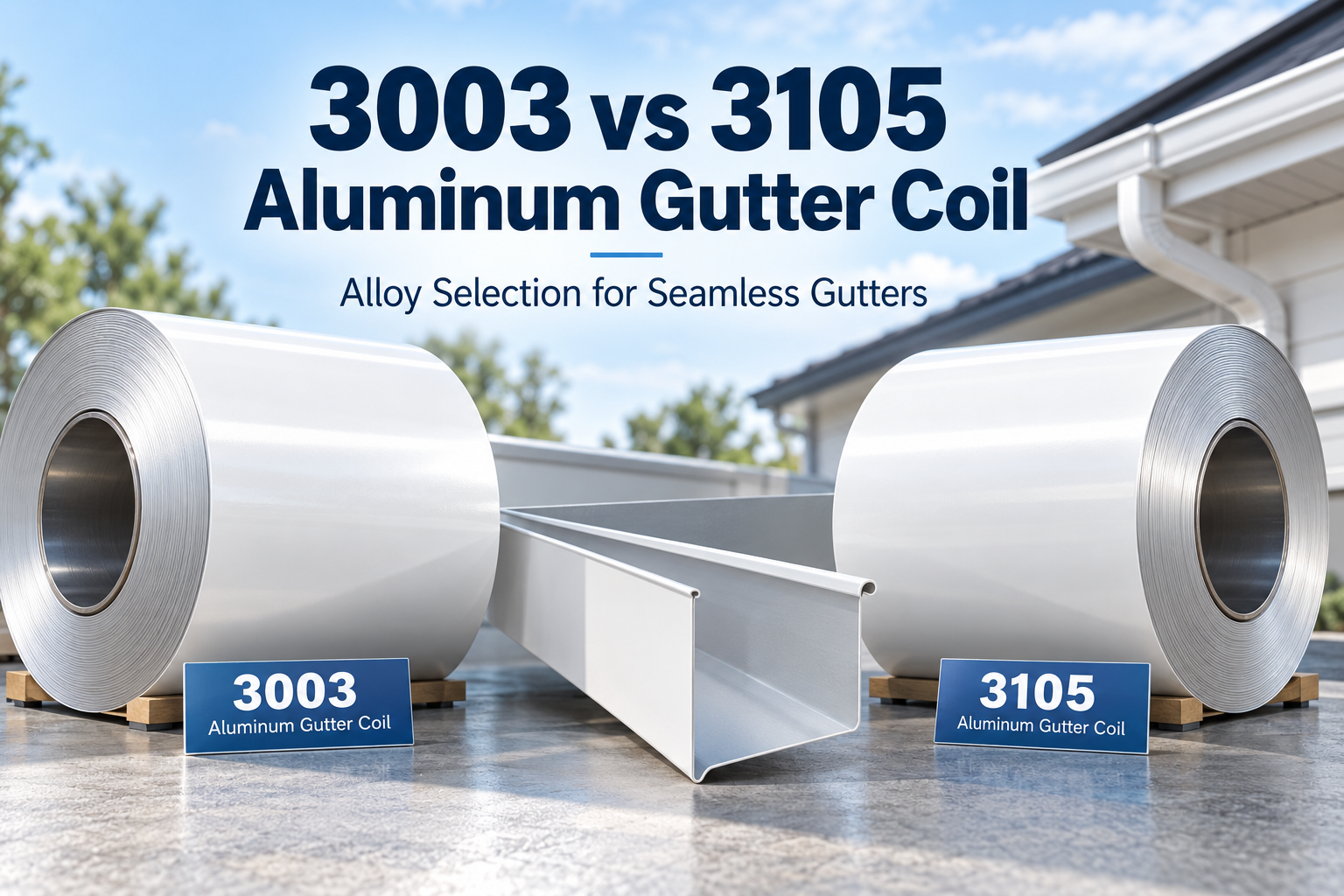
3003 belongs to the wrought aluminum-manganese family. Worthwill’s 3003 aluminum page describes it as a non-heat-treatable alloy with moderate strength, good formability and strong general corrosion resistance.
For gutter production, those characteristics are useful because the coil must pass through multiple forming rolls and bends without surface or edge problems. The exact result still depends on temper, thickness, slit quality, profile geometry and machine adjustment.
3003 is especially practical when the buyer already runs a proven 3003 gutter program, needs a broadly specified 3xxx-series alloy, or wants to keep the material specification consistent with existing tooling, approved samples or downstream fabrication.
3105 is also a non-heat-treatable 3xxx-series alloy, but it belongs to the aluminum-manganese-magnesium family. Worthwill’s 3105 aluminum page identifies gutters, downspouts, roofing, siding and prepainted aluminum as common applications.
That application profile makes 3105 a familiar choice for architectural roll forming and color-coated building products. It combines useful mechanical strength with good forming performance and corrosion resistance, which is why buyers often encounter 3105 in gutter and rainwater-system specifications.
3105 should still be selected as part of a complete production specification. The alloy name alone does not determine whether a coil will run correctly through a specific seamless-gutter machine.
The practical difference between 3003 and 3105 is smaller than many simplified online comparisons suggest. Both are non-heat-treatable 3xxx-series alloys, both can be roll formed, and both can be supplied as coated gutter coil. The final performance depends on the full material condition rather than the alloy designation alone.
| Comparison Point | 3003 | 3105 |
|---|---|---|
| Main alloying direction | Aluminum-manganese | Aluminum-manganese-magnesium |
| Formability | Good; widely used for general forming | Good; widely used for architectural roll forming |
| Corrosion resistance | Good general atmospheric corrosion resistance | Good general atmospheric corrosion resistance |
| Color coating | Suitable after correct cleaning and pretreatment | Common substrate for prepainted architectural products after correct pretreatment |
| Gutters and rainwater products | Suitable when the complete specification matches the forming process | Commonly specified for gutters, downspouts and related roll-formed products |
| Selection risk | Do not assume every temper and thickness will form the same way | Do not assume every temper and thickness will form the same way |
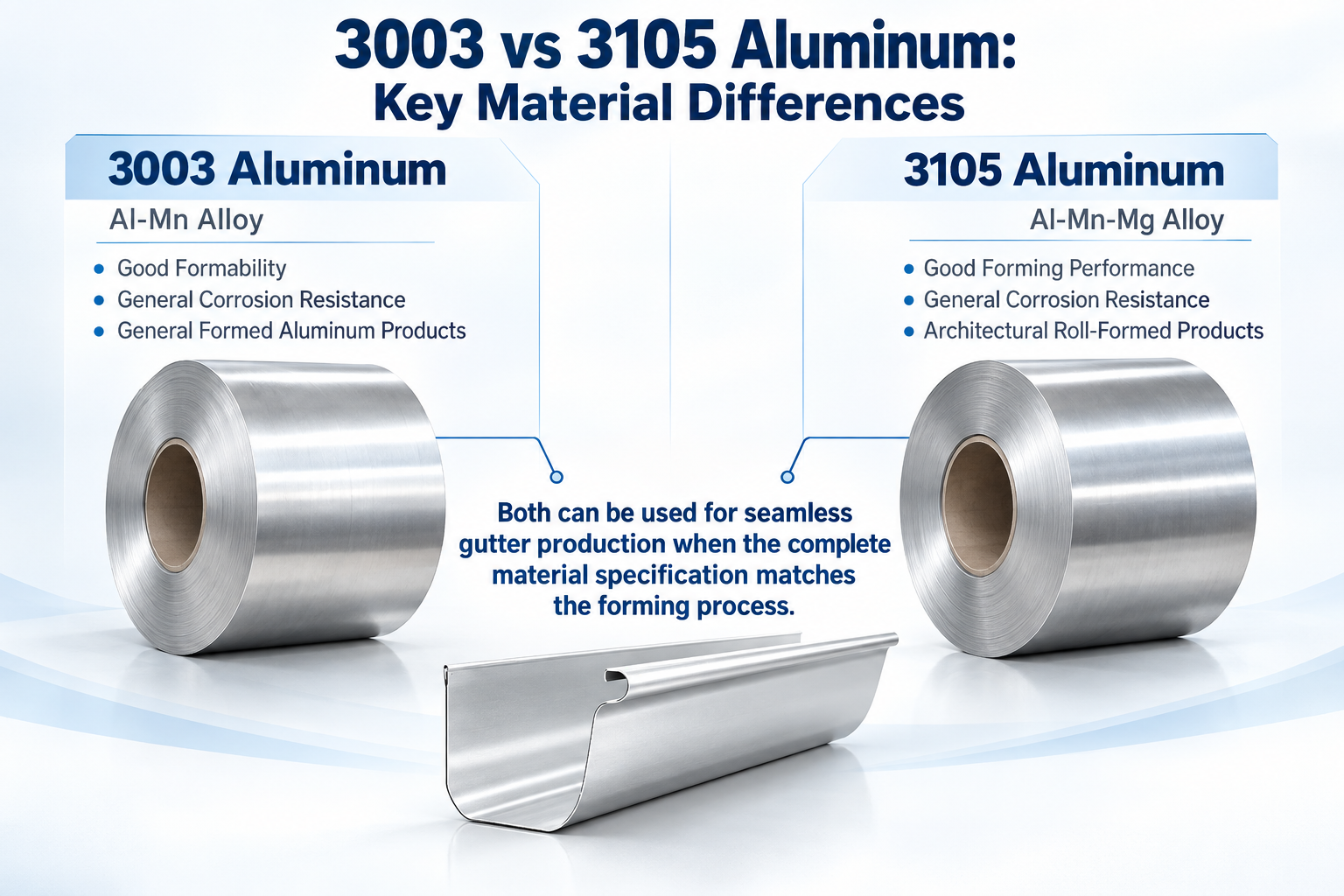
It is better not to treat this as a simple yes-or-no purchasing rule. 3105 is known for useful strength in thin-gauge architectural products, but the actual mechanical properties of both 3003 and 3105 change with temper and thickness.
For a seamless gutter, the buyer should therefore compare the confirmed mechanical-property range for the exact ordered condition rather than assume that one alloy number is automatically stronger, stiffer or easier to form.
This also explains why replacing a proven 3003 coil with 3105, or replacing 3105 with 3003, should not be done only from a general alloy comparison. The gutter profile, bend sequence, roll-forming speed and finished shape all matter.
A seamless gutter is formed continuously from coil stock. During production, the strip passes through a sequence of rolls that progressively create the finished gutter profile. If the complete material specification does not match the machine and profile, the operator may see inconsistent forming, edge distortion, surface marking or dimensional variation.
Before confirming 3003 or 3105, buyers should review the material together with the gutter-machine requirements.
The base alloy is only one part of a painted seamless-gutter specification. Worthwill supplies gutter coil with PE, HDP and PVDF coating systems, and the broader color coated aluminum range uses both 3003 and 3105 among its common building-product alloys.
PE coated aluminum is commonly selected for economical general-purpose and moderate-exposure applications. HDP coated aluminum provides improved exterior weatherability and color retention compared with standard polyester. PVDF coated aluminum is commonly considered for demanding exterior exposure, strong UV conditions and projects where longer-term appearance is important.
For gutter buyers, this means a small difference in base-alloy preference should not distract from coating selection, pretreatment, color approval, forming compatibility and the actual service environment.
The following values are the current confirmed Worthwill gutter-coil specifications used for this article.
| Item | Confirmed Specification |
|---|---|
| Alloys | 3003 / 3105 |
| Thickness | 0.70–1.00 mm |
| Parent Coil Width | 610–990 mm |
| Coil ID | 150 / 300 / 505 mm |
| Coating | PE / HDP / PVDF |
| Colors | RAL & Custom Matching |
| Slitting | Custom slitting available according to gutter-machine requirements |
These values describe the current gutter-coil supply range. Final slit width, coating, color and production details should be confirmed against the buyer’s gutter machine and finished profile before production.
A practical alloy decision starts with the buyer’s existing specification and production process.
A complete RFQ helps the supplier match the coil to the forming equipment and finished gutter rather than quoting only by alloy name.
No. Both alloys can be suitable for seamless gutters. 3003 offers good general formability and corrosion resistance, while 3105 is widely used in prepainted architectural and rainwater products. The better choice depends on the confirmed temper, thickness, profile, coating and forming process.
Both have useful forming performance. The actual behavior depends on temper, thickness, bend geometry, slit quality and machine setup, so the alloy number alone should not be used to predict forming performance.
Yes. Worthwill’s gutter-coil range includes PE, HDP and PVDF coating options, and both 3003 and 3105 can be used as coated aluminum substrates when the complete production specification is confirmed.
Worthwill’s current confirmed gutter-coil range is 0.70–1.00 mm.
Yes. Custom slitting is available according to gutter-machine requirements. Send the required feed width, profile or machine information when requesting a quotation.
3003 and 3105 are both valid aluminum gutter-coil choices. 3003 is a well-established general-purpose Al-Mn alloy with good formability and corrosion resistance. 3105 is an Al-Mn-Mg alloy widely used in roll-formed and prepainted building products, including gutters and downspouts.
For seamless gutters, the alloy should be selected together with temper, thickness, slit width, coil ID, coating system, color, profile and forming-machine requirements. That complete specification matters more than choosing an alloy from a simple good-better-best comparison.
For current supply options, see Worthwill’s Aluminum Gutter Coil product page and send the gutter profile, dimensions, coating, color and quantity for specification confirmation and quotation.