

Ordering sublimation aluminum is easier when the request is written around the finished blank, not only the base material. A clear purchase specification tells the supplier what will be printed, the required dimensions and shape, how edges and holes should be prepared, which face must remain protected, and how the pieces should be packed. This aluminum sublimation blanks buyer checklist turns those decisions into a practical RFQ that purchasing, production and quality teams can review together.
The same phrase can mean different things to a printer, fabricator and metal supplier. One buyer may need full sheets for in-house cutting, while another needs ready-to-press rectangles with rounded corners and holes. Begin the RFQ with the final use and the condition in which the material should arrive. State whether the order is for full sheets, cut panels or finished blanks, and identify the side that will receive the image.
It is also useful to describe the downstream process without prescribing unverified settings. Name the press type, ink and transfer-paper system if known, but ask for a trial sample before approving a production order. Heat-press settings depend on the coating, equipment and image system, so a purchasing specification should not assume that one temperature and time will suit every combination.
A concise opening line might read: “Rectangular sublimation aluminum blanks, printable face identified, rounded corners, two mounting holes, protective film retained until pressing, individually separated for clean handling.” Dimensions, tolerances and packing details should follow in separate fields. This avoids hiding critical requirements inside a long email.
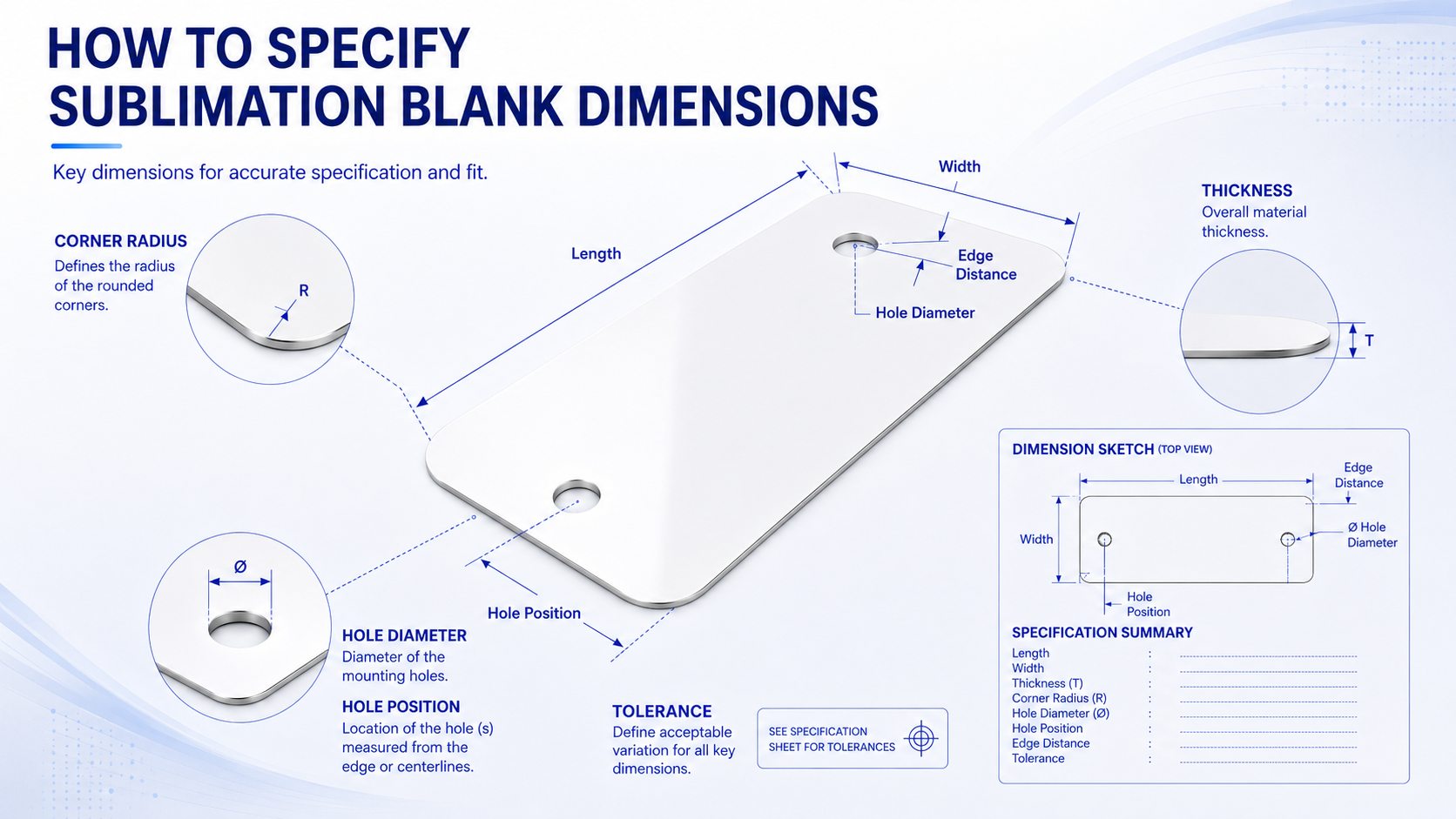
Dimensions should be stated in one unit system and tied to a drawing or approved sample when the part is not a simple rectangle. Length and width alone are not enough when the blank includes radiused corners, holes, slots or a directional brushed appearance. Include the quantity by size, because mixed-size cartons are difficult to check when labels are vague.
State finished length, width and thickness, with the unit shown beside every value.
Identify square, rounded or custom corners, and give the corner radius where it matters.
For holes or slots, provide diameter, center location, edge distance and orientation on a drawing.
Specify the acceptable dimensional tolerance instead of asking only for “high precision.”
Separate quantities by part number, size, finish and packing group.
If a blank will fit a frame, fixture or mounting pattern, use the mating dimensions to define acceptance. For repeat orders, keep the revision number on both the drawing and purchase order. A change to a hole position or corner radius can make old and new stock look almost identical while no longer being interchangeable.
The RFQ should distinguish the printable coating from the visible color or texture. Terms such as white, silver, gold, gloss, matte or brushed describe appearance, but they do not by themselves confirm compatibility with a particular sublimation process. Ask the supplier to identify the printable face and provide a matching sample from the proposed material.
When appearance is important, approve it under consistent lighting and after printing the same test artwork. A bare sample and a printed sample answer different questions: the bare piece helps check surface uniformity, while the printed piece shows how the coating, ink, paper and press interact. Keep an approved reference sample for repeat-order comparison and record whether small appearance variation is acceptable.
Confirm whether protective film is required, which side it covers and when it should be removed. The film should not be treated as proof that the printable surface is clean. The incoming inspection should still look for dust, scratches, pressure marks, adhesive residue and edge damage. Operators should also know which face is printable before the film is removed, so labels or packing orientation need to be unambiguous.
Edge quality affects handling, mounting and visual presentation. State whether cut edges may show light tool marks, whether burrs must be removed and whether corners should be uniform across the lot. For display pieces handled by end users, describe the expected touch condition in measurable or sample-based terms rather than relying on words such as “safe” or “smooth.”
Hole requirements deserve their own drawing detail. Include the reference edge, hole diameter, center coordinates and any countersink or slot geometry. If printed artwork must align with the holes, send the supplier the same orientation used by the artwork team. A part rotated 180 degrees may still pass a basic dimensional check but fail during assembly or display.
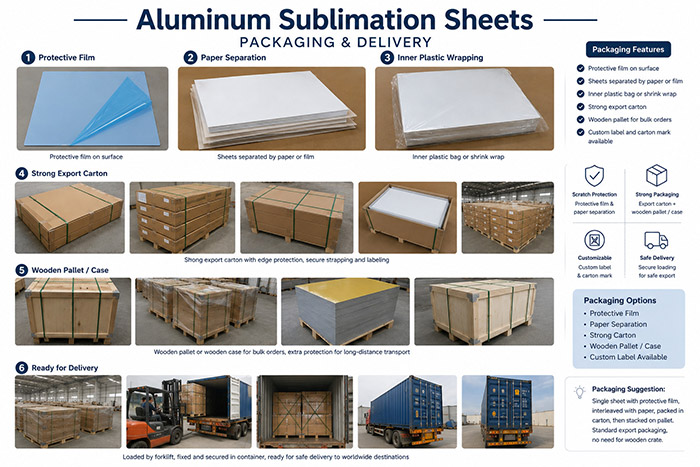
Sublimation blanks are handled as visible surfaces, so packing instructions should reduce face-to-face rubbing and make quantities easy to verify. Ask the supplier to propose separation material, bundle quantity, carton labels and outer protection appropriate to the part size and transport method. If the order contains several variants, require part numbers that connect each bundle to the purchase order.
Define how printable faces are separated and how protective film orientation is identified.
Set the number of pieces per inner pack and the maximum mix of part numbers per carton.
Require labels with part number, size, finish, quantity and purchase-order reference.
Agree on how cartons, pallets and moisture protection will be arranged for the shipping route.
Ask for packing photos or a sample pack when the first order has a new shape or surface.
Packing approval should happen before the full order is completed. A good surface can still arrive damaged if pieces move inside the carton or if labels force receivers to open every bundle to identify it. The goal is a system that protects the faces and lets receiving staff count, segregate and store the blanks without unnecessary handling.
A staged approval reduces the risk of discovering a mismatch after the complete shipment arrives. First review the written specification and drawing. Next inspect a bare blank for dimensions, shape, edge condition, face identification and packing. Then run the buyer’s own print test using the intended artwork and process. Only after those checks should the reference sample and document revision be approved for production.
The purchase order should also define what evidence accompanies the shipment. Depending on the buyer’s quality system, that may include a packing list, part labels, dimensional inspection records or retained samples. Do not request a certificate, test value or warranty unless the required document, method and acceptance criteria are explicitly defined and agreed.
Receiving inspection can begin with a practical sample plan: verify labels and counts, confirm several parts against the drawing, examine printable faces under consistent light, check corner and hole consistency, and review packing damage. Quarantine pieces from crushed or wet cartons until their surfaces and dimensions are checked. Record defects by part number and location so the supplier can distinguish a material issue from cutting, packing or transit damage.
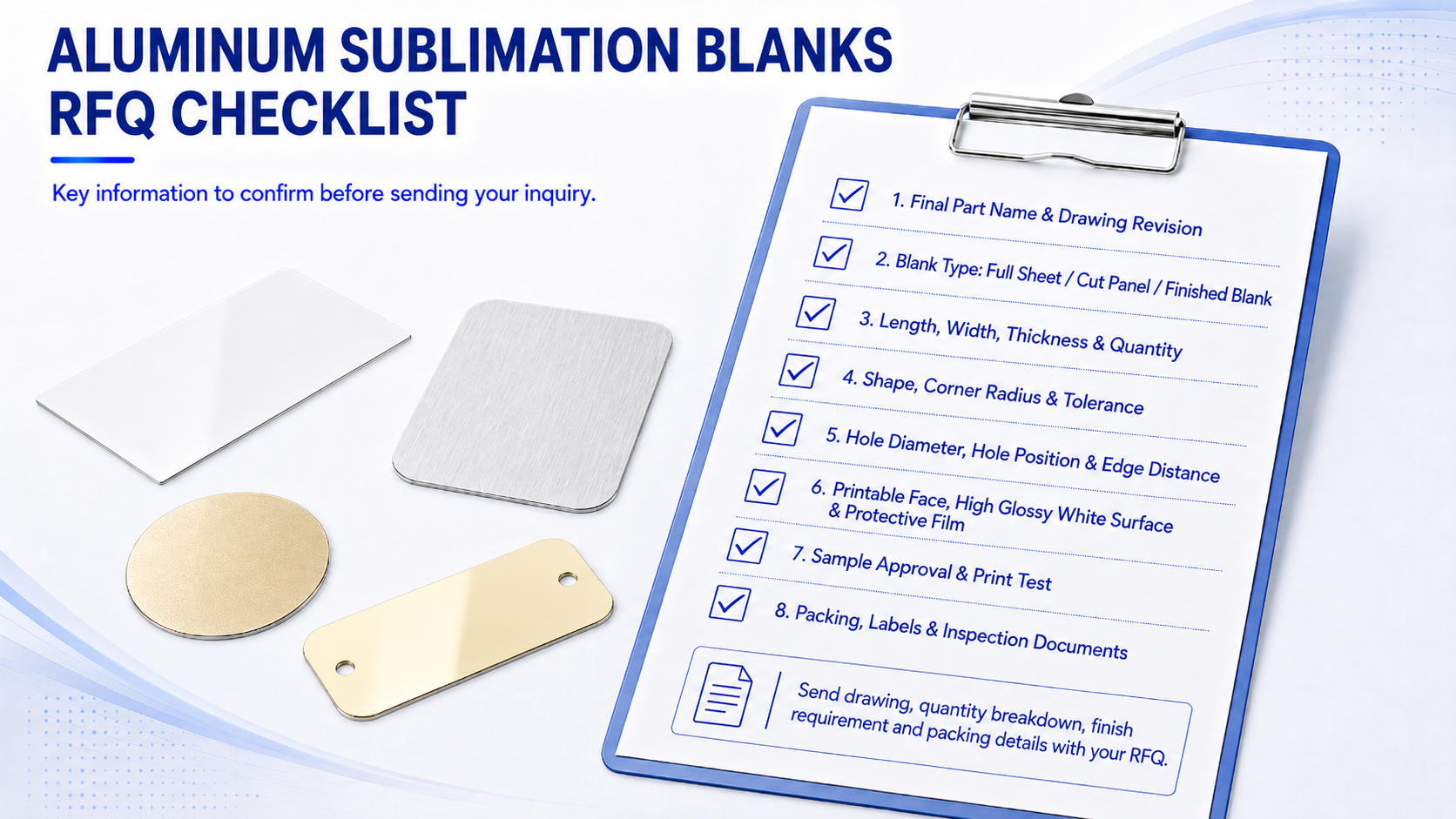
Before sending the inquiry, make sure the following fields can be answered without another email:
Final part name, drawing number and revision.
Full sheet, cut panel or finished blank.
Length, width, thickness, tolerance and quantity by size.
Shape, corner radius, edge condition, holes, slots and orientation.
Printable face identification, visible color or texture, and protective-film requirement.
Required bare and printed samples, including the buyer’s approval process.
Separation material, bundle quantity, carton labels and outer packing.
Inspection records or shipping documents that were specifically agreed.
A useful quotation is not just a unit price; it is confirmation that both sides are describing the same finished part. Send Worthwill the drawing, quantity breakdown, visible finish, printable-face requirements, sample plan and packing expectations together. The current aluminum sublimation sheet and blank product page is the primary product reference for this inquiry. Keep process settings subject to the buyer’s own press trial, and convert every approved sample decision into a revision-controlled purchase specification.
