


1060 and 3003 are both widely used aluminum grades for insulation jacketing, but they are not identical materials and should not be selected only by price or availability. For pipe insulation, 1060 is valued for its high aluminum purity, excellent formability and ease of fabrication, while 3003 provides higher mechanical strength and better resistance to denting and deformation while retaining good formability.
For many general pipe-insulation projects, either alloy can work when the thickness, temper, surface finish, moisture barrier and installation design are correctly specified. The better choice depends on the mechanical exposure, forming requirements, project standard and complete insulation-jacketing system.

If easy forming, bending and economical general-purpose jacketing are the main priorities, 1060 is often a practical choice. If the jacket will be exposed to more mechanical contact, larger insulation diameters, frequent maintenance activity or conditions where greater rigidity is preferred, 3003 is usually the stronger option.
Neither alloy should be selected in isolation. Aluminum thickness, temper, smooth or stucco embossed finish, moisture-retarder construction and installation details can have as much influence on the finished jacketing system as the alloy itself.
| Comparison | 1060 Aluminum | 3003 Aluminum | Practical Buyer Takeaway |
|---|---|---|---|
| Alloy Family | Commercially pure 1xxx-series aluminum | Aluminum-manganese 3xxx-series alloy | Different compositions create different strength and forming characteristics |
| Composition | Minimum 99.6% aluminum | Contains approximately 1.0–1.5% manganese | 3003 uses manganese to increase strength |
| Strength | Lower | Higher | 3003 is preferable where greater rigidity or dent resistance is required |
| Formability | Excellent | Good | 1060 is easier to form around pipes and fabricated details |
| Corrosion Resistance | Good in many atmospheric and industrial environments | Good in many atmospheric and industrial environments | Actual service performance also depends on environment, moisture control and installation |
| Typical Jacketing Use | General pipe insulation and applications prioritizing easy forming | Industrial pipe, tank and equipment jacketing requiring additional mechanical strength | Select according to actual exposure rather than alloy name alone |
| Moisture Barrier | Can be supplied with polysurlyn or polykraft | Can be supplied with polysurlyn or polykraft | Barrier type is a separate specification from alloy selection |
Aluminum jacketing is the protective outer layer of a mechanical insulation system. It is not the thermal insulation itself. The jacket covers materials such as mineral wool, glass wool, calcium silicate, foam glass or other specified insulation and helps protect them from weather, surface contamination and mechanical damage.
The aluminum therefore needs enough formability to wrap around pipes, fittings, tanks or equipment while maintaining sufficient stiffness after installation. A very soft and formable material can simplify fabrication, but a stronger alloy can provide better resistance to accidental dents and handling damage.
This is the main reason 1060 and 3003 are both used. They solve slightly different purchasing priorities rather than representing a simple good-versus-bad choice.
1060 is a commercially pure aluminum grade containing at least 99.6% aluminum. It is non-heat-treatable and is known for excellent formability, good corrosion resistance and practical fabrication performance.
For aluminum jacketing, its main advantage is how easily it can be cut, bent, rolled and formed around insulation. This can be useful for straight pipe sections as well as jobs that involve frequent cutting and fitting during field installation.
1060 aluminum jacketing is particularly worth considering when:
Extensive forming and bending are required.
The insulation geometry includes many pipe sections or fabricated details.
Mechanical impact is limited or moderate.
The project specification permits 1060.
Ease of installation is a higher priority than maximum jacket stiffness.
Worthwill currently lists 1060 among the typical alloys for both its aluminum insulation jacketing with a polysurlyn moisture barrier and its aluminum insulation jacketing with polykraft moisture barrier products.
The lower strength of 1060 does not automatically make it unsuitable for industrial insulation. The required jacket thickness, temper, pipe diameter and mechanical exposure must be considered together. Increasing thickness or changing temper can significantly affect stiffness, so alloy alone does not determine the final performance of the jacket.
3003 is a non-heat-treatable aluminum-manganese alloy. Manganese is the main alloying addition, typically around 1.0–1.5%, giving 3003 greater mechanical strength than commercially pure 1xxx-series aluminum while retaining good forming characteristics and corrosion resistance.
For insulation jacketing, this additional strength can be useful where the installed aluminum is more likely to experience handling, maintenance activity or incidental mechanical contact.
3003 aluminum jacketing is particularly worth considering when:
Higher rigidity is preferred at the same general gauge.
The jacket is used on larger insulated pipes, tanks or industrial equipment.
The installation area is exposed to more mechanical contact.
Dent resistance and shape retention are important.
The project specification specifically requires 3003.
The insulation system is installed in industrial facilities where the protective jacket may receive more demanding service.
3003 should not be described as difficult to form. It still has good formability and is widely fabricated into sheet and coil products. The practical difference is that it provides a stronger balance of formability and mechanical strength than 1060.
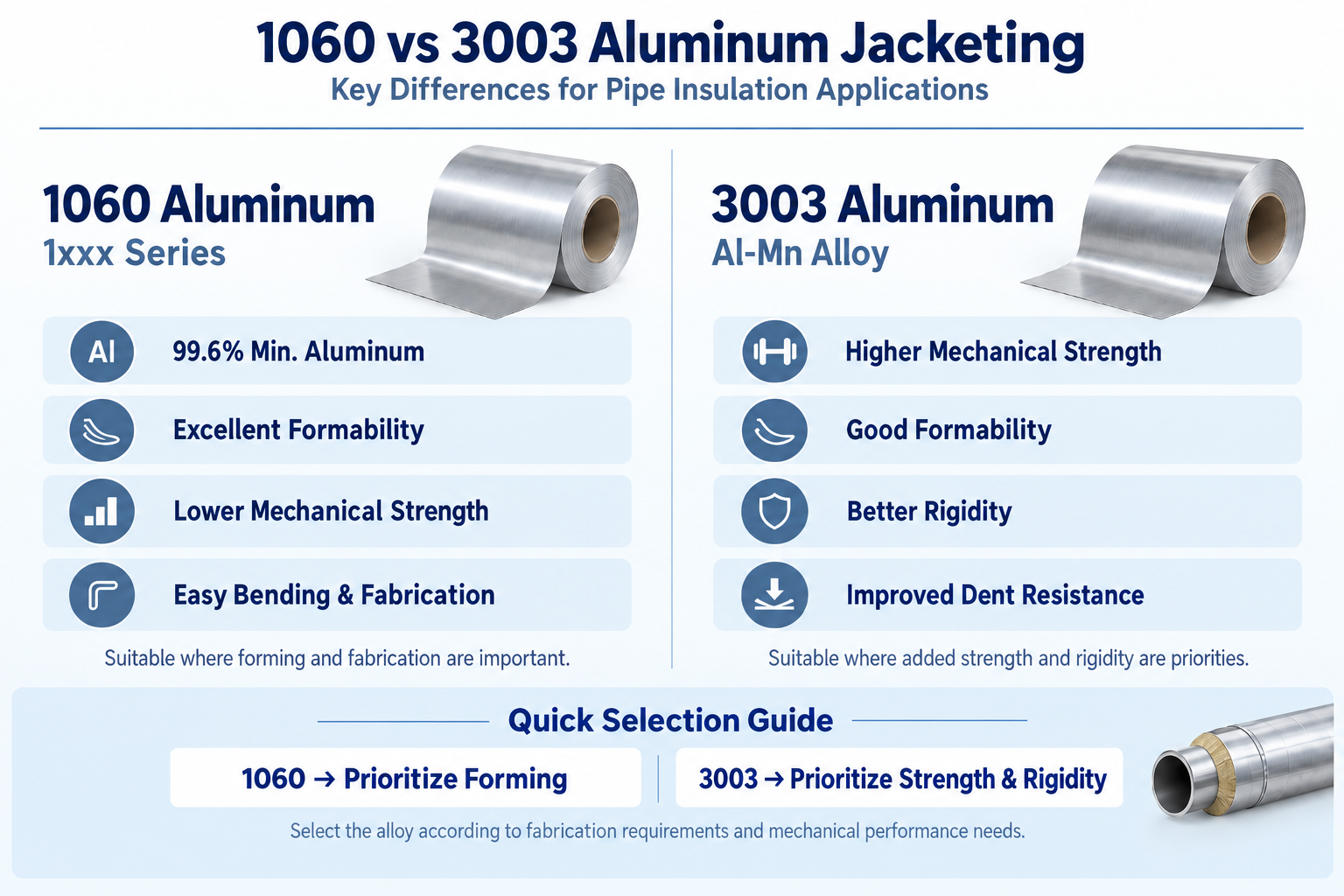
At comparable temper and thickness, 3003 generally provides greater mechanical strength than 1060. For pipe jacketing, this can translate into improved resistance to local deformation, handling dents and loss of shape.
This becomes more relevant on large insulation diameters and exposed equipment where broad unsupported areas of metal may be easier to deform.
However, alloy strength cannot replace correct thickness selection. A thin 3003 jacket should not automatically be assumed to outperform a properly specified thicker 1060 jacket for every installation. Thickness, temper, diameter, surface profile and fastening arrangement all affect the rigidity of the installed system.
1060 is easier to form because of its commercially pure composition and relatively lower strength. It is well suited to bending, rolling and other fabrication operations commonly required when preparing insulation jacketing.
This can reduce forming difficulty when the jacket needs to follow curved surfaces or when substantial field fabrication is expected.
3003 remains formable, but additional strength means the forming behavior is different. Buyers should therefore specify not only the alloy but also the required temper. A comparison between 1060 and 3003 without stating temper can be misleading because hardness and forming behavior change substantially between O, H12, H14, H16, H24 and other conditions.
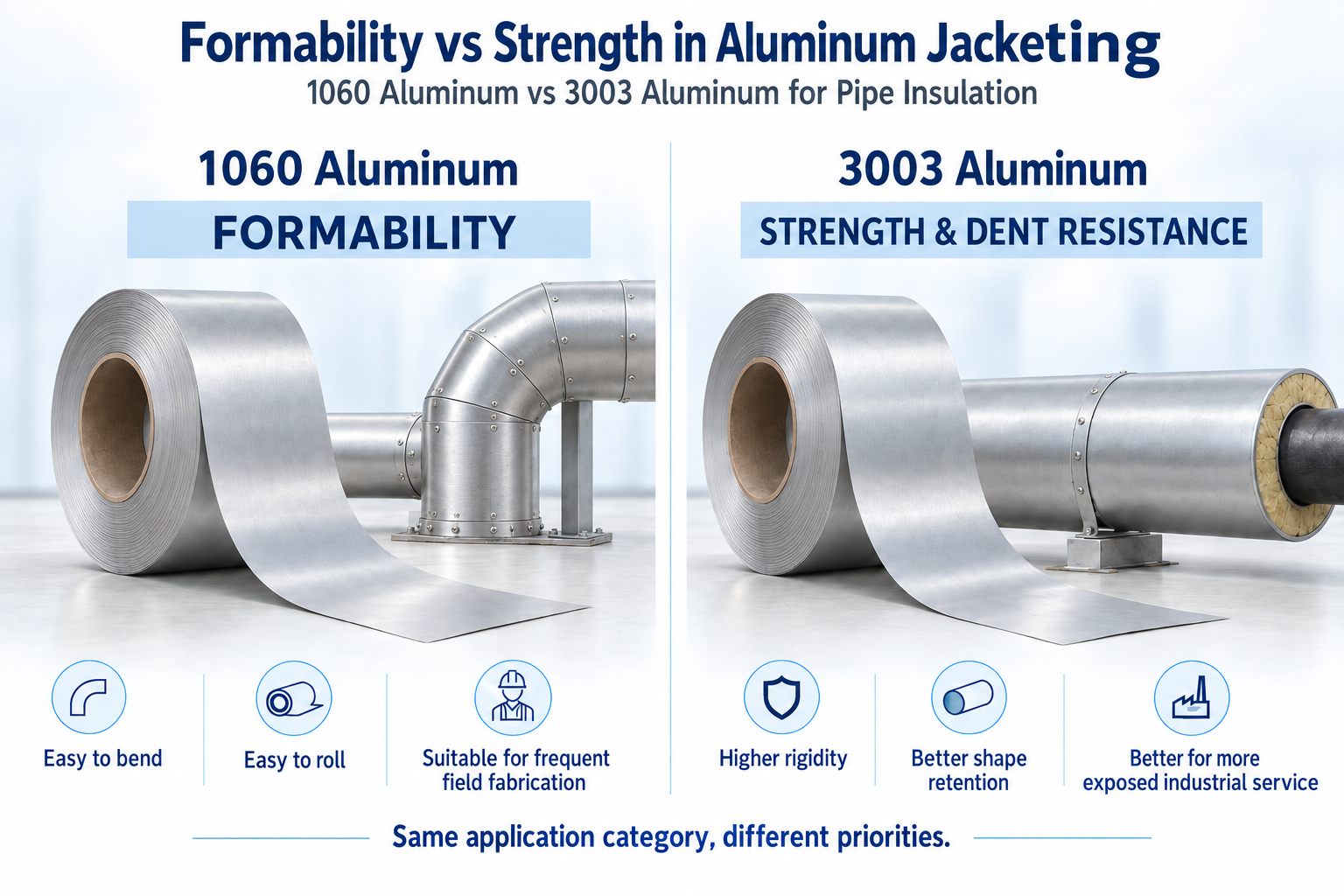
Both 1060 and 3003 provide useful corrosion resistance for many atmospheric and general industrial applications. It is better to avoid selecting one alloy solely from a general statement that one is “corrosion resistant.”
In a pipe-insulation system, corrosion-related performance is affected by far more than the aluminum alloy. Water entry, trapped moisture, contaminants, contact with dissimilar metals, damaged joints, the inner moisture barrier and installation workmanship all matter.
For this reason, the moisture-retarder system should be specified separately from the alloy.
Where the project environment is especially aggressive, the buyer should provide the actual service conditions and applicable material specification rather than assuming that an alloy change alone will solve the problem.
Choosing between 1060 and 3003 answers the question of the aluminum substrate. Choosing between polysurlyn and polykraft answers a different question: what type of inner backing or moisture-retarder construction should be used.
Worthwill’s aluminum insulation jacketing with a polysurlyn moisture barrier is available with typical alloys including 1050, 1060 and 3003. The current product specification lists a factory-laminated 3 mil, approximately 76 μm, light-blue polysurlyn moisture barrier, with smooth or stucco embossed aluminum surfaces available.
Worthwill’s aluminum insulation jacketing with polykraft moisture barrier also lists 1050, 1060 and 3003 among its available alloys. Its current specification includes polykraft backing with a typical kraft thickness of 0.1–0.15 mm, with the final construction confirmed according to the order.
This means that neither 1060 nor 3003 should automatically be associated with only one barrier system. A buyer can first select the alloy according to forming and mechanical requirements and then select the backing according to moisture exposure, handling conditions and the written project specification.
For a more detailed comparison of the backing systems themselves, see Worthwill’s guide to Polysurlyn vs. Polykraft for Aluminum Jacketing.
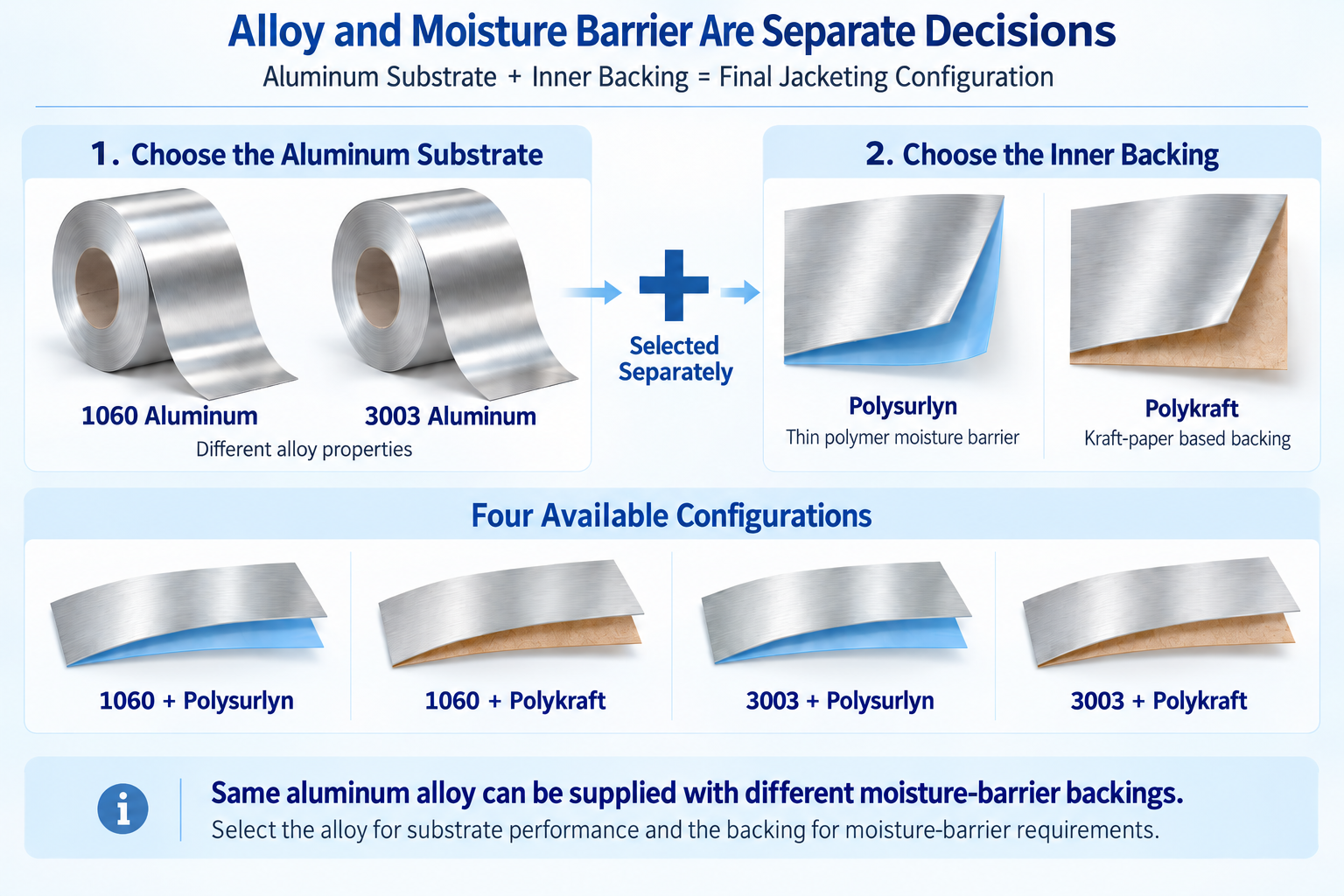
Alloy and surface finish are also separate decisions.
Smooth aluminum jacketing offers a traditional metallic appearance, straightforward forming and good surface-water shedding. Stucco embossed jacketing has a textured surface that can make small scratches and handling marks less visible, reduce glare and provide a modest increase in apparent rigidity.
Worthwill’s polysurlyn aluminum jacketing is available in both smooth and stucco embossed forms, while the current polykraft product is supplied as embossed aluminum coil or sheet.
The choice should be based on appearance, fabrication method, installation environment and project specification rather than assuming that one finish must always be paired with either 1060 or 3003.
1100 is another commercially pure 1xxx-series aluminum used in insulation-jacketing applications. Like 1060, it provides high formability and lower strength than 3003, but it is a different alloy designation and should not be treated as an automatic substitute.
One important distinction appears in ASTM C1729. In the C1729-21 alloy classification, 3003 or 3105 are used for Grades 1 and 2 in specified tempers, while dead-soft 1100 is identified as Grade 3. 1060 is not listed in that particular alloy classification.
Therefore, when an engineering specification explicitly requires ASTM C1729, buyers should verify the required alloy, temper, grade and edition rather than replacing 1100, 3003 or another specified material with 1060 simply because their general applications may appear similar.
For projects not governed by that specific alloy classification, 1060 remains a widely used commercial option for aluminum insulation jacketing where the governing standard and purchasing specification permit it.
A material that is commonly sold as aluminum jacketing is not automatically compliant with every jacketing standard.
ASTM C1729 covers aluminum jacketing for thermal and acoustical insulation and classifies material according to factors including surface treatment, alloy and temper, and moisture retarder. If a project requires ASTM C1729, the purchase order should identify the applicable edition and required classification.
For this reason, an RFQ should not simply state “1060 aluminum insulation jacketing, ASTM C1729” without checking whether the selected alloy and temper meet the classification required by the project.
Where ASTM C1729 compliance is mandatory, 3003 may fit an applicable alloy classification when supplied in the required temper and construction. Other project standards may permit 1060. The specification, drawing and engineering requirements should take priority over general market practice.
For general pipe insulation where easy fabrication and forming are the main priorities and the project specification allows the alloy, 1060 can be a practical choice.
For exposed industrial piping, tanks and equipment where additional stiffness, dent resistance and mechanical durability are preferred, 3003 is often the more suitable choice.
Use the following selection logic:
Choose 1060 when formability, bending and straightforward fabrication have priority.
Choose 3003 when higher mechanical strength and rigidity are more important.
Do not choose either alloy without specifying the temper.
Increase attention to thickness as pipe diameter and mechanical exposure increase.
Select smooth or stucco embossed finish according to the installation environment and appearance requirement.
Specify polysurlyn or polykraft separately from the alloy.
Where a project cites ASTM C1729 or another engineering standard, follow the exact permitted alloy, temper and classification.
A complete RFQ makes it much easier to compare quotations accurately. Instead of requesting only “1060 aluminum jacketing” or “3003 aluminum jacketing,” provide the complete finished-material requirement.
Include:
Required alloy and temper.
Aluminum thickness and width.
Coil, slit coil or cut-to-length sheet form.
Smooth or stucco embossed surface.
Polysurlyn, polykraft or other specified inner backing.
Required moisture-barrier thickness or construction.
Completed insulation diameter or equipment dimensions.
Indoor or outdoor service environment.
Expected mechanical exposure.
Required material or insulation-jacketing standard and edition.
Quantity, roll dimensions, packing method and destination.
Required inspection or documentation package.
For projects using a polysurlyn moisture barrier, buyers can review Worthwill’s Aluminum Insulation Jacketing with Polysurlyn Moisture Barrier product page. For projects based on kraft-paper backing, review the Aluminum Insulation Jacketing with Polykraft Moisture Barrier product page before preparing the final specification.
No. 3003 provides higher mechanical strength, but 1060 offers excellent formability and may be fully suitable for general insulation jacketing. The better material depends on thickness, temper, pipe diameter, mechanical exposure and project requirements.
Yes. Worthwill currently lists 1060 among the typical alloys available for aluminum insulation jacketing with a polysurlyn moisture barrier.
Yes. Worthwill’s current polykraft insulation embossed aluminum specification includes 3003 as one of the available alloy options.
No. Both belong to the commercially pure 1xxx series, but they are different alloy designations with different composition limits and specification usage. Where a standard or drawing requires 1100, it should not automatically be replaced with 1060.
They should be evaluated together but specified separately. Alloy selection mainly affects forming and mechanical characteristics, while the moisture barrier relates to the inner jacketing construction and moisture separation. The finished specification should define both.
There is no universal winner in the 1060 vs 3003 aluminum jacketing comparison. 1060 is a strong choice when easy forming and general-purpose pipe-insulation fabrication are the priorities. 3003 is usually preferred when the finished jacket needs greater strength, stiffness and resistance to mechanical deformation.
The final decision should combine alloy, temper, thickness, surface finish, moisture-barrier construction, pipe or equipment dimensions, service environment and applicable engineering standard.
Worthwill supplies aluminum insulation jacketing in both 1060 and 3003 options, including aluminum jacketing with a polysurlyn moisture barrier and aluminum insulation jacketing with polykraft moisture barrier. Send the actual project specification, insulation diameter, alloy and temper, thickness, finish, barrier requirement and required standard before ordering so the complete jacketing construction can be confirmed.