


A mirror aluminum sheet may look highly reflective at first glance, but a bright, shiny surface does not always tell you how well it will reflect light in a finished product.
For lighting reflectors, architectural panels, decorative components and solar applications, the difference matters. Two aluminum sheets can have a similar mirror appearance while delivering different optical performance because of their surface treatment, coating, smoothness and the way reflectivity is measured.
When purchasing mirror finish aluminum sheet or coil, it is worth looking beyond a single reflectivity percentage. This guide explains the main factors affecting aluminum mirror reflectance, how reflective grades differ, and what buyers should check before ordering.
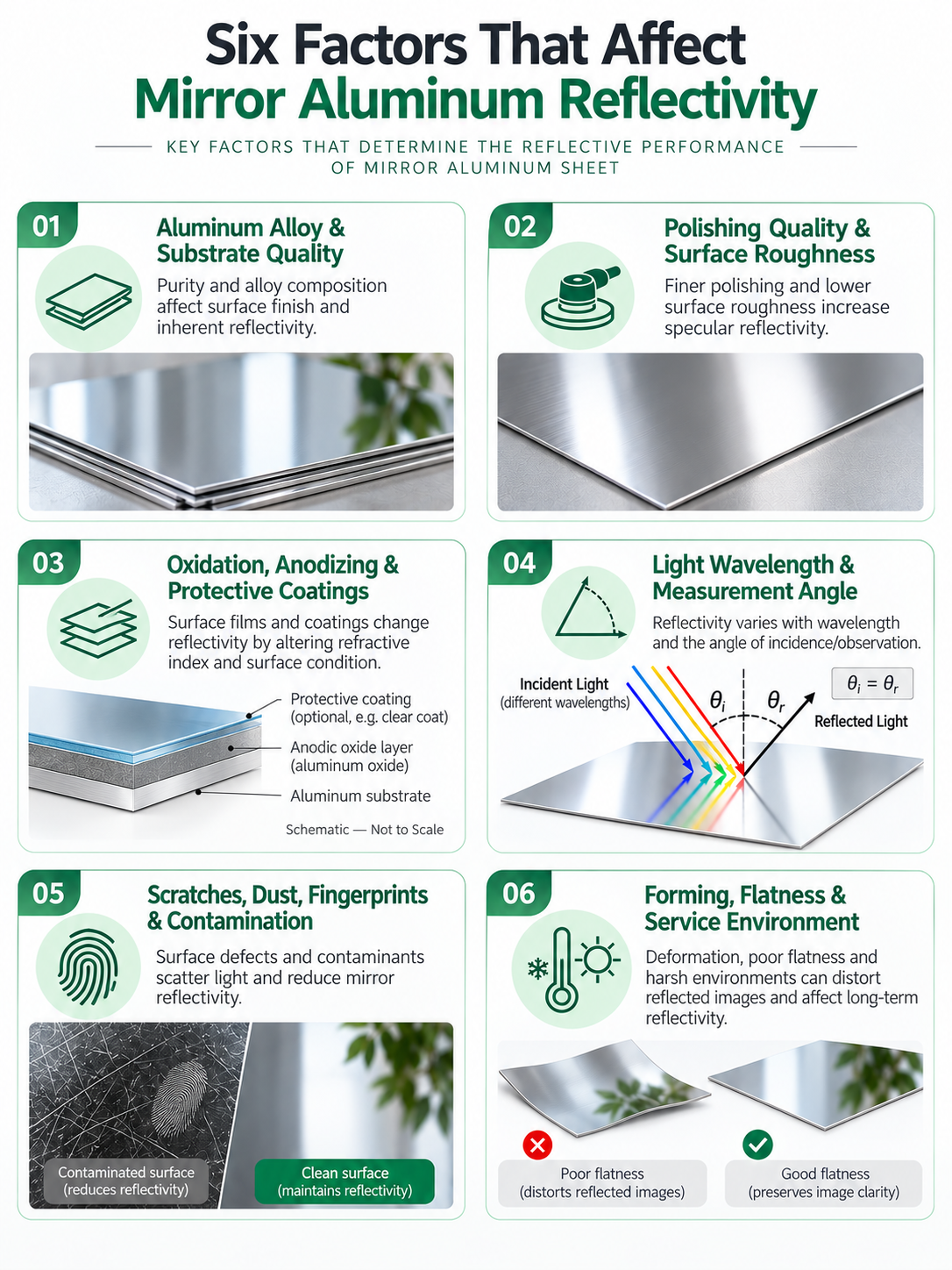
The reflective performance of mirror aluminum sheet depends mainly on surface smoothness, polishing quality, oxide or coating structure, optical measurement conditions and the condition of the finished surface.
High reflectivity and clear mirror reflection are related, but they are not identical. A surface may reflect a large amount of incoming light while scattering some of it, making reflected images appear less sharp.
For buyers, the important question is not simply whether a supplier offers 85%, 90% or 95% reflective aluminum. It is whether the reported value measures the type of reflection required by the application.
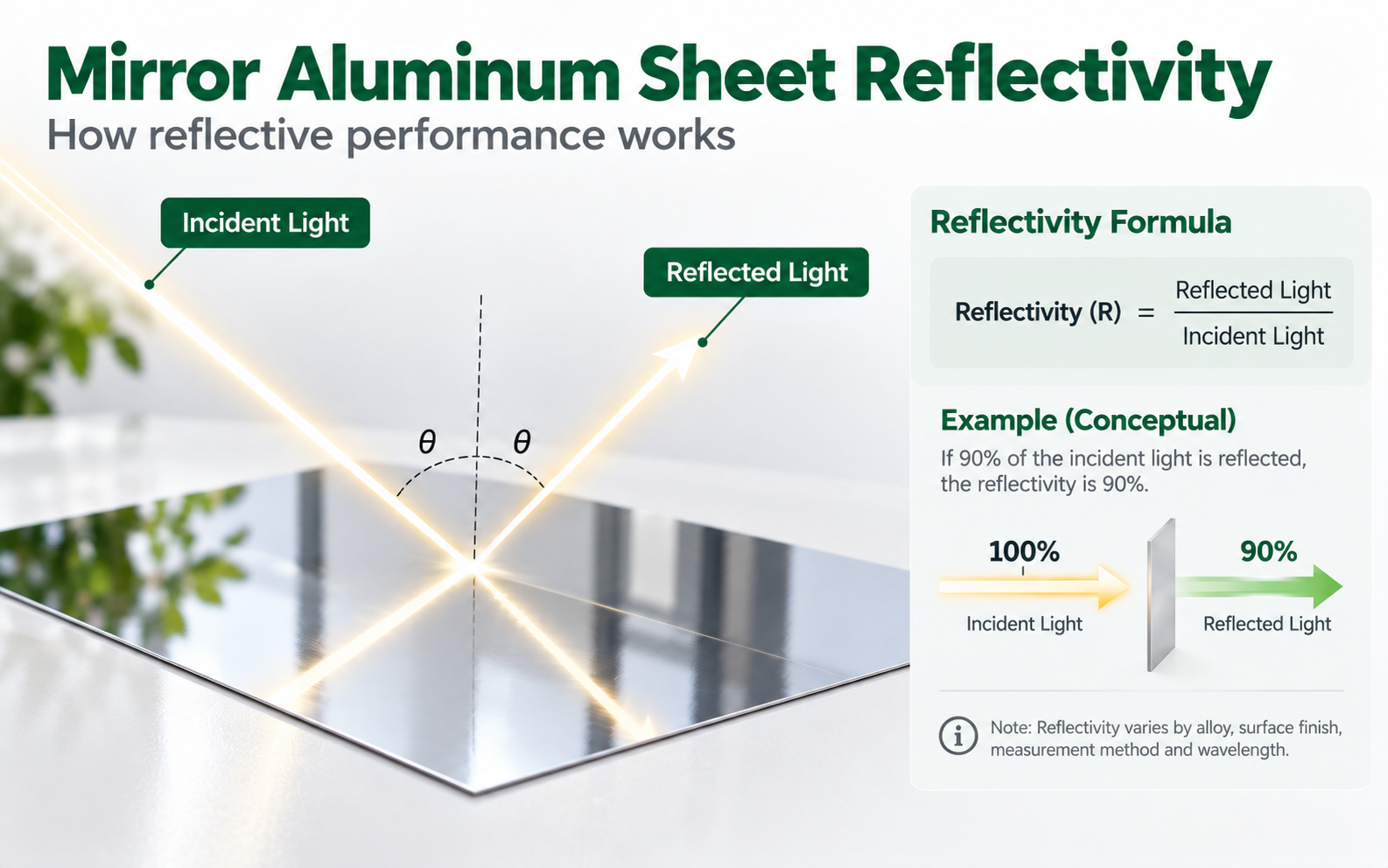
Reflectivity, also called reflectance, describes the proportion of incident light reflected by a material surface under defined measurement conditions.
For example, a reflectance value of 90% means that 90% of the incident optical energy within the specified measurement conditions is reflected.
However, the number alone does not explain where the reflected light goes.
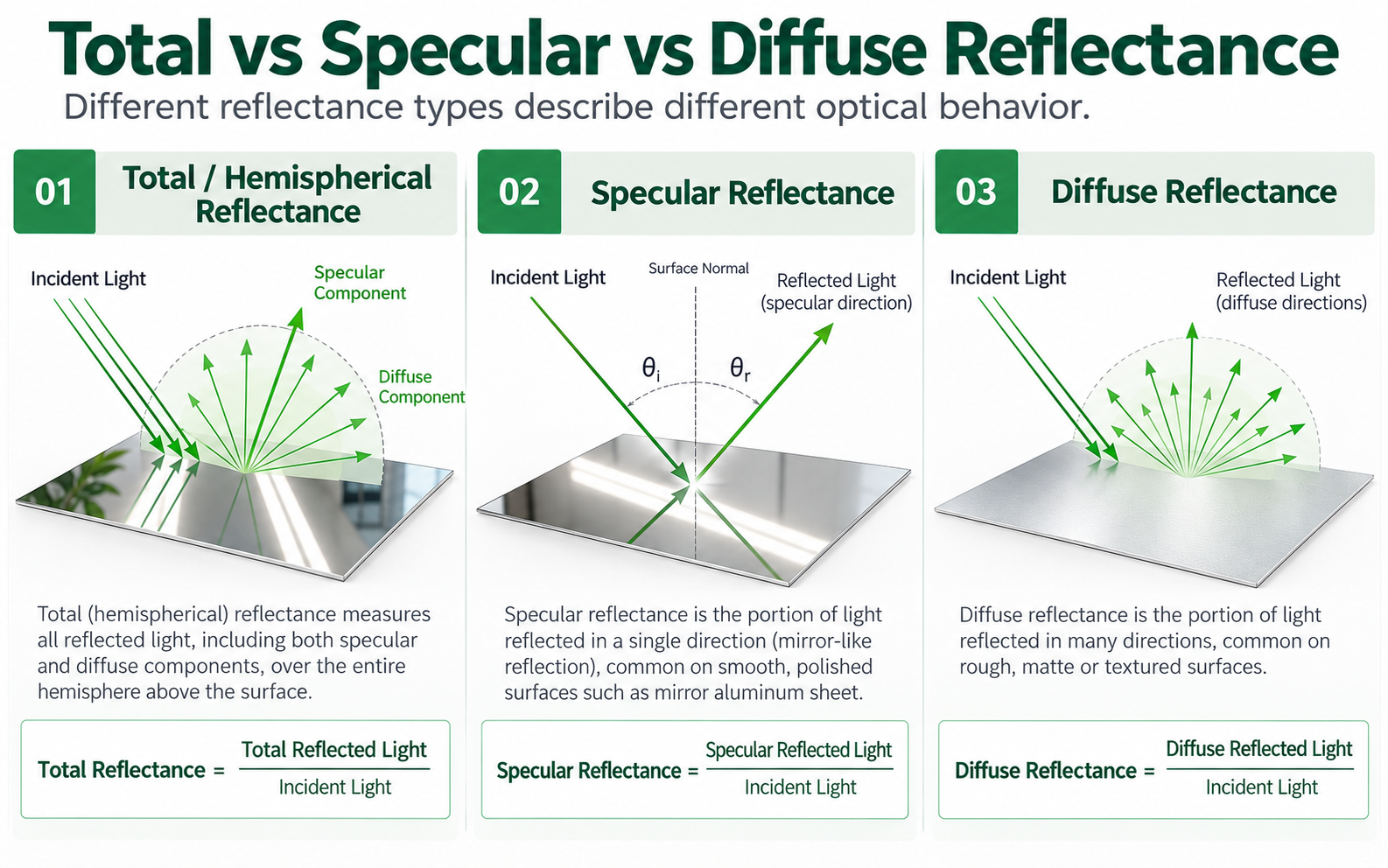
These three terms describe different aspects of reflective performance.
| Optical Property | What It Measures | Why It Matters |
|---|---|---|
| Total / Hemispherical Reflectance | Light reflected in all directions over the measured hemisphere | Useful for evaluating overall reflected energy |
| Specular Reflectance | Light reflected around the mirror direction within a defined acceptance angle | Important for controlled lighting, reflectors and optical applications |
| Diffuse Reflectance | Light scattered away from the specular component | Helps explain why a surface may look less mirror-like |
| Distinctness of Image (DOI) | How clearly reflected objects or image edges appear | Important for decorative mirror finishes and appearance-critical panels |
Total reflectance includes both specular and diffuse components when these components are measured and defined consistently.
A highly polished surface normally produces a more concentrated reflected image than a rough or textured surface. That difference is especially important when the aluminum must direct light rather than simply reflect it.
For comparison, brushed aluminum has a directional surface texture that changes its visual response to incoming light. It should not be evaluated as though it were a conventional mirror finish.
Commercial mirror aluminum products are often marketed using figures such as 85%, 90% or 95%. These numbers are useful starting points, but they are not universal alloy grades or standardized product categories.
Worthwill’s Mirror Finish Aluminum Sheet/Coil product page lists a reflectivity range of 86%–95% across its mirror aluminum offerings. The actual value must be confirmed for the selected finish and measurement method.
An industry example shows why these details matter. ALANOD’s MIRO high reflective 95 product specifies hemispherical solar reflectance of 95% ± 2% and diffuse solar reflectance of 5% ± 2%. Those values relate to that product’s defined construction and measurement conditions, rather than to every mirror-finished aluminum sheet.
Not necessarily.
For a reflector designed to redirect as much light as possible, higher usable reflectance may offer a performance advantage, provided the specular characteristics also meet the optical design.
For an interior wall panel, appliance trim or decorative sign, the difference may be less important than image clarity, color consistency, scratch resistance, formability and cost.
Buyers should also avoid comparing an 85% visible-light reflectance value with a 95% solar-weighted reflectance value as though they represented the same measurement.
The wavelength range, measurement geometry and testing method must be comparable.
The aluminum substrate provides the foundation for the mirror surface.
Commercially pure aluminum grades such as 1050, 1060 and 1100 are commonly used in reflective sheet and coil products because they offer good formability and are suitable for selected surface-finishing processes.
However, alloy designation alone does not determine final reflectivity. Surface preparation, substrate cleanliness, rolling condition and the subsequent finishing process can have a greater influence on the finished optical result.
Substrate flatness also matters. If the sheet is wavy or distorted, reflected images may appear bent even when the surface itself is highly polished.
For more information about the base material, see Worthwill’s 1060 mill finish aluminum sheet and coil.
A mirror appearance is created by controlling surface irregularities so that reflected light remains concentrated around the specular direction.
Mechanical polishing, bright finishing and specialized reflective-surface processing can produce different results.
Fine scratches, polishing marks, rolling lines and microscopic surface irregularities may scatter light. A sheet can therefore appear shiny while producing a slightly blurred reflection.
For appearance-critical applications, visual inspection under consistent lighting is useful alongside instrumental measurements.
Aluminum naturally forms a thin oxide layer when exposed to air. That layer can affect its optical behavior and helps protect the underlying metal.
Commercial mirror aluminum can also use anodizing, transparent protective treatments or specialized deposited reflective coatings.
These treatments serve different purposes:
Polished aluminum provides a bright metal surface, but its long-term appearance depends on the finishing system and service environment.
Anodized mirror aluminum uses a controlled oxide layer that can improve surface protection when properly specified.
Specialized reflective coatings may be engineered to achieve higher reflectance, improved optical consistency or application-specific performance.
Anodizing does not automatically increase reflectivity. Depending on the treatment, oxide thickness and optical construction, it can alter both total and specular reflection.
For a broader explanation of anodized surfaces, see Anodized Aluminum Sheet & Coil.
Aluminum reflectivity is not a single fixed value under every lighting condition.
The measured result can change according to wavelength, incidence angle and the instrument’s collection geometry.
Visible-light performance is especially important for decorative panels and lighting applications. Solar applications may require a measurement covering a much wider spectral range, including wavelengths outside the visible spectrum.
A supplier quoting 95% reflectivity without identifying the measurement conditions leaves an important question unanswered.
For optical applications, the buyer should request the relevant spectral range, test geometry and reflectance type.
Reflective surfaces make minor defects easy to notice.
Handling scratches, fingerprints, polishing residue, dust and cleaning marks may affect reflected-image clarity and, depending on their severity, the measured optical performance.
Protective film can help reduce damage during cutting, transportation and installation, but the film itself is not part of the final reflective surface unless the product is specifically designed that way.
For bulk orders, buyers should confirm the protected side, film type, storage conditions and removal requirements.
Cleaning should follow the approved surface-treatment guidance. Abrasive materials or unsuitable chemicals may damage the reflective finish.
A mirror aluminum coil may leave the finishing line with a consistent reflective surface, but subsequent fabrication still matters.
Leveling, cutting, bending, stamping and handling can introduce scratches or alter panel flatness. Tight bending can also challenge certain coatings or surface treatments.
For architectural installations, neighboring panels should be checked for consistent appearance, especially where reflections make waviness or orientation differences visible.
Outdoor service introduces additional concerns, including moisture, pollution, UV exposure and cleaning conditions. A high initial reflectance value does not establish outdoor durability.
Weathering performance must be confirmed for the specific finish and exposure environment.
A reliable reflectivity specification should state not only the result, but also how it was obtained.
One relevant method is ASTM E903, which describes measuring spectral optical properties using integrating spheres and calculating solar-weighted properties. It can be applied to materials with both specular and diffuse reflection.
Where the clarity of a reflected image is important, ASTM E430 provides methods for evaluating certain high-gloss reflection characteristics, including distinctness-of-image properties.
A conventional gloss reading is not a substitute for a reflectance measurement. In particular, ASTM D523 addresses specular gloss measurement of nonmetallic specimens, so its gloss-unit values should not be presented as aluminum reflectivity percentages.
For application-critical orders, request the following information:
Reflectance type: total, hemispherical, specular or diffuse.
Spectral range: visible, solar-weighted or application-specific wavelengths.
Measurement geometry: incidence angle and, for specular testing, acceptance angle.
Sample identification: product grade, surface treatment, batch and tested side.
Test conditions: method or instrument, relevant calibration and sample condition.
Acceptance requirement: agreed minimum value, tolerance or approved reference sample.
If a project requires a certified laboratory report or third-party verification, that requirement should be agreed before production.
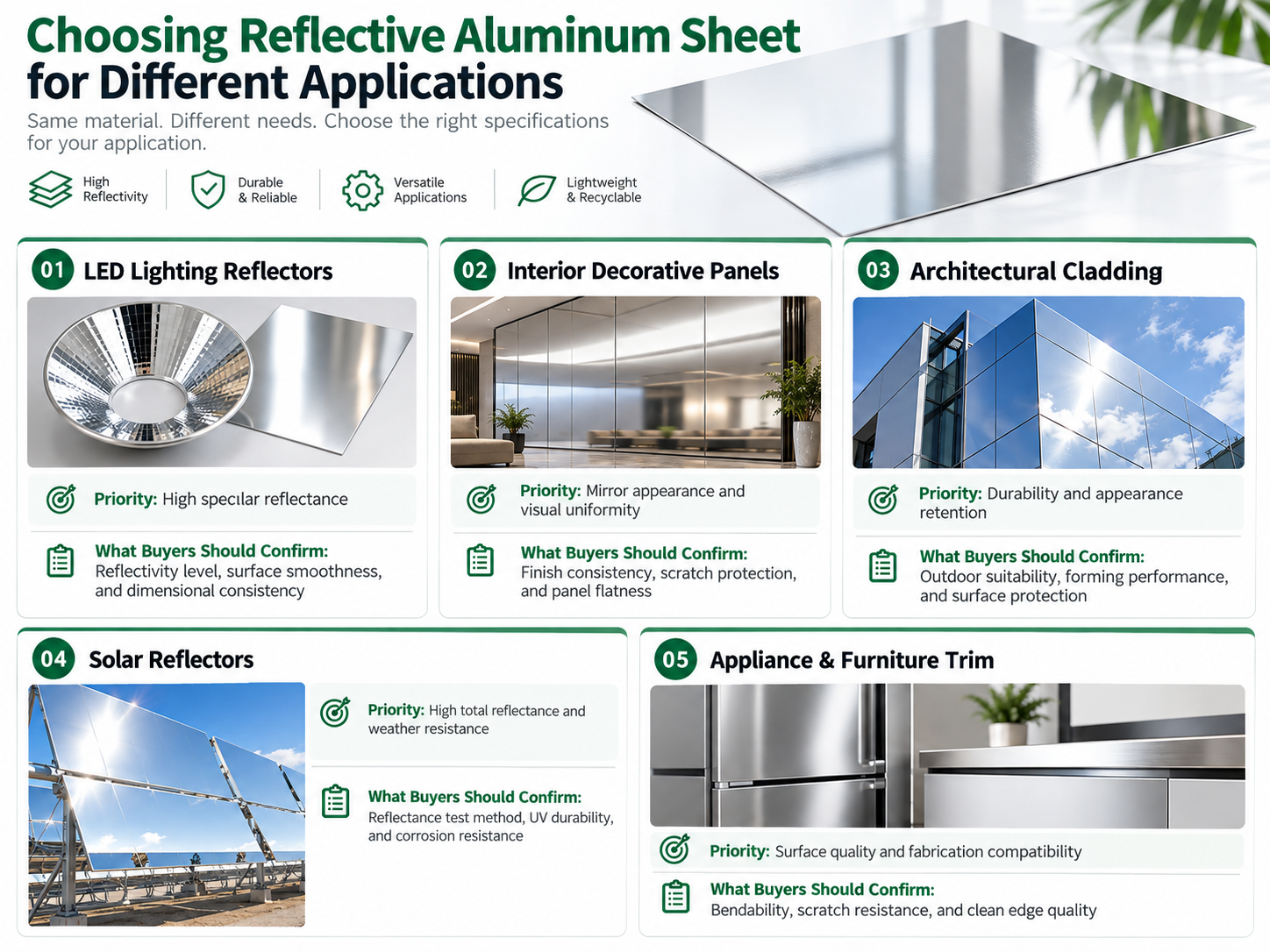
Different applications place different demands on the reflective surface.
| Application | Main Performance Priority | What Buyers Should Confirm |
|---|---|---|
| LED lighting reflectors | Suitable visible-light reflectance and controlled light direction | Optical test data, specular performance, forming requirements |
| Interior decorative panels | Mirror clarity, uniform appearance and surface protection | Approved visual sample, flatness, scratches, protective film |
| Architectural cladding | Appearance consistency and resistance to the intended environment | Coating system, outdoor suitability, panel flatness, cleaning requirements |
| Solar reflectors | Relevant solar-weighted and specular reflectance | Spectral test report, incidence/acceptance angles, weathering performance |
| Appliance and furniture trim | Decorative finish, fabrication quality and surface durability | Alloy, temper, bendability, handling protection, approved sample |
For decorative applications, the material with the highest advertised reflectivity is not automatically the most suitable choice.
A well-controlled mirror finish with consistent panel appearance may be preferable to a nominally higher reflectance grade that has not been evaluated for the actual fabrication process.
Mirror aluminum sheet and mirror aluminum coil can be produced with comparable reflective surface systems.
The product form does not independently determine reflectivity. The more important variables are the surface treatment, material condition and processing history.
Sheet is often convenient for precut decorative panels, sign components and finished blanks. Coil is useful for continuous processing, slitting and cut-to-length production.
Worthwill’s published mirror aluminum product range includes 1050, 1060 and 1100 alloy options, commonly specified H24 or agreed tempers, and a listed base-material size range of 0.25–3.0 mm thickness and 30–1550 mm width. Actual combinations and reflective finishes require confirmation.
For either sheet or coil, buyers should evaluate surface uniformity after the intended fabrication process—not only before cutting or forming.
One common mistake is specifying only “95% mirror aluminum” without defining what the percentage measures.
Another is choosing a mirror finish solely from a product photograph. Photos are affected by lighting, camera exposure and the objects reflected in the sheet.
It is also risky to assume that every anodized surface is more reflective, or that high initial reflectivity guarantees suitable outdoor performance.
For repeated production, an approved sample and a clearly written inspection requirement usually provide a more reliable purchasing reference than a finish name alone.
Commercial mirror aluminum products may be offered with reflectivity figures around 85%–95%, depending on the finish and supplier. Worthwill currently lists 86%–95% across its mirror aluminum range. These figures should not be treated as interchangeable unless the measurement conditions are the same.
Yes, certain engineered reflective aluminum surfaces can reach approximately 95% under specified testing conditions. The value must be verified for the actual product rather than assumed from its polished appearance.
Not always. Anodizing changes the surface construction and may provide protective benefits, but the final reflectance depends on the complete treatment system. Compare test data for the finished products.
Surface texture, fine scratches, polishing irregularities and panel distortion can reduce reflected-image clarity. A glossy appearance alone does not guarantee sharp specular reflection.
Some mirror-finished aluminum systems may be suitable for outdoor applications, but suitability depends on the coating, corrosion resistance, weathering performance and exposure conditions. It should not be assumed from reflectivity alone.
Thickness is not normally the primary factor controlling the optical reflectance of an opaque mirror surface. However, thickness, temper and flatness can affect rigidity, fabrication and the appearance of reflected images.
Mirror aluminum sheet reflectivity is determined by more than how shiny the surface looks. The finishing process, optical coating, surface smoothness, testing method and handling conditions all influence the final result.
For lighting and optical components, measured reflectance and light-direction performance deserve particular attention. For decorative and architectural applications, surface uniformity, image clarity, fabrication quality and durability may be just as important.
Henan Worthwill Industry Co., Ltd. supplies mirror finish aluminum sheet and coil for decorative and industrial processing requirements. Explore our Mirror Finish Aluminum Sheet/Coil range or send your application, target reflectivity, alloy, thickness, width, quantity and surface-treatment requirements for specification review.