


Two aluminum honeycomb cores can look almost identical but behave differently under load. One may use smaller hexagonal cells, while the other uses thicker aluminum foil. Both changes affect the amount of metal in the core, but they do not necessarily produce the same mechanical performance.
Choosing the right aluminum honeycomb core means looking beyond a single specification. Cell size, foil thickness, core density, alloy and the intended loading conditions all need to be considered together.
This guide explains how these factors work and what to check before placing an order. For available materials and dimensions, see Worthwill’s Aluminum Honeycomb Core product page.
Neither parameter is automatically more important. They affect the honeycomb structure in different ways.
For a lightweight sandwich panel, the best choice is not necessarily the smallest cell or thickest foil. The core must provide enough support for the facing sheets without adding unnecessary weight.
Cell size is one of the most frequently misunderstood specifications in aluminum honeycomb core purchasing.
Some manufacturers describe cell size using the distance across opposite parallel walls. Others provide the length of one hexagonal cell side. These measurements are related, but they are not the same.
Worthwill’s current aluminum honeycomb core specifications use cell side length (a), with available listed values from 0.5 mm to 15 mm.
For an ideal regular hexagonal cell:D = √3 × a ≈ 1.732 × a
Where:
The following examples show how cell side length translates into theoretical across-flats diameter.
| Cell side length (a) | Theoretical across-flats diameter (D) |
|---|---|
| 3 mm | 5.20 mm |
| 4 mm | 6.93 mm |
| 6 mm | 10.39 mm |
| 8 mm | 13.86 mm |
These are calculated dimensions for ideal regular hexagons, not guaranteed manufacturing measurements. Actual dimensions can vary with expansion, cell geometry and production tolerances.
When comparing quotations from different aluminum honeycomb core suppliers, always confirm which cell-size measurement is being used. A drawing with dimension arrows can prevent a costly misunderstanding.

Aluminum foil thickness determines how much metal is used in each cell wall.
Worthwill’s aluminum honeycomb core range includes the following foil thickness specifications:
0.025, 0.03, 0.04, 0.05, 0.06, 0.07 and 0.10 mm.
These values describe the foil material, not the overall thickness or depth of the honeycomb core. Core thickness is a separate dimension measured through the depth of the cells.
For example, compare two cores with the same cell geometry and aluminum alloy, but different foil thicknesses:
This does not mean the finished core will be exactly 50% denser or 50% stronger. Bonded cell walls, adhesive content, expansion geometry and the failure mechanism all affect the result.
Thicker foil can help the cell walls resist local instability, but actual compressive or shear strength needs to be supported by appropriate test data.
The connection between cell size, foil thickness and core performance becomes easier to understand when density, compression and shear are considered separately.
Aluminum honeycomb core density is the mass of the expanded core divided by its external volume, usually expressed in kg/m³.
For comparable ideal hexagonal geometries, the proportion of solid wall material increases approximately with the ratio of foil thickness to cell side length, t/a.
This gives two useful general relationships:
Consider three illustrative configurations:
| Configuration | Cell side length | Foil thickness | Nominal t/a ratio |
|---|---|---|---|
| A | 6 mm | 0.05 mm | 0.0083 |
| B | 3 mm | 0.05 mm | 0.0167 |
| C | 6 mm | 0.10 mm | 0.0167 |
Configurations B and C each have approximately twice the nominal t/a ratio of Configuration A. However, this does not mean they will have identical density or strength.
Real expanded honeycomb includes bonded nodes, manufacturing variations and other details not represented by this simple ratio. The examples are for comparing geometry, not published Worthwill density or strength test results.

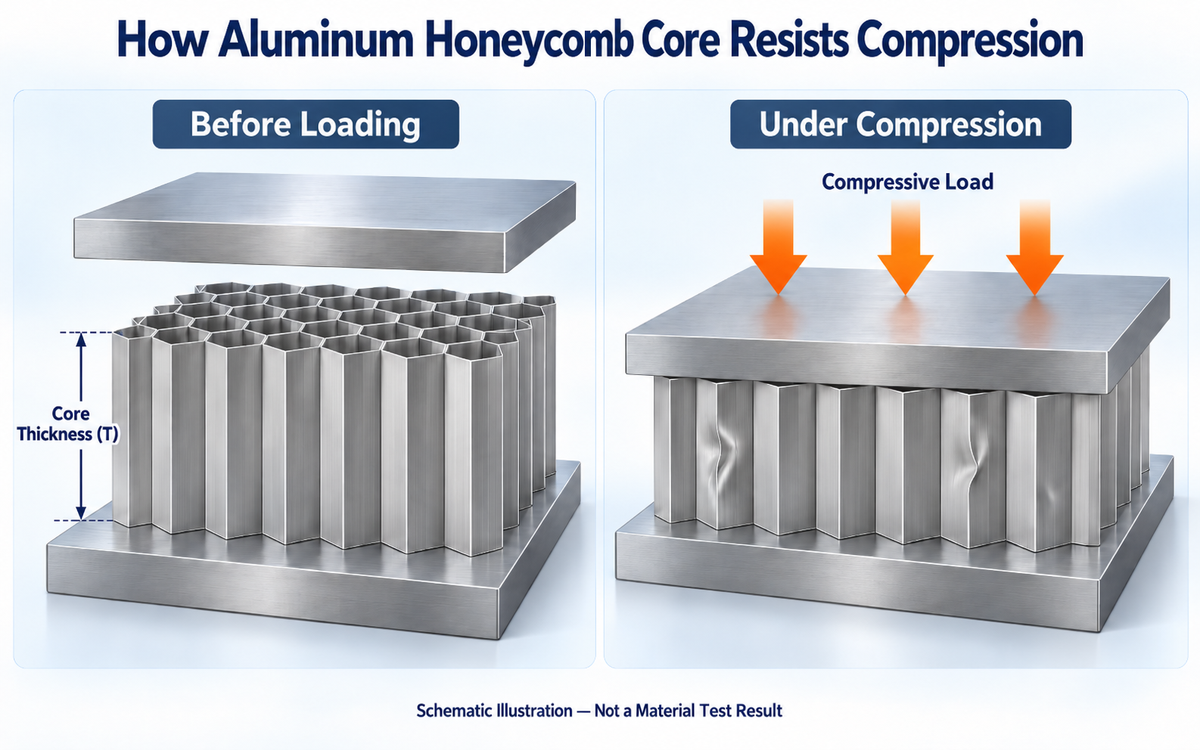
Compressive strength describes how a honeycomb core resists loading, commonly applied through its thickness.
Under compression, aluminum cell walls may bend, buckle or progressively collapse. Cell size, foil thickness, alloy properties, bonding and imperfections all influence this behavior.
A smaller-cell or thicker-foil core may carry greater compressive loads under comparable conditions, but it is not possible to calculate reliable compressive strength from those two specifications alone.
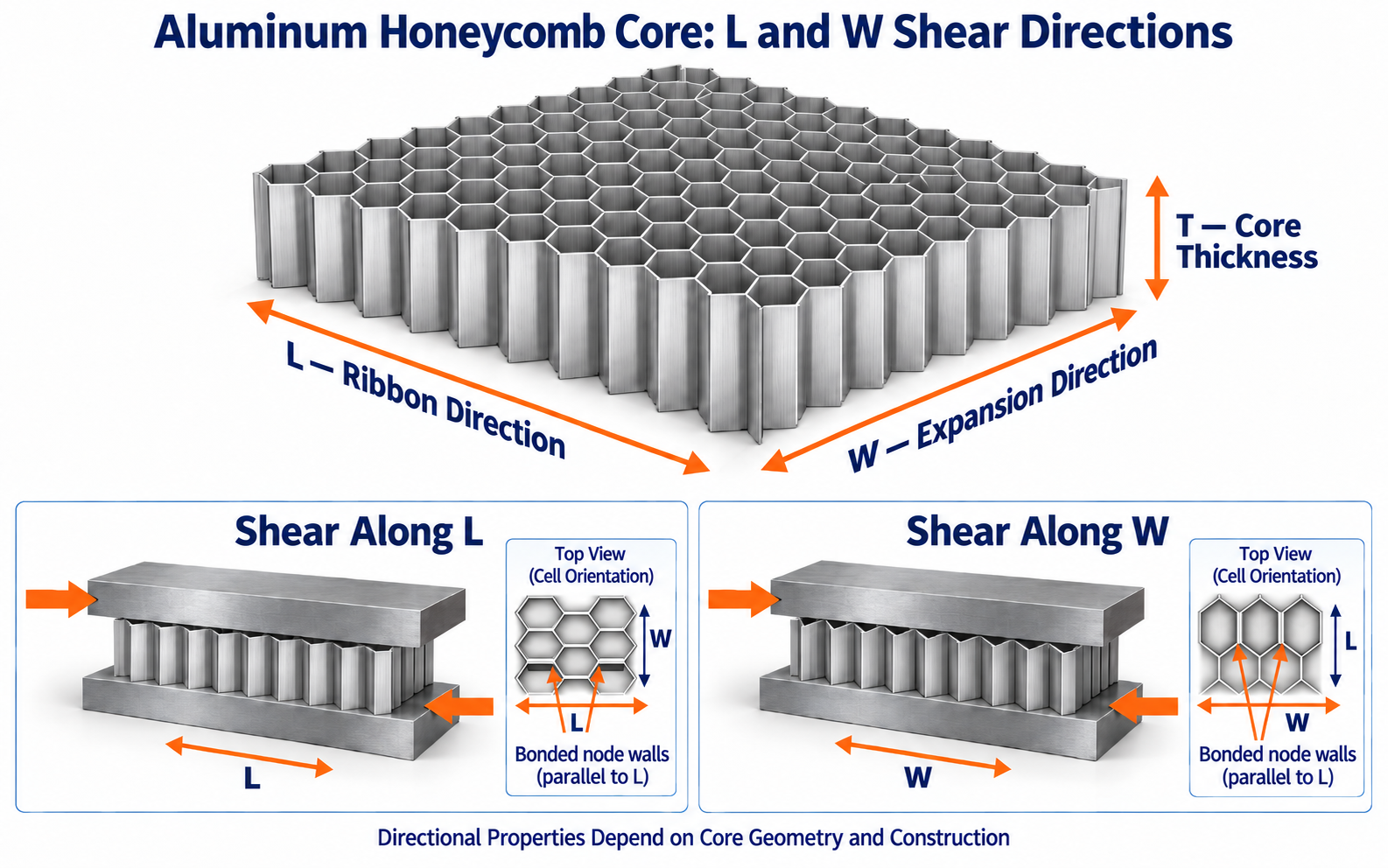
Shear loading causes the core to resist deformation parallel to the panel faces.
For expanded aluminum honeycomb, shear behavior can differ between the ribbon direction (L) and transverse direction (W). The cell geometry and manufacturing process therefore matter alongside the nominal foil thickness.
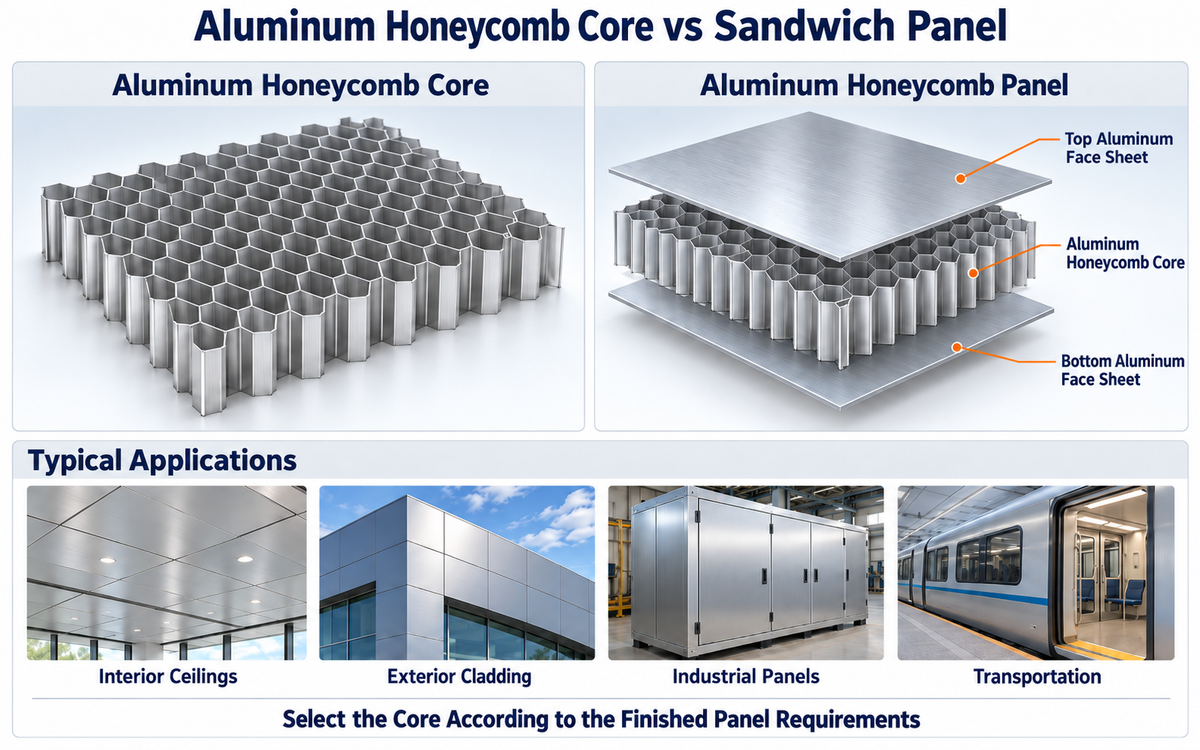
When a honeycomb core is used inside a sandwich panel, the face sheets, core thickness, bonding system and support arrangement also influence the finished panel’s behavior.
The important distinction is that core compressive strength, core shear strength and finished-panel bending stiffness are different performance measures.
The table below summarizes the general trade-offs when comparing otherwise similar aluminum honeycomb core configurations.
| Specification change | General effect | Main consideration |
|---|---|---|
| Smaller cell size, same foil thickness | Usually increases wall material per unit volume and may improve certain load-bearing properties | More weight and material consumption |
| Larger cell size, same foil thickness | Usually reduces apparent density | Reduced local support may be a concern |
| Thicker foil, same cell size | Generally increases density and may improve resistance to crushing or buckling | Higher weight and material cost |
| Thinner foil, same cell size | Generally reduces core weight | Lower resistance under some loading conditions |
These relationships are useful for initial selection. They are not substitutes for verified density figures, mechanical test reports or an engineering assessment of the final assembly.
The right configuration depends on how the finished component will be used.
1. Architectural Ceilings and Interior Panels
For ceilings, partitions and decorative interior panels, low weight and adequate facing-sheet support are often important.
A lighter honeycomb core may be suitable where loads are limited. However, the cell size should also be reviewed against face-sheet thickness, flatness requirements and local indentation risks.
2. Curtain Walls and Exterior Cladding
Exterior applications require additional attention to wind loading, fastening details, environmental exposure and long-term panel performance.
Smaller cells or thicker foil should not be selected as a substitute for structural design verification. The complete Aluminum Honeycomb Panel, including its face sheets and bonding system, must be evaluated.
3. Industrial Panels and Equipment Components
Equipment covers, lightweight platforms and machinery panels may have localized loads, repeated handling or specific stiffness requirements.
The appropriate combination of cell geometry, foil thickness and core depth depends on the load direction, panel span and connection design.
4. Transportation and Lightweight Structures
Transportation components often require a balance between weight reduction and mechanical durability.
Cell size and foil thickness should be selected according to the loading conditions and finished-component requirements. Where mandatory performance standards apply, compliance must be verified separately.
Worthwill supplies aluminum honeycomb core made with 3003-H18 and 5052-H18 alloy foil. The choice between these materials also depends on the required mechanical properties, environmental conditions and project specifications.
For an accurate aluminum honeycomb core quotation, provide more than a general cell-size requirement.
A useful RFQ should include:
If you are specifying a complete sandwich panel rather than just the core, the face sheets, adhesive, total thickness and fabrication details must also be considered. Worthwill’s Aluminum Honeycomb Panel Specification Checklist explains those additional requirements.
Is smaller aluminum honeycomb cell size always stronger?
Not always. Smaller cells generally increase the number of cell walls in a given area, but actual strength also depends on foil thickness, alloy, bonding quality and loading direction. Two different honeycomb constructions can have similar density but different mechanical performance.
Does thicker aluminum foil always mean higher honeycomb core density?
When other factors remain comparable, thicker foil generally increases core density. However, the exact density cannot be determined from foil thickness alone. Cell geometry, bonded nodes and expansion conditions must also be considered.
Is foil thickness the same as honeycomb core thickness?
No. Foil thickness is the thickness of the aluminum material forming the cell walls, often measured in hundredths of a millimeter. Core thickness is the overall depth of the honeycomb structure and is specified separately.
Cell size and foil thickness work together, but they are not interchangeable.
Smaller cells generally increase the amount of cell-wall material per unit volume. Thicker foil increases the amount of metal in each wall. Both can influence density and mechanical behavior, but neither parameter alone determines the performance of the finished honeycomb core or sandwich panel.
For purchasing and design, start with the required weight, loading conditions, core dimensions and finished-panel construction. Then compare the cell geometry and foil thickness needed to meet those requirements.
Explore Worthwill’s Aluminum Honeycomb Core specifications or send your drawings and application requirements for a project-specific quotation.