

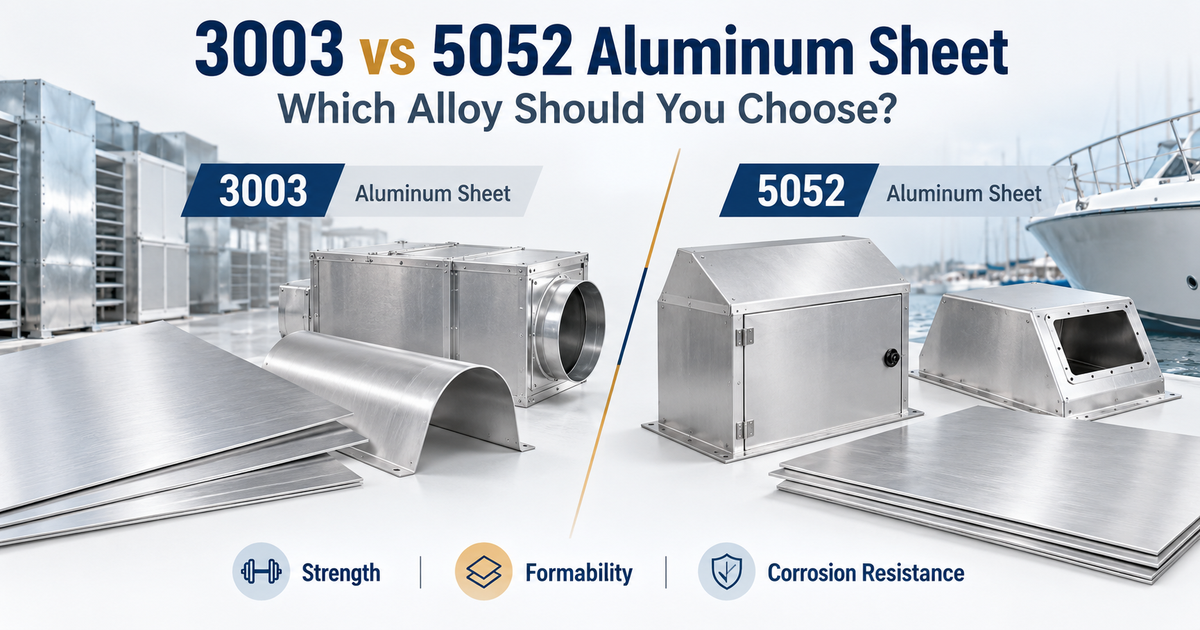
Choosing between 3003 and 5052 aluminum sheet is not simply a question of which alloy is stronger. Both are non-heat-treatable, corrosion-resistant aluminum alloys, but they behave differently during bending, forming and service. The right choice depends on the part you are making and the conditions it will face.
Short answer: Choose 3003 aluminum sheet for general fabrication, easier forming and cost-sensitive parts. Choose 5052 aluminum sheet when higher strength, better resistance to salt exposure or more demanding service is required. Before ordering, compare the actual tempers, not just the alloy numbers.
| Feature | 3003 Aluminum Sheet | 5052 Aluminum Sheet |
|---|---|---|
| Alloy family | 3xxx aluminum-manganese (Al-Mn) | 5xxx aluminum-magnesium (Al-Mg) |
| Typical sheet temper | H14 or H24; O for substantial forming | H32 or H34; O for substantial forming |
| Strength | Moderate; suitable for many formed sheet-metal parts | Higher in commonly compared tempers |
| Formability | Very good; particularly in softer tempers | Good; bend radius and springback need attention |
| Corrosion resistance | Good in normal atmospheric environments | Generally preferred for salt-laden and marine-related exposure |
| Weldability | Good with a qualified process | Good with a qualified process |
| Cost position | Often the lower-cost choice | Often higher material cost; verify current quotations |
| Common uses | HVAC parts, cookware components, covers, trim | Marine-related parts, tanks, enclosures, vehicle components |
Neither alloy is universally better. For a lightly loaded indoor enclosure, paying more for 5052 may bring little benefit. For a salt-exposed equipment housing, 3003 may not provide the same margin of corrosion resistance or strength. See Worthwill’s 3003 mill finish aluminum and 5052 mill finish aluminum product pages for supply options.
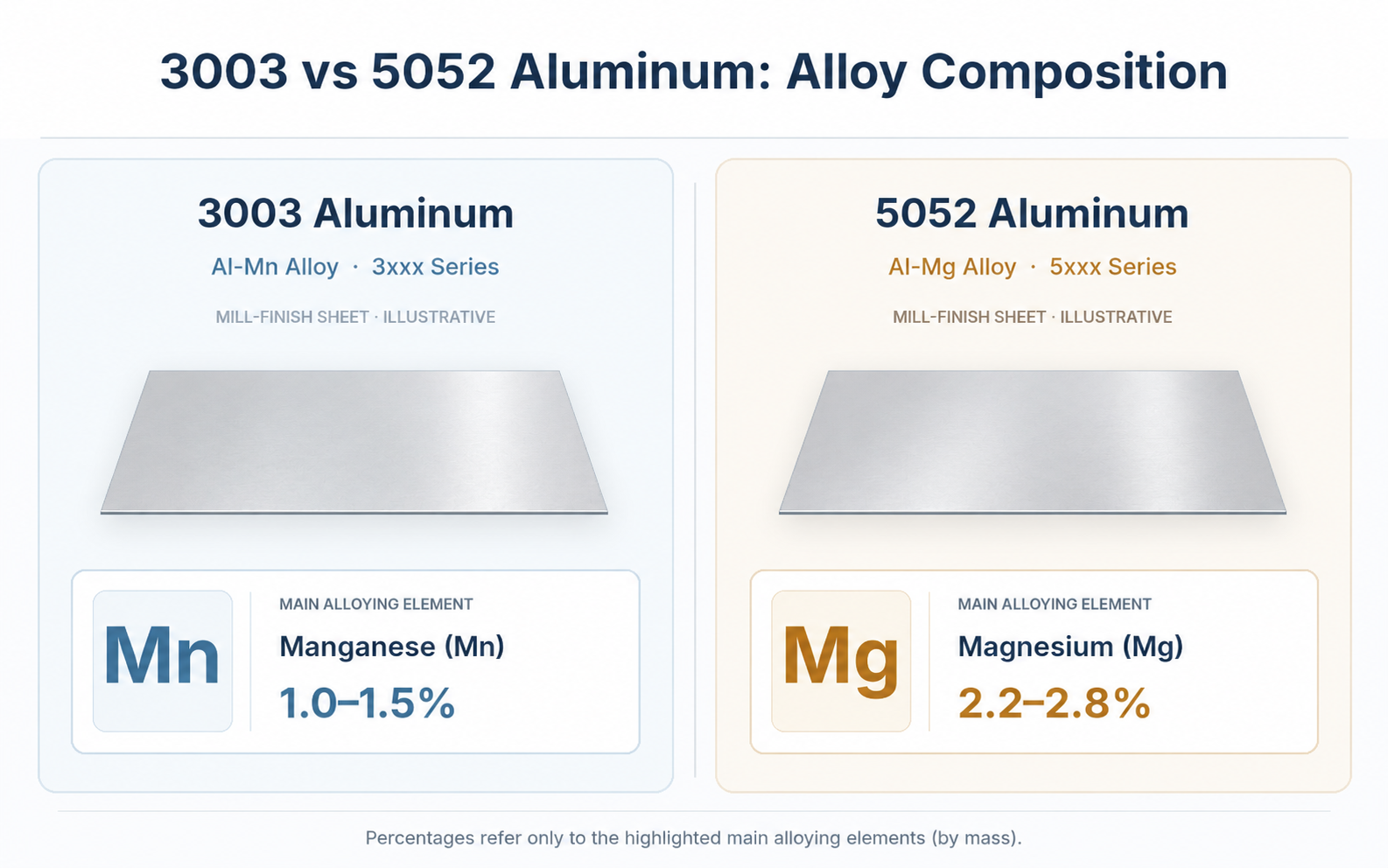
The main difference starts with chemical composition. 3003 is an aluminum-manganese alloy, typically containing 1.0–1.5% manganese and a small copper addition. 5052 is an aluminum-magnesium alloy, typically containing 2.2–2.8% magnesium together with chromium. These additions change the balance of strength, workability and corrosion behavior.
Both alloys gain strength mainly through cold working rather than precipitation heat treatment. This is why a designation such as 3003-H14 or 5052-H32 is more useful to a fabricator than the alloy number alone. The temper describes the supplied material condition, which affects forming and mechanical performance.
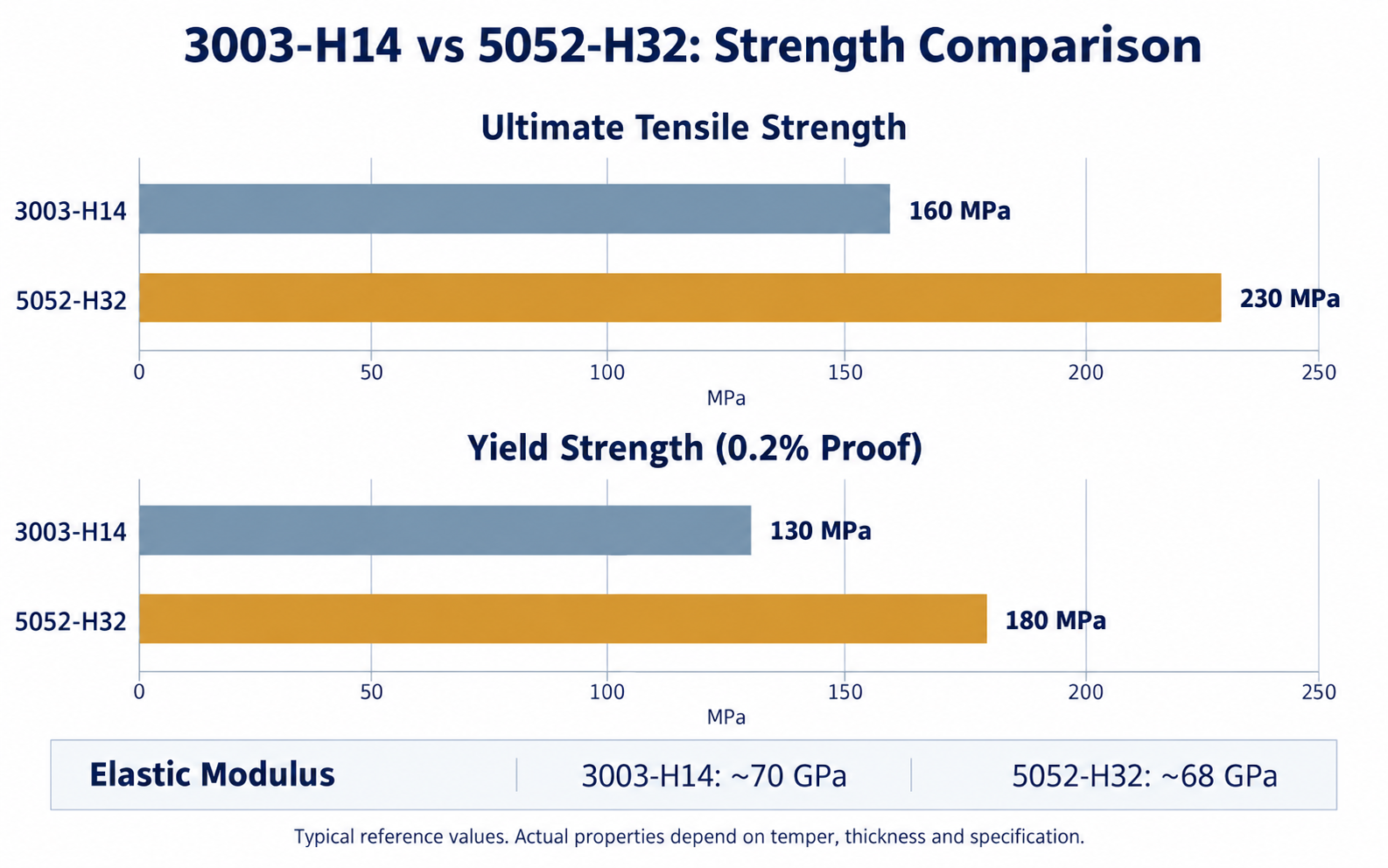
For a practical sheet-metal comparison, 3003-H14 and 5052-H32 are commonly used reference conditions. The figures below are approximate typical property values, not guaranteed minimums for every thickness or production lot.
| Mechanical property | 3003-H14 | 5052-H32 |
|---|---|---|
| Ultimate tensile strength | About 160 MPa | About 230 MPa |
| Yield strength (0.2% proof) | About 130 MPa | About 180 MPa |
| Brinell hardness | About 42 HB | About 60 HB |
| Elastic modulus | About 70 GPa | About 68 GPa |
On these reference values, 5052-H32 has roughly 44% higher ultimate tensile strength. That does not mean a finished 5052 panel is automatically 44% stiffer. Elastic modulus is similar for both alloys; panel stiffness also depends strongly on thickness, shape, ribs and support spacing.
Actual guaranteed tensile properties and elongation depend on the ordered temper, gauge and specification. For purchasing or engineering acceptance, use the applicable standard and material test certificate rather than treating these reference values as universal guarantees. Technical references include the 3003-H14/5052-H32 property comparison and the scope of ASTM B209/B209M.
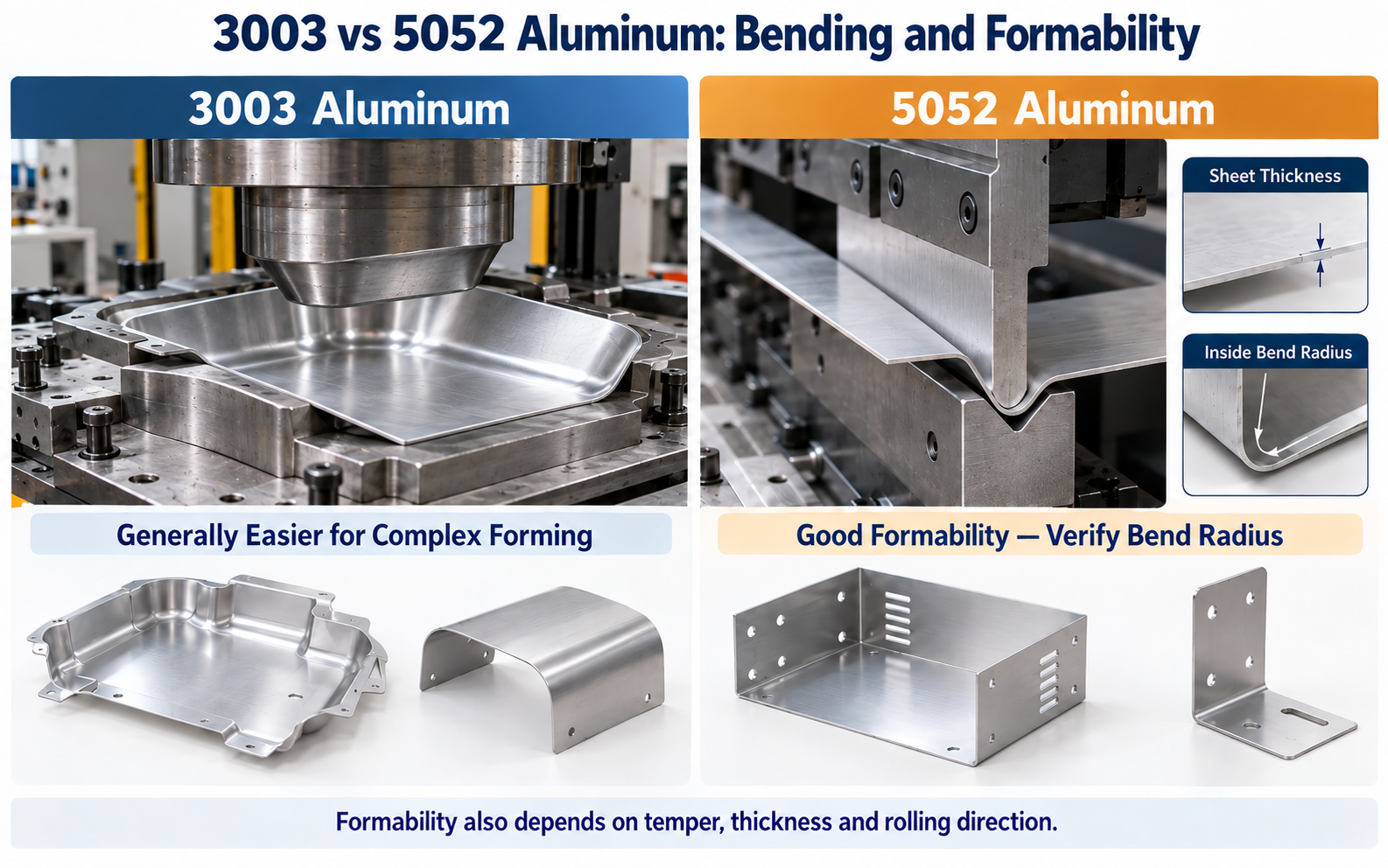
3003 is generally the easier starting point for deep drawing, spinning and intricate formed parts, especially in an annealed or suitably soft temper. Its combination of workability and moderate strength is useful in everyday sheet-metal fabrication.
5052 can also be bent, stamped and formed successfully. However, harder 5052 tempers may need a larger inside bend radius, appropriate tooling and more allowance for springback. A tight bend that works on 3003-H14 should not automatically be copied to 5052-H32 without checking the forming conditions.
For deep or complex shapes: Start by checking 3003-O or another suitable forming temper, then verify strength after fabrication.
For bent covers and brackets: Compare 3003-H14 with 5052-H32 based on load, bend radius, thickness and grain direction.
For repeat production: Test the actual material and tooling before approving an alloy or temper change.
Bending performance is not determined by alloy alone. Thickness, rolling direction, edge quality, forming speed and part geometry all matter.
Both 3003 and 5052 resist corrosion well in many ordinary environments. 3003 is a practical choice for roofing accessories, ventilation parts, indoor equipment and other general applications with normal atmospheric exposure.
For coastal locations, salt spray or marine-related equipment, 5052 is generally the safer material to evaluate first. Its magnesium-containing composition offers a useful corrosion-resistance advantage in demanding service. This does not mean every 5052 sheet is automatically suitable for permanent seawater immersion or every marine structure; exposure conditions, joint design and relevant standards still need review.
Corrosion performance also depends on surface finish, drainage, contact with dissimilar metals, fasteners and any coating system. For architectural work, select the substrate and surface treatment together. Worthwill also supplies color coated aluminum sheet and coil for suitable coated applications.
Both alloys are commonly welded and fabricated using appropriate procedures. The finished joint must be evaluated for its required strength, sealing and corrosion performance. On strain-hardened sheet, welding can soften the heat-affected zone, so design calculations should not simply use the unwelded H-temper strength at the weld.
Both alloys can be cut, punched and formed. For decorative surfaces, do not assume the same anodized color, brightness or appearance on the two alloys. Agree on a reference sample if visual consistency matters. For projects involving perforated aluminum sheet, consider hole pattern, remaining metal, edge distance and bending after perforation as well as the base alloy.
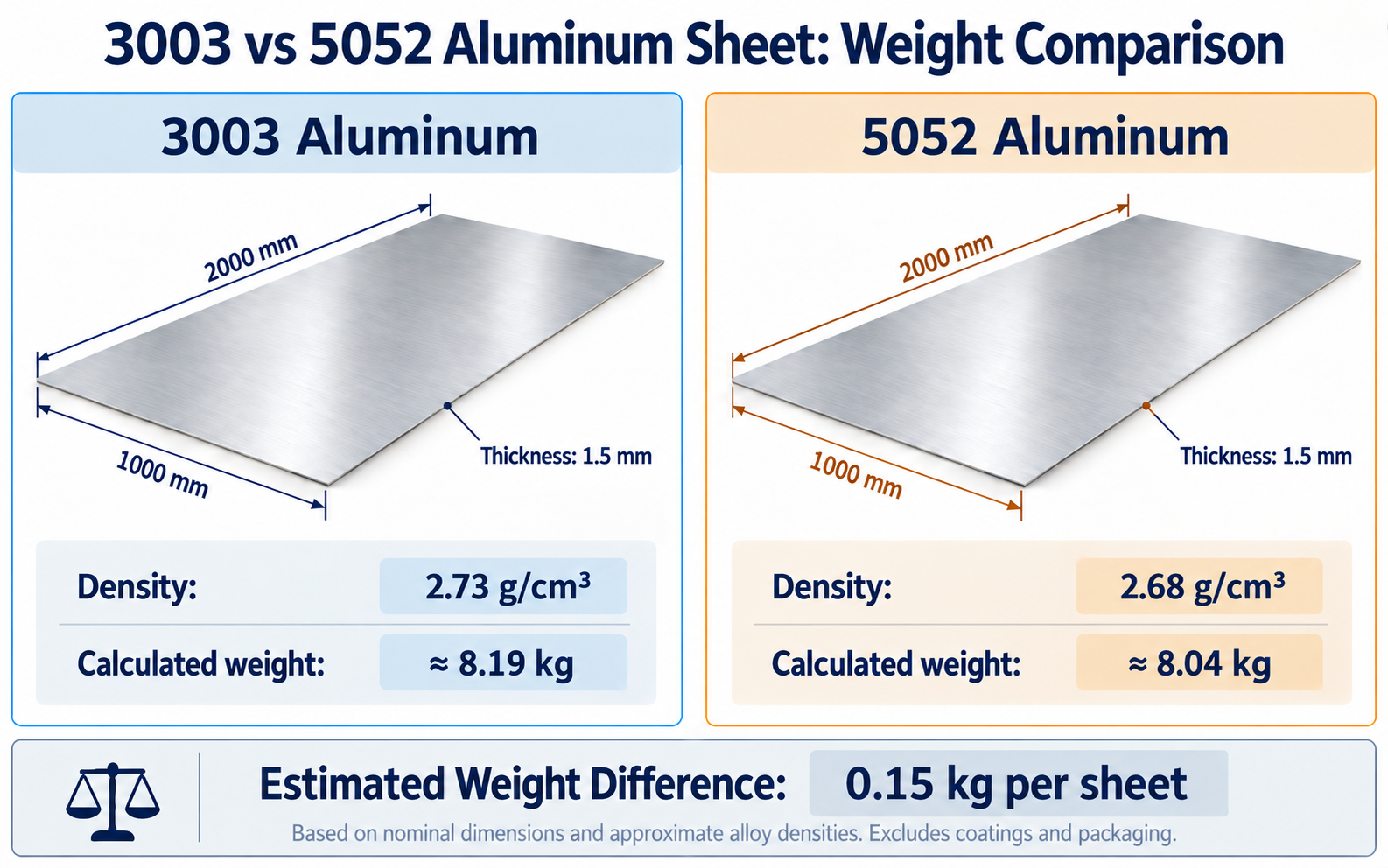
5052 is slightly less dense than 3003. For a simple estimate, use approximately 2.73 g/cm³ for 3003 and 2.68 g/cm³ for 5052. At the same dimensions, this creates only a small sheet-weight difference.
For example, a 1.5 mm × 1000 mm × 2000 mm flat sheet has a volume of 0.003 m³. Its estimated weight is about 8.19 kg in 3003 or 8.04 kg in 5052, excluding packaging and any added coating. This is an illustration, not a mill-certified shipping weight.
In most projects, thickness and finished-part design affect weight much more than this small density difference.
3003 sheet is often more economical to purchase, while 5052 commonly carries a higher material premium. There is no reliable fixed percentage that applies to every order. Aluminum market price, alloy surcharge, temper, thickness, width, quantity, processing and delivery requirements all affect the quotation.
Compare the cost of the finished component, not just the price per metric ton. A lower-cost sheet may lose its advantage if it needs additional reinforcement, more forming trials or a protective system. Equally, specifying 5052 where 3003 already meets the design can add unnecessary cost.
| Application | Practical starting choice | What to confirm |
|---|---|---|
| HVAC ducts and ordinary equipment covers | 3003 | Temper, forming depth and corrosion exposure |
| Cookware and spun or drawn components | 3003 | Formability, surface requirements and food-contact rules |
| Indoor cabinets and lightly loaded panels | 3003 or 5052 | Load, bend radius and total fabrication cost |
| Marine-related housings and salt-exposed parts | 5052 | Actual exposure, joints, coating and applicable standard |
| Vehicle panels, tanks and industrial enclosures | 5052 where extra strength is needed | Loads, weld-zone strength and inspection requirements |
| Perforated screens or formed architectural panels | 3003 or 5052 | Open area, panel span, environment and finish |
These are selection starting points, not universal engineering approvals. The final alloy and temper must match the part drawing, applicable specification and intended service.
For an accurate quotation and a consistent production batch, send the following details rather than only writing “3003 sheet” or “5052 sheet”:
Alloy and temper: For example, 3003-H14, 3003-O or 5052-H32. Do not treat different H tempers as automatic substitutes.
Form and size: Sheet, plate or coil; thickness × width × length for flat sheets, or thickness × width and coil requirements for rolled material.
Fabrication: State whether the sheet will be bent, deep drawn, welded, punched, anodized or coated; provide drawings for demanding parts.
Surface and tolerances: Confirm mill finish, flatness, edge condition, protective film and any appearance requirements.
Standards and inspection: Specify ASTM B209/B209M or applicable EN material and dimensional standards, the required certificates and any project-specific tests.
Quantity and destination: Include total weight, shipment destination and delivery requirements so the offer matches the order.
Worthwill supplies aluminum sheet, plate and coil subject to the ordered alloy, temper, size and available production route. For these products, the general bulk-order MOQ is approximately 3 metric tons, subject to specification and confirmation. You can review the wider mill finish aluminum range or contact Worthwill with your drawing or purchase specification.
Generally, yes. In common sheet tempers such as 3003-H14 and 5052-H32, 5052 typically has higher tensile and yield strength. Check the specific temper, thickness and certified properties before substituting one grade for the other.
Sometimes, for general formed parts without demanding strength or salt-exposure requirements. Do not substitute it for a specified marine, welded or load-carrying component without design and material approval.
No, it is widely used for bent sheet-metal parts. It can, however, require different bend radii or tooling settings from 3003-H14. Confirm the required inside radius and rolling direction by trial or fabrication guidance.
3003 may be sufficient for normal outdoor conditions. If the enclosure faces coastal salt, heavier loads or demanding industrial exposure, evaluate 5052 together with the enclosure design, surface finish and fasteners.
Choose 3003 aluminum sheet when your priorities are easy forming, reliable general-purpose corrosion resistance and competitive fabrication cost. Choose 5052 aluminum sheet when your priorities are increased strength and improved resistance to salt-exposed service. The correct decision comes from matching alloy, temper, thickness, fabrication process and environment—not from a grade name alone.
For a quotation, send Worthwill your intended use, drawings if available, alloy/temper, dimensions, quantity and destination. We can review the requested 3003 aluminum sheet or 5052 aluminum sheet against the supply specification.
