

Two perforated aluminum sheets can have the same hole diameter and still have different open areas. The reason is simple: hole spacing and arrangement matter just as much as hole size. This is important when you are buying perforated aluminum for ventilation, architectural screens, ceilings or equipment guards.
Open area is a useful starting point, but it does not tell the whole story. A panel with 40% open area does not automatically deliver 40% of an unrestricted airflow rate, and a higher percentage is not always the better design.
This guide explains the common perforated metal open area formulas, works through actual dimensions and shows what to check before choosing a pattern. For available alloys, dimensions and surface finishes, see Worthwill’s Perforated Aluminum Sheet, Plate & Panel product page.
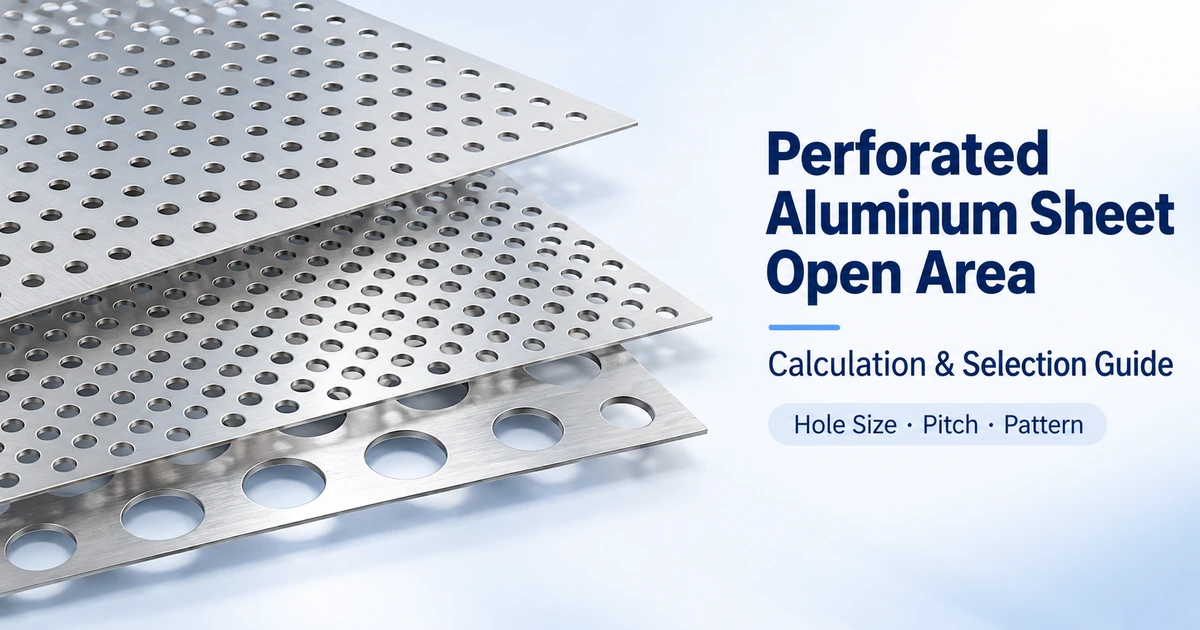
Open area is the percentage of a specified sheet surface occupied by holes. For a regular pattern, calculate the area of one opening, divide it by the area of its repeating pattern cell and multiply by 100.
Open Area (%) = Hole Area / Repeating Pattern Cell Area × 100
For round holes, the two most useful formulas are:
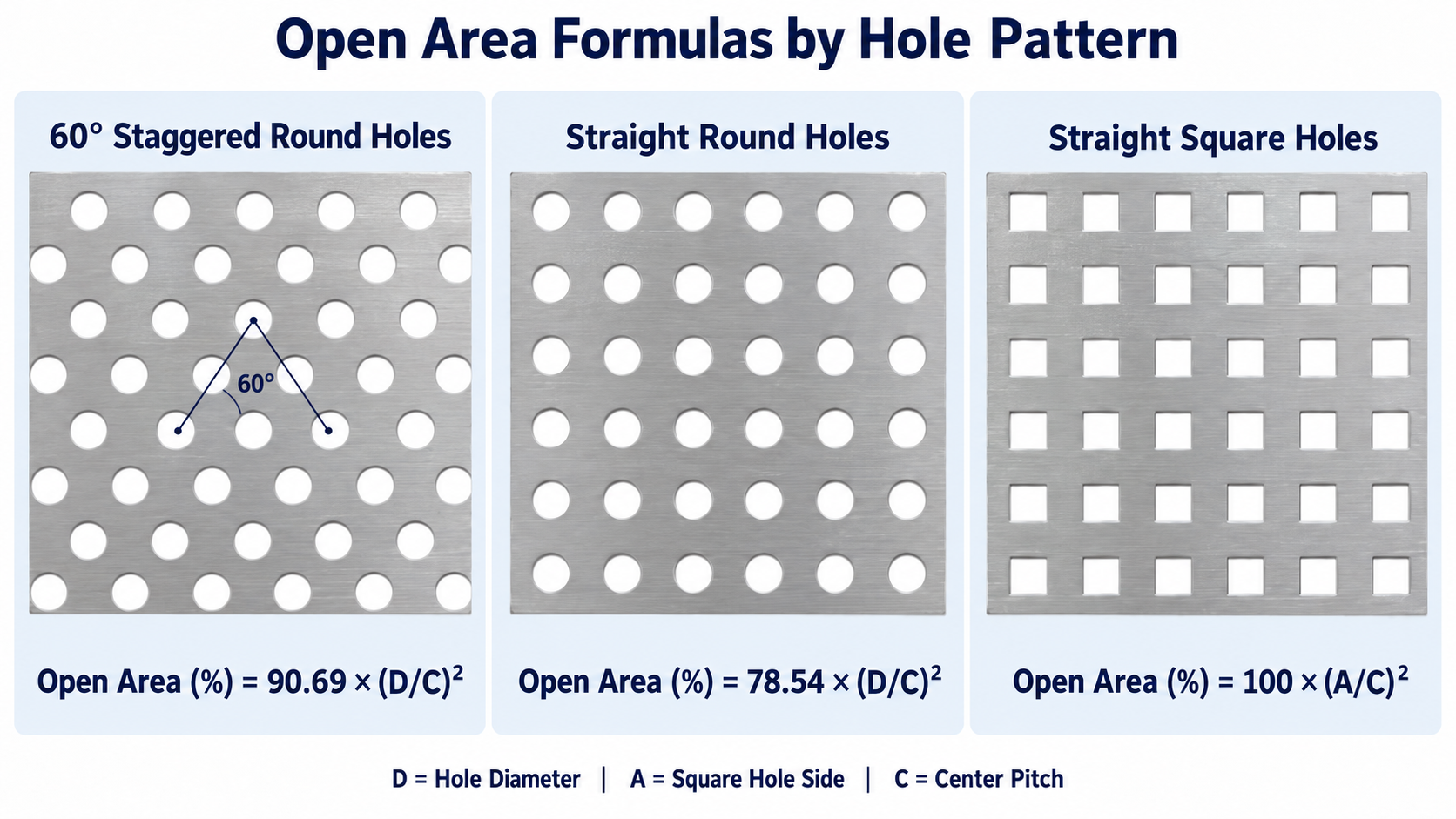
60° staggered round holes: Open Area (%) = 90.69 × (D / C)2
Straight-row round holes: Open Area (%) = 78.54 × (D / C)2
Here, D is the round-hole diameter and C is the center-to-center hole pitch. Both must use the same unit. These formulas describe an ideal, regularly perforated field; solid borders and custom cutouts need a separate check.
Before using a perforated metal open area calculator, make sure the dimensions on the drawing mean the same thing to you and the supplier.
Hole diameter (D): The diameter of a round opening, or the specified width and length for a non-round opening.
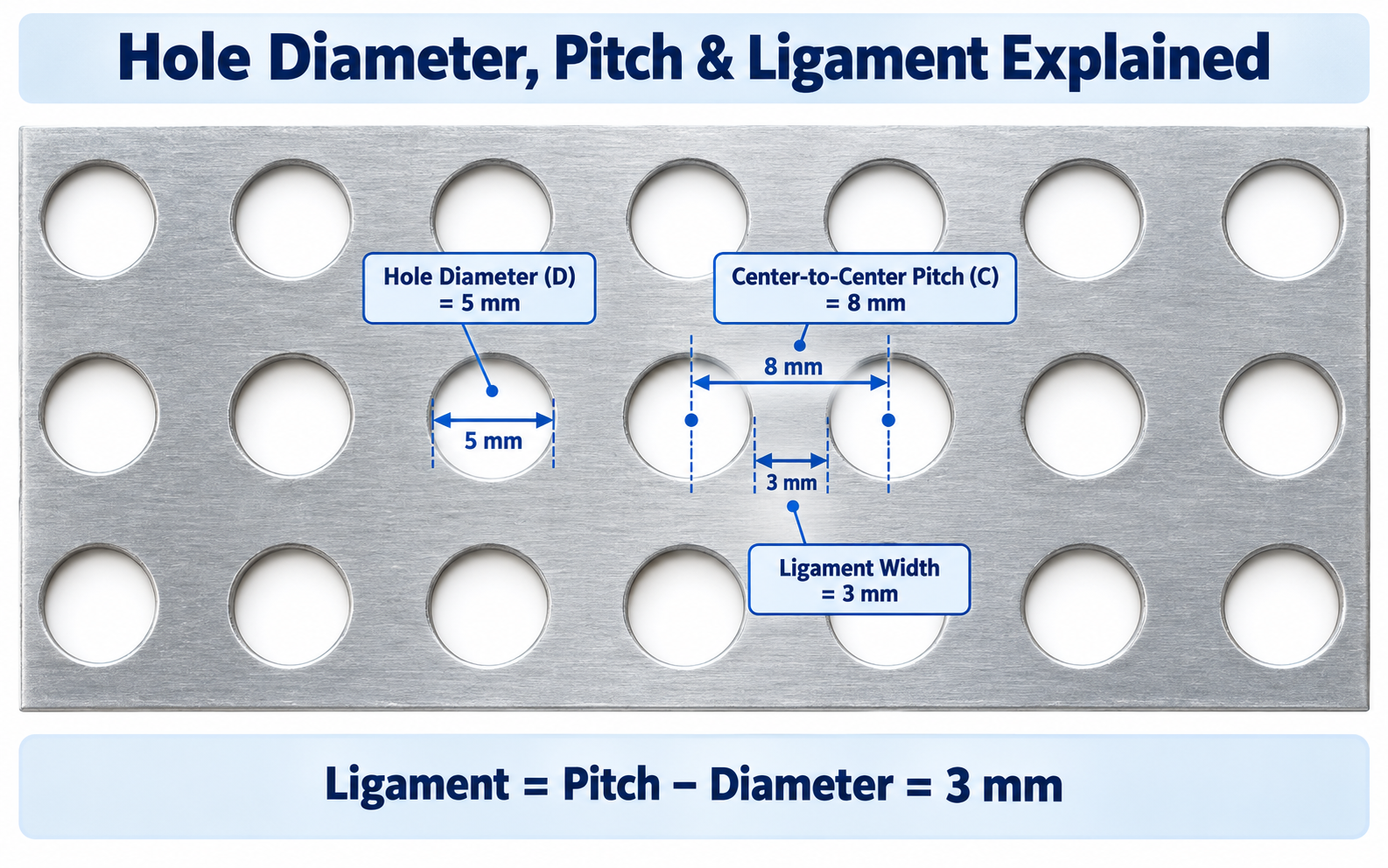
Pitch (C): The distance measured from the center of one hole to the center of the next. It is not the clear gap between holes.
Arrangement: The layout of the holes, such as 60° staggered centers or straight rows. Different arrangements can give different percentages even when D and C stay the same.
Ligament or bar width: The narrow strip of aluminum between adjacent hole edges. For neighboring round holes, the nominal ligament is C − D.
For example, 5 mm round holes on 8 mm centers leave a nominal 3 mm ligament between neighboring holes. That remaining metal, along with alloy, temper, thickness, panel dimensions and support, matters when reviewing the panel’s strength and fabrication suitability.
A 60° staggered pattern places round holes in offset rows. For an equal center-to-center pitch in the triangular arrangement, use:
Open Area (%) = 90.69 × (D / C)2
This arrangement packs round holes more closely than a straight square grid at the same diameter and nearest-neighbor pitch. It is widely used for perforated aluminum screens, ventilation panels and general industrial perforations.
In a straight pattern, holes line up in equally spaced rows and columns. If horizontal and vertical center spacing are both C, use:
Open Area (%) = 78.54 × (D / C)2
If the horizontal and vertical pitches differ, calculate the circular hole area divided by the rectangular pattern cell area instead: Open Area (%) = 78.54 × D2 / (C1 × C2).
For square holes of side length A laid out on a square grid with equal pitch C:
Open Area (%) = 100 × (A / C)2
For unequal horizontal and vertical pitches, use the actual opening area divided by the rectangular repeating cell area. Do not apply the round-hole coefficients to square holes.
For slotted or custom perforations, divide the area of one opening by the area of its repeating layout cell. A round-ended slot, a square-ended slot and an irregular decorative cutout do not all have the same opening area. Use the approved drawing or CAD layout rather than guessing from the overall hole length alone.
Suppose a buyer specifies 5 mm round holes with an 8 mm center-to-center pitch. For a 60° staggered arrangement:
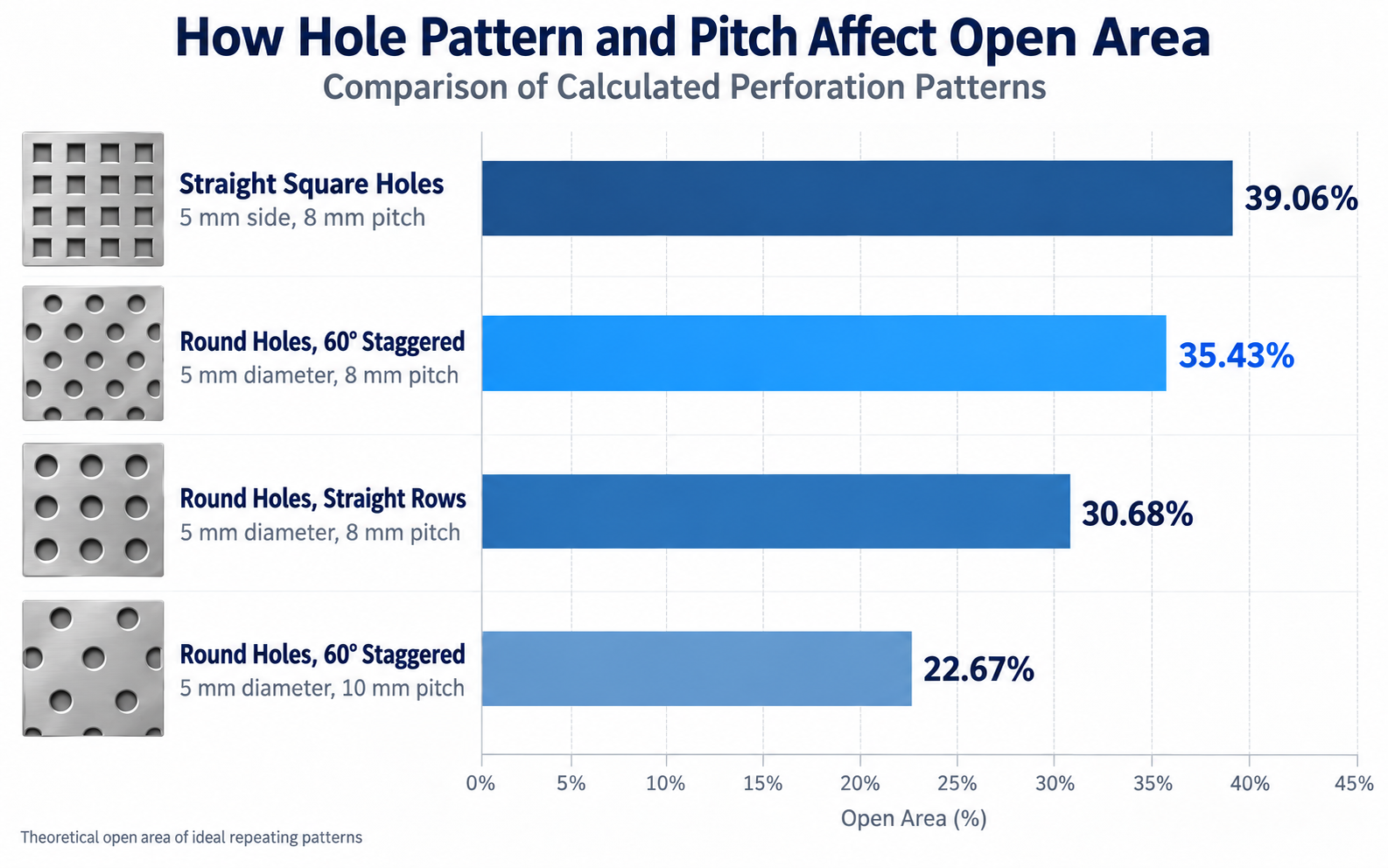
Open Area = 90.69 × (5 / 8)2 = approximately 35.43%
Change the arrangement to straight rows without changing the diameter or pitch:
Open Area = 78.54 × (5 / 8)2 = approximately 30.68%
The layout change alone changes the theoretical open area by about 4.75 percentage points. If you instead keep the staggered layout and increase the pitch from 8 mm to 10 mm, open area falls to approximately 22.67%.
| Hole Pattern | Hole Size | Pitch | Theoretical Open Area |
|---|---|---|---|
| Round, 60° staggered | 5 mm diameter | 8 mm | 35.43% |
| Round, straight rows | 5 mm diameter | 8 mm | 30.68% |
| Square, straight rows | 5 mm side | 8 mm | 39.06% |
| Round, 60° staggered | 5 mm diameter | 10 mm | 22.67% |
Note: These figures are calculated from ideal repeating patterns. They are not measurements of a finished sheet with solid edges, corner cutouts or mounting zones.
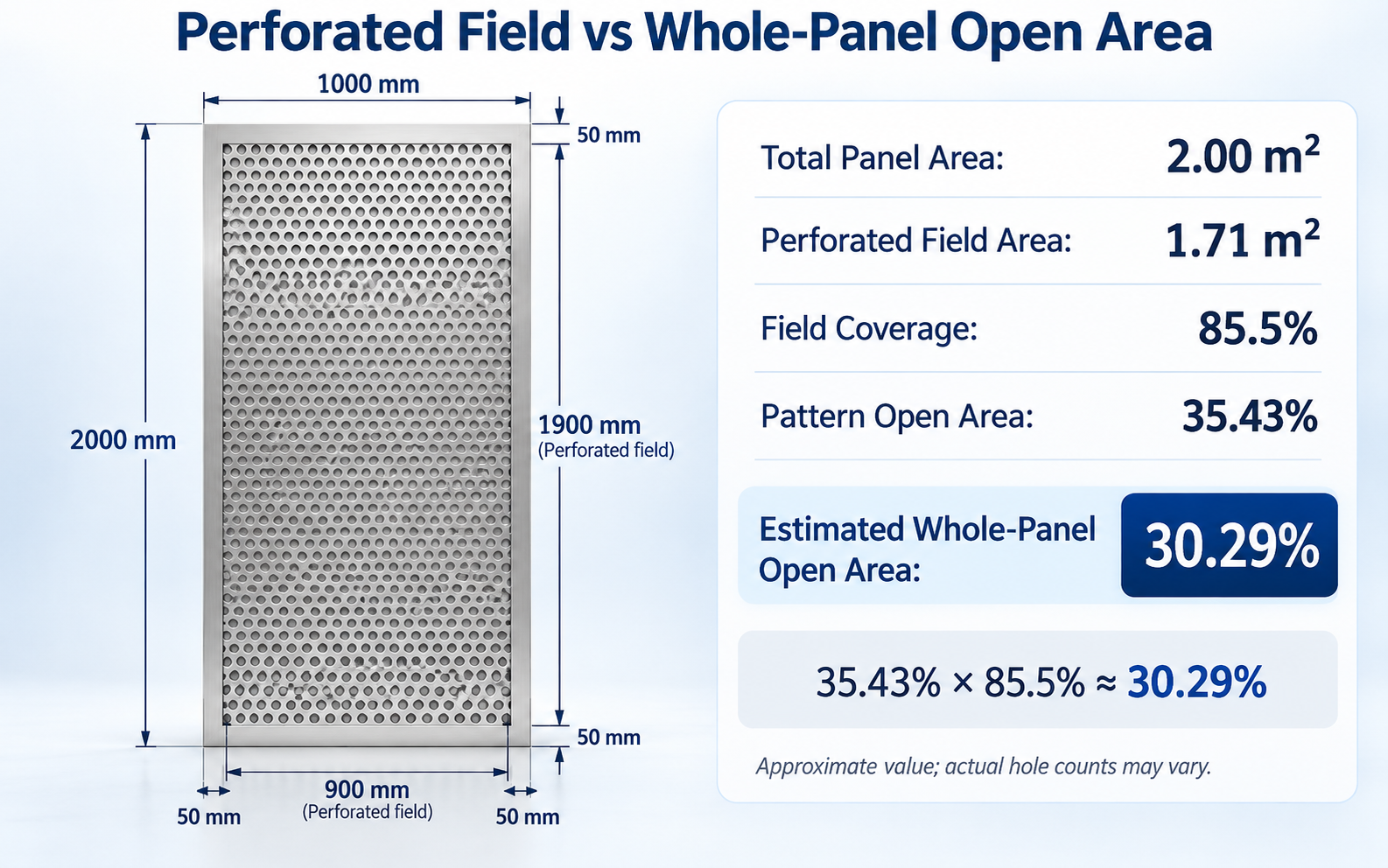
One common quotation mistake is to use the open area of the repeating hole pattern as though it described the entire finished panel. Many architectural perforated aluminum panels have solid edge margins for bending, fastening or framing.
Take a 1000 × 2000 mm panel with a nominal 50 mm solid border on all four sides. The central perforated field is 900 × 1900 mm, or 1.71 m2, while the whole panel is 2.00 m2. The field covers 85.5% of the total panel area.
If the hole pattern has 35.43% theoretical open area, an approximate whole-panel figure is:
Whole-panel open area ≈ 35.43% × 1.71 / 2.00 = 30.29%
This is an estimate because actual hole counts and partial holes near the border affect the finished result. For irregular perforations, folded panels and projects with specified free-area requirements, calculate from the approved panel drawing or actual opening count.
Not necessarily. Higher geometric open area generally provides more unobstructed opening area, but actual airflow also depends on hole shape, panel thickness, edge condition, the air-pressure difference, downstream obstructions and the complete ventilation system.
A 40% open-area screen should not be treated as delivering exactly 40% of the airflow through an unrestricted opening. Where an HVAC or equipment design specifies flow rate or pressure drop, the responsible engineer should check the actual operating conditions rather than rely on open area alone.
The same caution applies to acoustic panels. Perforation changes the facing’s open area, but the sound absorption of a ceiling or wall assembly also depends on its acoustic backing, cavity and installation.
Start with what the panel needs to do, then choose hole size, pitch and layout together. The following considerations are more useful than choosing one universal open-area percentage.
| Application | Main Priority | What to Check |
|---|---|---|
| Facade screens and sunshades | Visual openness, shading and appearance | Viewing distance, panel size, solid margins, fixings and structural design |
| Ventilation panels and grilles | Air passage with suitable protection | Free area, pressure drop, hole dimensions and system airflow |
| Acoustic ceilings and wall linings | Appearance and acoustic-system design | Perforation pattern, backing material, cavity and test data |
| Machine guards and enclosures | Physical protection and ventilation | Opening size, safety clearance, stiffness and required protection standards |
For architectural work, compare the perforation with the full facade assembly, not only the flat aluminum sheet. Worthwill also supplies Aluminum Facade Cladding Panel products for building-envelope fabrication.
Open area does not replace the base-material specification. Worthwill’s perforated aluminum sheet and panel range commonly includes 1060, 1100, 3003, 5005, 5052 and 6061 alloys, with a typical thickness range of 0.5–6.0 mm. Round holes of 2–10 mm are commonly requested, and approximately 10–60% open area is a project reference range rather than a guaranteed limit for every design.
The right combination depends on alloy, temper, thickness, hole-to-thickness relationship, panel size and production method. A hole pattern suitable for a thin flat sheet may not be appropriate for a thicker plate or a panel that needs tight bends.
For example, 3003 aluminum sheet is a practical substrate for many formed architectural and general-purpose components, while 5052 can be considered where higher strength and different corrosion-exposure requirements matter. Final selection should follow the project drawing and required mechanical properties.
Surface treatment also belongs in the same specification. Mill finish, anodizing, powder coating and PVDF coating may be considered according to the end use. For decorative screens and finished panels, see Powder Coated Aluminum Sheet & Coil. Perforation, bending and finishing should be planned in the correct sequence, including coverage at cut edges.
A clear RFQ makes it easier to compare two suppliers’ quotations for the same product. Include:
Aluminum alloy and temper, or the intended application if you need a recommendation.
Material thickness and sheet size, such as 1220 × 2440 mm (approximately 4 × 8 ft).
Hole shape, hole diameter or dimensions, and center-to-center pitch.
Hole arrangement: 60° staggered, straight or a drawing-specific pattern.
Required open area, stating whether it refers to the perforated field or the whole finished panel.
Solid edge margins, bend zones, fixing holes and other unperforated areas.
Surface finish, panel fabrication, quantity and service environment.
Drawings or CAD files for custom patterns or finished architectural panels.
If you only know the required appearance or operating function, share a reference drawing and explain the intended use. Worthwill can review a suitable perforation layout against the material and fabrication requirements before quotation.
No. Pitch is measured center to center. For two neighboring 5 mm round holes on 8 mm centers, the nominal metal ligament between their edges is 3 mm.
No. You also need the center spacing and hole arrangement. The same diameter can produce different open-area percentages in straight and staggered patterns.
No. It means that approximately 35% of the referenced flat surface is occupied by openings. Actual airflow depends on pressure difference, hole geometry, material thickness and the whole system.
For panels of the same alloy, thickness and outer dimensions, removing more material generally reduces the metal weight. Solid margins, formed edges, reinforcement, coatings and other fabrication details change the finished-panel weight.
1220 × 2440 mm is a commonly requested sheet format. Availability of a particular hole pattern, alloy, thickness and finish should be confirmed together.
For perforated aluminum sheet, specify the hole size, pitch and arrangement together. Use the formula to compare regular patterns, then check solid borders and the actual panel drawing before treating that percentage as the finished panel’s free area.
If you are specifying aluminum perforated sheets, plates or finished panels for a project, send Worthwill the drawing, dimensions, intended use and quantity. We can review the perforation and material specification and prepare a quotation based on the confirmed requirements.
