


Position: Home > Applications > Signage & Printing
License plate production starts with the aluminum substrate. Before a plate is embossed, printed or laminated with reflective sheeting, manufacturers need to select the right alloy, temper, thickness and surface condition. A material that works well for a flat printed plate may not be suitable for deeply embossed registration characters.
Aluminum license plate blanks are used to manufacture vehicle registration plates for cars, motorcycles, trucks and other vehicles. The material is lightweight, corrosion-resistant and suitable for high-volume cutting and forming when its mechanical properties match the production process.
Henan Worthwill Industry Co., Ltd. supplies aluminum sheet, coil and processed aluminum materials for industrial manufacturers. For license plate applications, we help buyers evaluate suitable aluminum substrates, particularly 3105 and other specified alloys, based on their embossing process, reflective film requirements and purchasing specifications. Our focus is the aluminum material used to manufacture license plates, rather than finished registered vehicle plates.
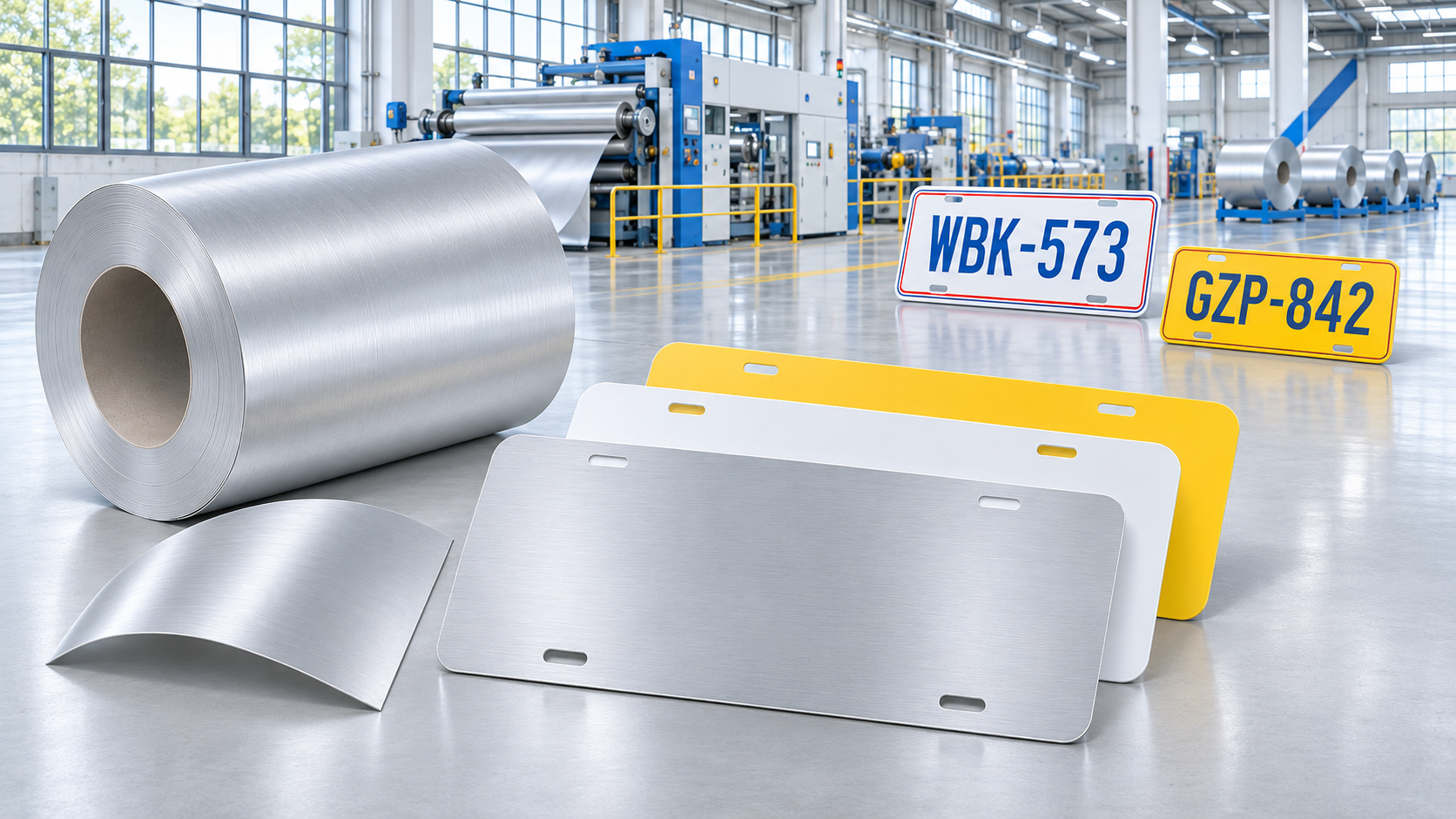
Aluminum license plate material is usually supplied as a rolled sheet, narrow coil or cut-to-length blank. Depending on the manufacturing process, the aluminum may be delivered with a natural mill finish, a specially prepared surface for reflective sheeting, or an approved coating for non-reflective plates.
For many embossed and reflective license plate systems, 3105 aluminum is an important reference alloy because it offers a useful balance of strength and formability. Other grades, including 1050, 1100, 1200 and 3003, may be considered where their properties meet the applicable manufacturing specification. These alloys are not automatically interchangeable.
The key point is that a license plate is a manufactured assembly. Its final performance depends on the aluminum substrate, any chemical pretreatment, the reflective or decorative surface system, the printing process and the forming method.
Different license plate production methods place different demands on aluminum. The following guide helps buyers identify the main factors before selecting an alloy or temper.
| License Plate Type | Aluminum Requirements | Surface Requirements | Key Selection Factor |
|---|---|---|---|
| Embossed reflective plates | Controlled strength and ductility for raised characters | Pretreatment compatible with reflective sheeting | Embossing performance and film adhesion |
| Flat digitally printed plates | Stable flatness and suitable stiffness | Surface compatible with the approved print and reflective system | Flatness, printing quality and adhesion |
| Non-reflective painted plates | Suitable formability and corrosion resistance | Approved prepainted or decorative coating system | Coating durability and forming compatibility |
| Government-specified registration plates | Specified alloy, temper, thickness and tolerances | Required pretreatment, coating or reflective system | Compliance with the issuing authority’s specification |
These are material-selection principles, not universal license plate specifications. The approved design, country-specific requirements and downstream production process determine the final material.
3105 aluminum sheet and coil are useful starting points for manufacturers producing stamped or embossed license plates.
3105 is a non-heat-treatable aluminum-manganese-magnesium alloy. Compared with commercially pure aluminum, it provides additional strength while retaining useful forming properties. Different H tempers allow the material to be matched to specific processing requirements.
For example, 3M’s published reflective license plate manufacturing guidance identifies 3105 aluminum in several conditions for non-embossed, embossed and combined production processes. The specified temper changes with the forming method rather than remaining the same for every plate.
For license plate manufacturers, the main considerations are whether the aluminum can form raised characters without tearing, whether the plate remains sufficiently flat and whether the surface can be prepared for the required reflective film.
1100 aluminum sheet and coil offer excellent formability and good corrosion resistance.
This grade may be considered for selected light-gauge blanks and formed aluminum components where the required strength and temper are compatible with the final application. However, 1100 should not be substituted for 3105 or another specified license plate alloy without verifying its mechanical performance and regulatory acceptance.
3003 aluminum sheet and coil combine good corrosion resistance with practical forming performance. They are commonly used in fabricated aluminum products and can be evaluated for non-regulated identification plates or related stamped components.
For official vehicle registration plates, acceptance depends on the exact alloy, temper and manufacturing requirements. General-purpose 3003 material should not be presented as a certified replacement for a specified registration plate substrate.
Some European and international license plate material specifications use commercially pure aluminum grades such as EN AW-1050 or EN AW-1200 in defined tempers.
These grades can be suitable when their forming behavior, thickness and surface treatment meet the required standard. Buyers should provide the exact alloy designation and temper stated in their technical documents instead of selecting material based only on aluminum purity.
Thickness and temper must be considered together. A thinner plate may require a harder condition to maintain sufficient stiffness, while deeper embossing generally requires enough ductility to form characters without cracking.
As a technical reference, 3M’s reflective license plate manufacturing procedures describe the following examples for 3105 aluminum:
• Non-embossed digital license plates: approximately 0.56 mm (0.022 inch), with H18 or H28 temper.
• Combined digital and embossed production: approximately 0.69 mm (0.027 inch), with H12 or H22 temper.
• Embossed license plates: approximately 0.81 mm (0.032 inch), with H12 or H22 temper.
These are examples from a particular reflective sheeting manufacturer’s process guidance. They are not universal industry limits or a standard Worthwill inventory list. Other programs may specify different thicknesses, alloys and mechanical properties.
For instance, some license plate material systems use aluminum around 0.98-1.00 mm thick. The correct specification must come from the issuing authority, the approved plate design or the validated production process.
When selecting aluminum for embossing, manufacturers should check:
• Elongation: Sufficient ductility to form raised letters and numbers without tearing.
• Yield strength: Suitable resistance to permanent deformation and unwanted plate distortion.
• Springback: Predictable character shape after the forming die is released.
• Thickness tolerance: Consistent material feeding and forming performance across production batches.
• Flatness: Controlled distortion before and after blanking and embossing.
A trial run using the actual embossing die is more useful than relying on alloy designation alone.
Reflective license plates require more than a clean-looking aluminum sheet. The surface must be compatible with the selected reflective sheeting and its adhesive system.
Mill finish aluminum has a natural rolled metal surface without a decorative coating. It can serve as a starting substrate for further cleaning and surface treatment.
However, untreated mill finish aluminum should not automatically be considered ready for reflective film lamination. Residual rolling oil, oxidation, dirt or unsuitable surface chemistry can interfere with adhesion.
For reflective plate production, the substrate may require an approved chemical pretreatment or conversion coating. The appropriate treatment depends on the reflective film manufacturer’s instructions and the relevant material specification.
Surface cleanliness, coating consistency and the absence of loose or powdery residue are important. Some plate systems also specify a protective lacquer or washcoat on the reverse side.
Buyers requiring pretreated aluminum should provide the required treatment type, coating weight or other acceptance criteria. Pretreated material availability must be confirmed for the specific order.
Some license plate systems use painted or decorative aluminum rather than a retroreflective background. In these applications, the coating must be approved for the required appearance, weather resistance and any subsequent embossing or printing.
Worthwill also supplies color coated aluminum sheet and coil for industrial applications. However, a standard PE or PVDF architectural coating is not automatically suitable for reflective license plate manufacture. Coating compatibility and regulatory requirements must be checked separately.
The reflective effect of a conventional retroreflective vehicle plate normally comes from its applied reflective sheeting, not from the bare aluminum metal.
The aluminum provides the formed substrate. The reflective sheeting, printed graphics, coatings and security features perform their own functions within the finished plate assembly. Reflective film performance must therefore be evaluated separately from aluminum material properties.
The most economical supply format often depends on the manufacturer’s production line, tooling and order volume.
Aluminum coil is suitable for manufacturers using continuous leveling, lamination, slitting or automated blanking equipment.
Coil buyers should confirm thickness and width tolerances, flatness, winding quality, inner diameter, coil weight and edge condition. Coil geometry must match the equipment used on the production line.
Narrow slit coil can reduce downstream width preparation when the required plate format and equipment are already defined. Slitting width, burr control and edge protection should be agreed before production.
Cut-to-length aluminum is practical for manufacturers operating sheet-fed presses or smaller production lines.
Customers should specify the required length and width, flatness tolerance, edge quality and whether the material will undergo additional blanking, corner rounding or hole punching.
Worthwill can review coil, slit coil and cut-to-length sheet requirements according to the selected alloy, temper and processing route. Finished plate-shaped blanks and any special surface treatment require separate manufacturing confirmation.
Many license plate production defects can be traced to an unsuitable substrate specification or inconsistent material handling.
1. Cracked embossed characters: The material may be too hard, insufficiently ductile or incompatible with the embossing depth and die design.
2. Warped plates: Poor flatness, excessive forming deformation or unsuitable temper can leave a plate distorted after pressing.
3. Reflective film peeling: Surface contamination, incorrect pretreatment or incompatible adhesive systems can weaken bonding.
4. Burrs and damaged edges: Poor cutting or slitting quality can scratch reflective film, affect tooling or create handling problems.
5. Inconsistent printing: Variations in the coating, surface condition or substrate flatness can affect graphics and finishing quality.
Before ordering large quantities, manufacturers should test representative samples through the actual cleaning, lamination, blanking, embossing and printing process. The acceptance criteria should be documented before full production.
There is no single global specification for aluminum license plate blanks. The following table shows the information that should be confirmed when preparing a purchase request.
| Specification Item | What to Confirm |
|---|---|
| Material | Aluminum coil, slit coil, sheet or cut-to-length blanks |
| Alloy | 3105, 1100, 3003 or the exact project-specified grade |
| Temper | H12, H14, H18, H22, H24, H28 or another approved condition, depending on alloy and process |
| Thickness | Nominal thickness and permitted tolerance according to the project |
| Dimensions | Coil width, slit width or sheet length and width |
| Surface condition | Mill finish, specified pretreatment or approved coating |
| Backside finish | Uncoated or specified protective lacquer / washcoat |
| Processing | Slitting, leveling, cut-to-length, edge trimming or confirmed blank processing |
| Inspection | Thickness, flatness, surface quality, edge condition and required mechanical properties |
| Order details | Quantity, packing, destination and applicable technical standard |
Common vehicle plate dimensions vary by market. North American and European registration plate formats, for example, are not identical. Motorcycle and commercial vehicle plates may also have different dimensions.
For regulated vehicle plates, always supply the authority’s approved drawing or purchasing specification. Do not assume that a standard commercial aluminum sheet automatically meets license plate certification requirements.
Henan Worthwill Industry Co., Ltd. supports industrial buyers looking for aluminum materials suitable for forming, stamping and surface finishing.
Relevant product categories include:
For related advertising panels, safety boards and general signage materials, see our Aluminum Sign Board Materials for Sign Manufacturing application guide.
Our standard MOQ for most aluminum sheet and coil products is typically 3 metric tons. Standard orders are normally dispatched within 30 days after receipt of the balance payment. Final specifications, processing availability and commercial terms are confirmed with each order.
Reflective sheeting, government registration numbers, finished vehicle plates and official plate certification are not included in the standard aluminum material supply described here.
3105 is an important alloy used in several reflective and embossed license plate manufacturing systems. Other alloys may be specified by local authorities or manufacturers. The final selection depends on the required temper, mechanical properties, thickness and approved production process.
There is no universal thickness. Published manufacturing references include approximately 0.56 mm, 0.69 mm, 0.81 mm and 0.98 mm for different plate systems. The correct thickness depends on the plate design, alloy, temper, embossing requirements and applicable standard.
Yes, provided the aluminum alloy, temper and thickness are suitable for the required embossing depth. The material should form raised characters without cracking, tearing or unacceptable plate distortion. Production trials are recommended before bulk orders.
Not exactly. For conventional reflective license plates, the aluminum is the base substrate and a separate retroreflective film provides the reflective function. Surface preparation must be compatible with the selected film and manufacturing system.
Not automatically. Standard prepainted aluminum may be suitable for some non-reflective applications, but reflective license plate production normally requires an approved surface preparation and film system. Compatibility and regulatory requirements must be verified.
Worthwill primarily supplies aluminum sheet, coil and selected processed aluminum materials. License plate manufacturers complete the approved reflective lamination, printing, embossing, security features and final plate production. Specially prepared substrates or blanks can be discussed according to project requirements.
The right aluminum substrate helps license plate manufacturers achieve repeatable embossing, consistent processing and reliable surface preparation. Choosing material by price or alloy name alone can create avoidable problems during production.
Whether you need 3105 aluminum coil, slit aluminum material or cut-to-length sheet for further processing, Worthwill can review your application and material requirements before quotation.
Send us your required alloy, temper, thickness, dimensions, surface treatment, production process, quantity and destination. If your project involves official registration plates, please include the relevant technical specification or approved drawing.
Contact Worthwill Aluminum to Discuss Your License Plate Material Requirements
The following publications provide additional context on license plate substrates, reflective sheeting and manufacturing requirements. Their specifications are application-dependent and should not be treated as universal material requirements.